Drowning in plastic

Today is Global Recycling Day. So does recycling actually work?

Recycling is THE single best known ‘green’ concept, I reckon. Say ‘environment’ and the answer is ‘recycling’. It’s what kids are taught to do at school, it’s what labels on plastic products claim they (can) do, it’s what any environmentally-minded and nature-loving person is honour-bound to do.

But does it work??? No.

In South Africa, at least 90% of our 54 million plus tons of annual waste lands up in landfill sites, or is just dumped anyhow and anywhere, spoiling nature, and often ending up in the sea.
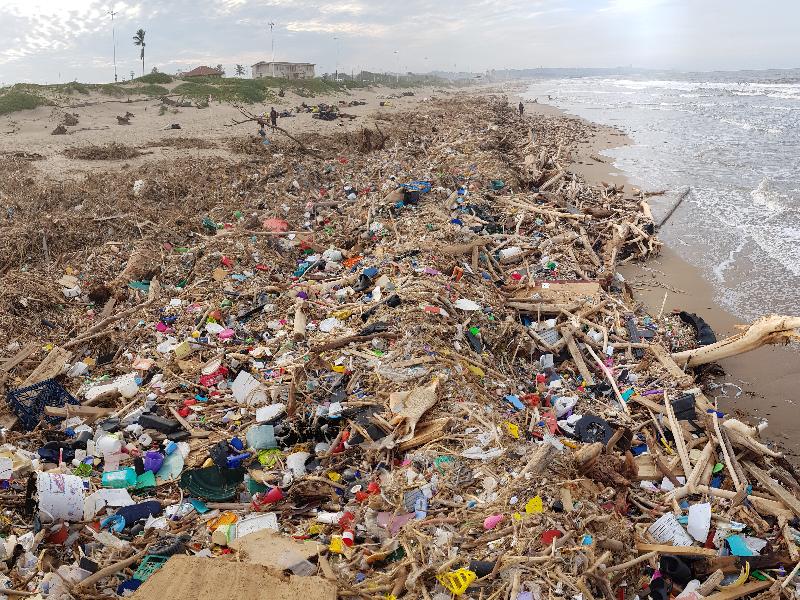
Sure, recycling generates income for nearly a quarter of a million waste-pickers and powers South Africa’s recycling economy, but… should it have to? Banning so-called problem plastics (including polystyrene containers, plastic cutlery, food sachets and snack packaging) would actually boost the economy.

According to Greenpeace, four years ago 34 out of 54 African countries had passed laws banning single-use plastics, or were planning to, but real-life results are far from encouraging. Even though South Africa made it onto that list, it is apparently the world’s 11th-biggest litterbug.

Recycling is NOT the solution to the problem of plastic. The Fraud of Plastic Recycling describes “how Big Oil and the plastics industry deceived the public for decades and caused the plastic waste crisis.” Separating fact from convenient fiction and plenty other online articles debunk myths around recycling. Even the word ‘litterbug’ was invented in “sophisticated marketing campaigns to shift blame from producers to consumers”, while plastics companies fought tooth and nail against anti-plastic laws and bans.

As a consumer I really struggle to avoid buying unwanted plastic with my groceries. Every time I challenge a shop manager on their excessive use of plastic, their excuse is ‘consumer pressure’ FOR small and tidy portions wrapped in duplicate or triplicate. I’m not sure if this is just an excuse, or if they really do get customer complaints like “I demand my food is wrapped in more plastic”. When will we as consumers put our foot down on this issue?

In the meantime, and even though I know it mostly doesn’t work, I recycle faithfully. What else can one do? For three years I collected all the empty milk bottles our family was using, planning to organize a ‘bottle garden workshop’ some day. But I never got around to it, and the bottles piled up. And up.

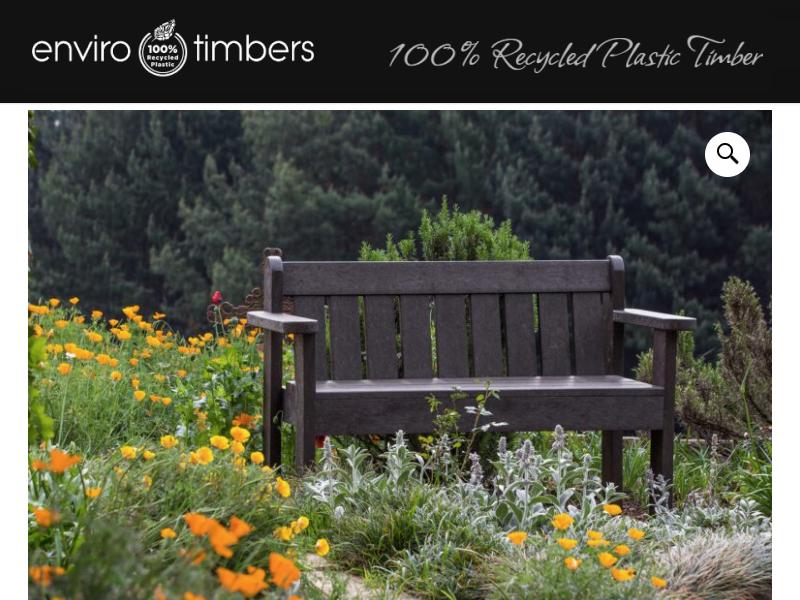
Luckily a friend told me that the local SPCA is collecting milk bottles and passing them on to a local family run business that turns plastic into furniture! So my bottle-mountain found a new home.
Brown gold

Today, on World Soil Day, we celebrate the fact that healthy, living soil in nature is full of dead things, dung, fungi, gazillions of tiny creatures, bacteria and nutrients – just what plants need to grow, in their great variety, producing biomass, and generating food for everyone. Let us remember that in nature we all eat, poop and die.

This World Soil Day I want to share my experience with recycling human waste. Discarding our precious waste is such a waste! And flush toilets waste precious water. A human composting toilet saves both water and nutrients to fertilize the garden.

I’m not crazy, and I’m not the only one doing this! One can even buy human composting toilets online. But I didn’t want to spend loads of money on fancy equipment or install something I might regret. Instead, I attached an old broken toilet seat to an old plywood plank, and laid it across the bathtub which we never use anymore (because we take short showers to save water), with a bucket underneath, and another bucket with compost.

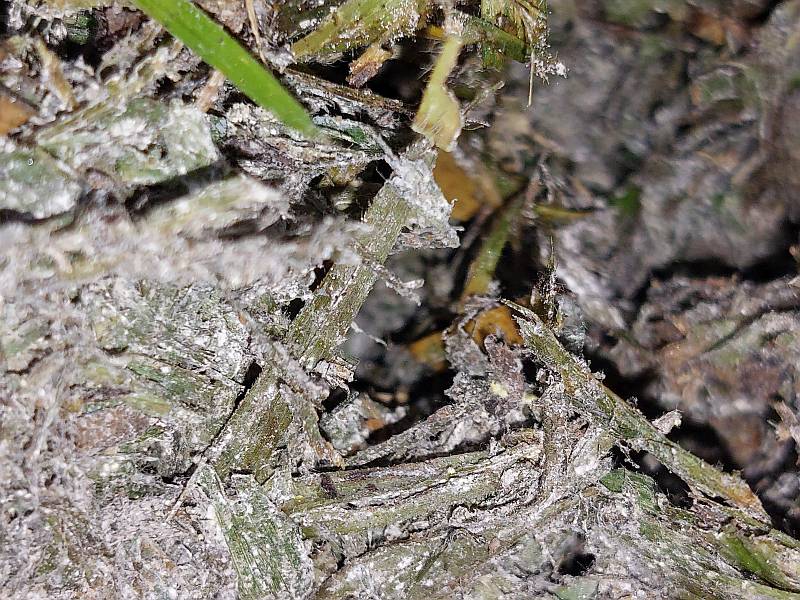
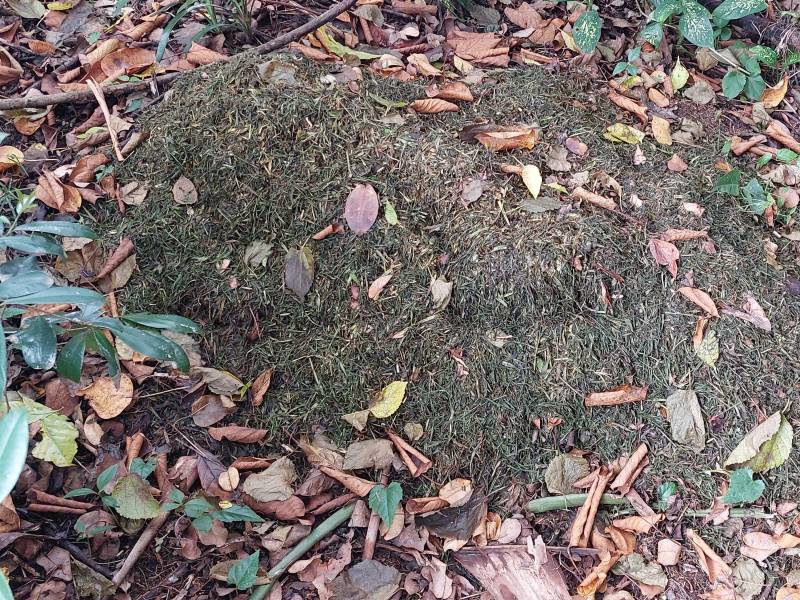
I tried both well-decomposed leaf litter from a compost heap in the garden, and fairly recently cut lawn clippings. (We dump cut grass in a pile under a tree. After 2-3 weeks it turns white, covered in mold.) Both kinds of compost worked fine.

My very own human composting toilet system (not copy-righted).

It’s very simple: 1) scatter some compost in the bottom of the toilet bucket, 2) do your business, 3) cover the business with another two handfuls of compost. Ok, and then put a lid on.

Surprisingly, it does not stink. The compost seems to absorb the bad odors. All you smell is the pleasant forest fragrance of the compost itself. It’s best to keep the solids and liquids separate, so don’t pee in the bucket with the solid waste. (Diluted urine can be used separately as fertilizer.)

Anyway, every week or two I emptied the bucket it into a compost box. This didn’t stink either. After several months I kind of lost interest in the experiment, but the pile of sh*t continued to do its job, and a year later I found a load of beautiful ‘brown gold’: high quality fertilizer for my garden.

Brown gold: rich natural fertilizer

To do this permanently, one would have to rotate through two or more separate compost boxes, to give each batch a chance to decompose fully.

What about contamination and disease? Helminth eggs and protozoa cysts die off at a certain rate, depending on various factors such as aeration, temperature, moisture and sun exposure, so the compost becomes safe after a certain time – anything from 6 months to 2 years. The climate, the setting, the material mixed with the waste, all play a role. Digging the compost under the soil instead of sprinkling it on top increases safety. I can’t help thinking my approach of adding ‘living’ compost from the garden would have sped up the natural composting process. For further information, this detailed report is a useful source.

My biggest problem was convincing my family to help collect this ‘brown gold’. They understand in principle why it is a good thing, but I suppose we have all been conditioned to consider our waste disgusting, rather than natural and useful. “Expand your mind, allow yourselves to think new thoughts, try work with me, this is just one more way to live sustainably,” I tried to motivate them. No success (yet). Maybe some day we won’t have a choice.

Seeing how that flooding event here in Durban damaged so much infrastructure, including sewers and water purification plants, and seeing how a year later raw sewage was still flowing in our streams and onto our beaches, made me think how with climate change we can’t take things for granted anymore. Perhaps I’m being over-dramatic, but there may come a time when we will have to manage our own waste, who knows. Best to be prepared. It’s called disaster readiness.

Hot box cooking

Cooking in a hot box / hot bag saves electricity while reducing our carbon footprint. Food takes only slightly longer to cook than on the stove, and can be left unattended (it doesn’t burn or boil over, and doesn’t need to be stirred).

I even find that stews and soups cooked like this tastes better and more fragrant. Rice is more fluffy and evenly cooked.

A hot bag can also be used to keep things cool – more efficiently than a cooler box.

This is the kind of hot box / wonderbag / hay box that one can buy, promoted here by the Department of Economic Development, Tourism and Environmental Affairs.

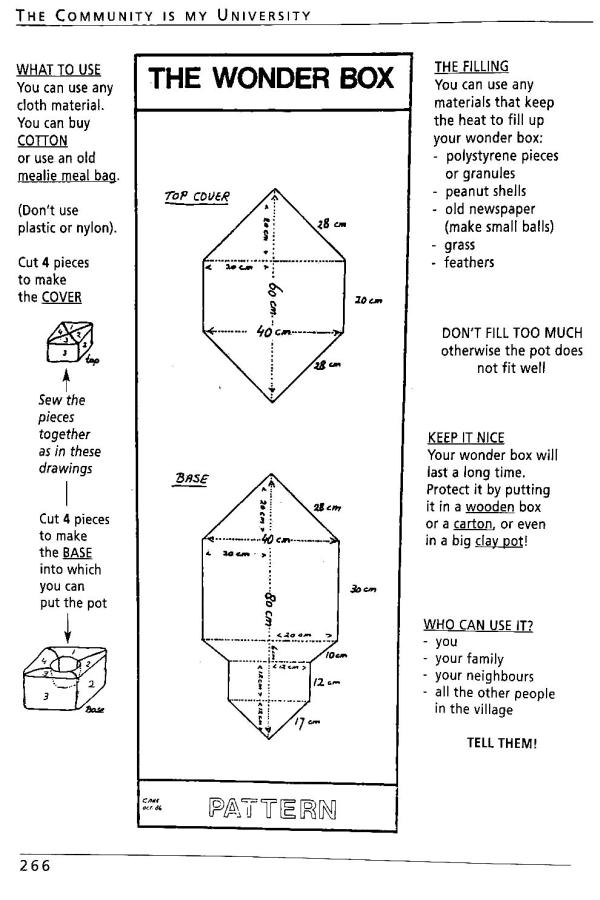
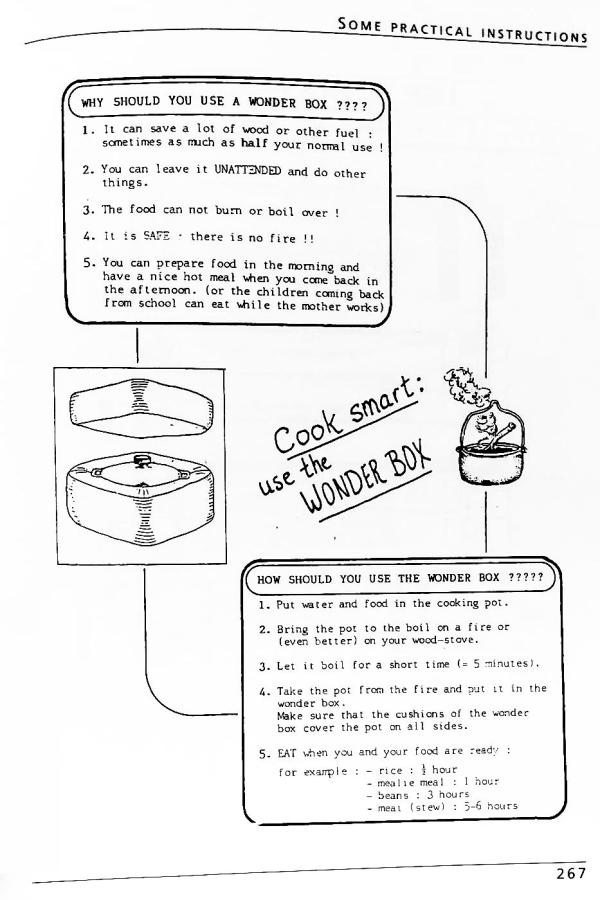
This beautiful book on community development and rural health, has instructions for rural women on how to make a ‘wonder box’ out of old cloth such as old linen mealie meal bags and stuffed with insulating peanut shells, grass, feathers or old newspaper.

You don’t need a box at all though. Some warm blankets work just as well. Hikers know this trick: you only need one little gas cooker for a 3-course meal. Boil a pot of rice, wrap it in your sleeping bag, then prepare your soya mince sauce (which cooks much better, without burning, in another sleeping bag), while you cook the dried vegetables (or make a nice cup of Milo).

Hiking and camping at Mont-Aux-Sources in the Drakensberg.

At sea level, water boils at 100°C. For every 300m rise in altitude, the boiling point of water is about 1°C lower. So at the top of Amphitheatre, at 3200m, water boils at 89°C. At high altitude food simply takes longer to cook – just something to keep in mind.

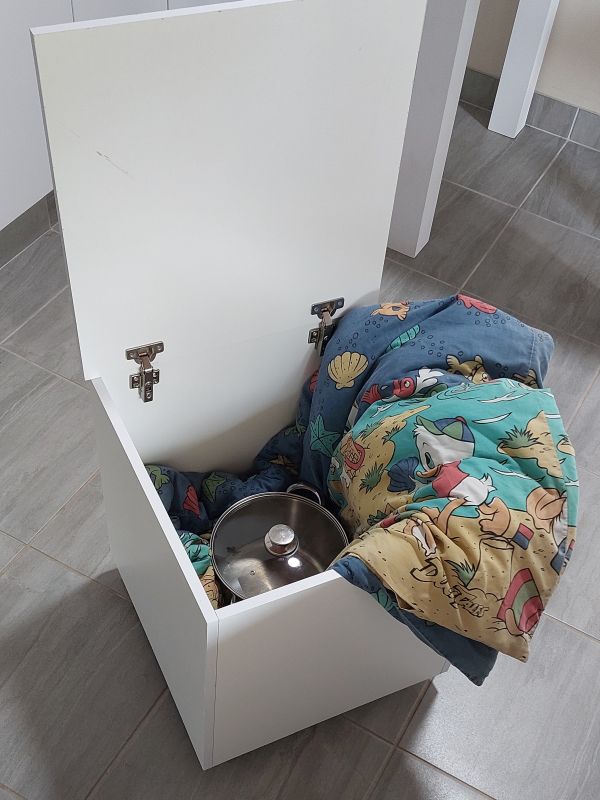
For my kitchen I recycled an old kiddies’ duvet that had gotten lumpy. I use this regularly to cook rice, stews, soups – anything that otherwise needs prolonged simmering on the stove. It really helps during loadshedding: as long as I get the pot boiled before the power goes off, no problem.

I got this fancy solid box made, on wheels, with a lid. It goes under the table, serves as a seat, and when needed, it comes out and becomes an oven.
How much electricity (and carbon dioxide emissions) does a hotbox avoid?

That depends on the kind of stove we are comparing it against, and the kind of food we are cooking. Since one needs to bring the food to the boil either way, the hotbox only saves on the simmering time. Food that only takes 15 min to cook on a stove would save only a little electricity; food that has to cook for hours, saves a lot. So the cooking box is particularly useful for meals that require longer cooking times.

1kWh electricity produces approximately 1kg of carbon dioxide emissions.

For those who like actual numbers, Eskom reports that it produced 198 281GWh of electricity in 2022, with 207.2Mt carbon dioxide emissions (plus 32.90Mt ash and 66.65kt particulate matter). Converted that is 198,281 million kWh and 207,200 million kg. Divide kg by kWh to get emissions per energy used.

A typical 1000W stove plate, if set to maximum heat, would use 1kWh per hour, and produce 1kg of carbon dioxide in emissions. So let’s say you simmer food (on level 3 out of 6) then you can assume a typical 1000W plate will consume approximately 0.5kWh per hour on half heat, which equates to about 0.5kg carbon dioxide. Now do that every day. Perhaps you use more than one stove plate at a time. All that adds up very quickly.

Please have a look at the total kWh on your last monthly electricity bill, and multiply that number by 12 to get the number of kg of carbon dioxide your household adds to the atmosphere every year. Now think: you can do something about that. Just dig out an old blanket and start today!

Previous posts:

Rag rugs

The Internet is full of fantastic ideas for upcycling generally (turning waste into something useful), and rag-rugs specifically. Old T-shirts too stained to pass on as second-hand clothing, still find a use. Stretchy fabric works best. Ideally the fabric should not fray.

Rags to strips

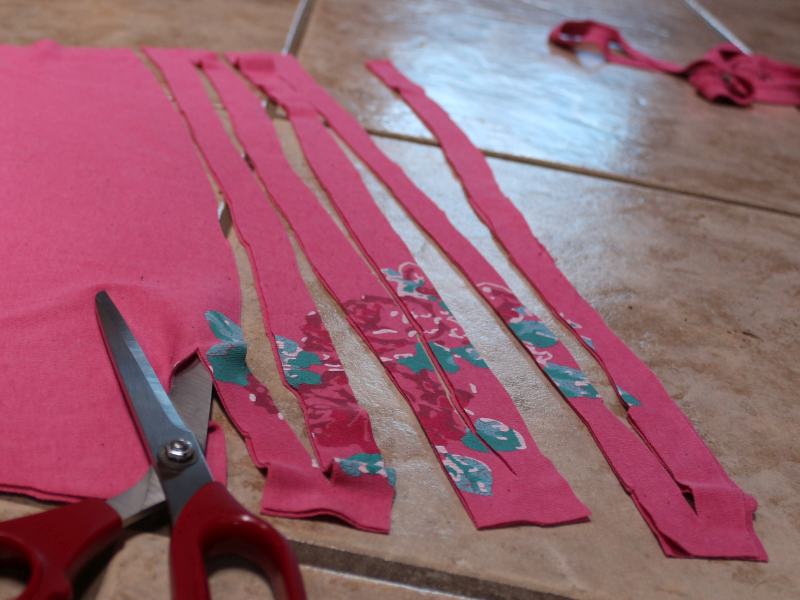
Start by cutting off any seams. Then cut the fabric into strips, in a zig-zag pattern to make one long continuous ribbon. You don’t need to cut straight either, curves is fine.

On fabrics that stretch in one direction only, it is better cutting in the direction of the stretch rather than across it.

The strips can be from 1 to 3cm wide. The thinner the fabric, the wider the strips.

The thicker the yarn, the thicker the final carpet will turn out.

Find a route that has the smallest off-cuts, for instance:

top
sleeve
pants

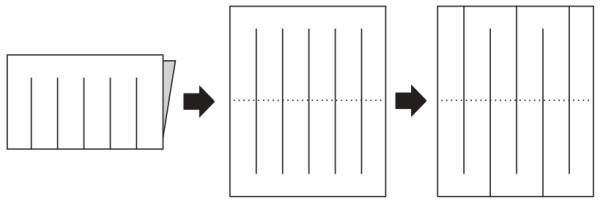
To save time, fold the fabric in half. Cut from the fold to within 1cm of the edge. Open up the fabric, and snip through to the edge, on alternating rows, to create a continuous strip, like this:

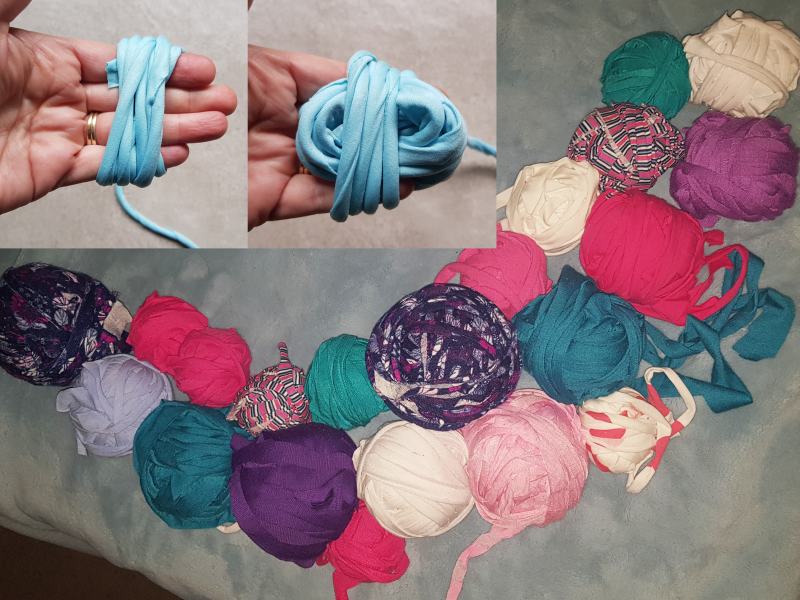
A lovely selection of matching colours.

Strips to yarn

To connect individual strips quickly and easily, loop them through each other. Cut slots into the ends; first push the end of strip A through the slot in B, then pull strip B through the slot in A:

Once I got a huge bag of off-cuts from a T-shirt factory. It took ages to untangle all that cotton Lycra – much longer than it took to crochet the rugs afterwards.

Yarn to rug

If you don’t know how to crochet, check out Sarah‘s blog for example. The simplest crochet pattern starts with a chain, and then works back and forth until the rug is long enough.

The last time I crocheted anything was at age 5.

Here is an alternative pattern for a rectangular rug. Hopefully the instructions make sense. (I am a complete novice and cannot read or write a proper crochet recipe.)

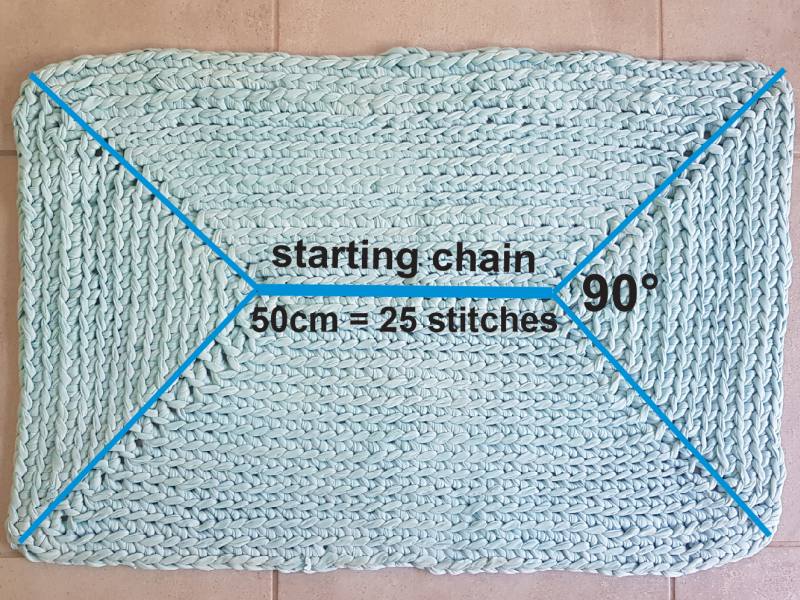
First, mark out on the floor how big you want the rug to be. Mark out two right-angled triangles on each end. Measure how long the starting chain needs to be. Calculate 2cm per stitch.

On this rug the starting chain was 50cm long, about 25 stitches.

Use a 10mm thick crocheting hook.

  • Create a chain (Step 4 on Sarah’s blog)
  • ‘Work into the chain’ (Step 5)
  • As you get back to the beginning, put three stitches in the end loop of the chain (figure A below).
  • Crochet along the chain and do the same on the other end (A).
  • On the next round, add an extra stitch on each of the four corners (B).
  • On the following round, and each round thereafter, add two stitches in each corner (C).
  • With each round, there are two extra stitches on each side of the rectangle (D).
  • When the rug is big enough, or you run out of yarn, fasten off (Step 9).

I love my colourful rug!

Bottle garden

In a city, one doesn’t always have access to a vegetable patch. But vertical gardens are a great way to grow food on hot, sunny walls.

Here is a 4min video of how to make this fully functional drip-irrigated vertical vegetable garden using recycled 2L plastic milk bottles.

On the Internet there are many different ideas and designs for vertical bottle gardens. Some of them are quite complicated, and need lots of hardware. My aim is always to spend as little time, money and energy as possible, and to recycle junk that is lying around anyway. Plus it must actually work. Tried and tested.

I started experimenting back in 2019. The first design was a flop. Ok I managed to grow a crop of veggies, but (a) each bottle had to be watered individually (groan!), (b) the water simply dripped out the bottom (leeching the soil), (c) the soil shrank in the bottle as it dried leaving a gap, so the water would just run around the soil without getting absorbed, (d) … anyway, there were other drawbacks that are not worth listing.

This arrangement was ultimately not successful.

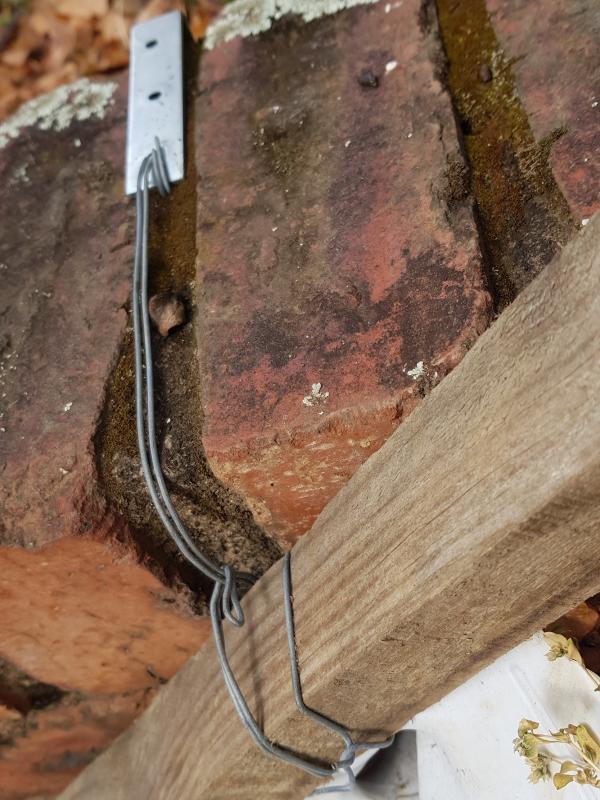
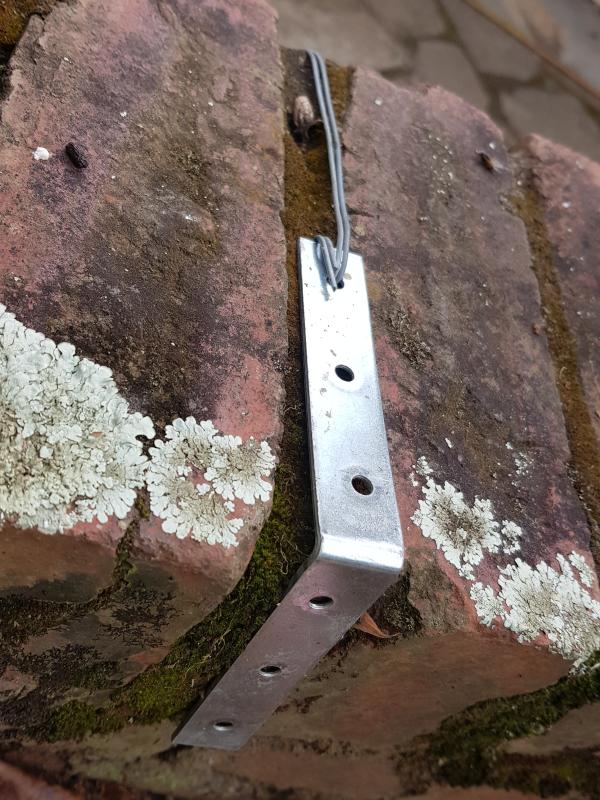
The only part that really worked was the idea to use wire and square metal brackets hung loosely over the top of the wall, to hold up the bottle racks, instead of drilling and screwing anything permanently into the bricks. This system was quick and easy to put up, move and importantly – remove. On house walls one could hold up the rack by wires attached to roof rafters or window sills.

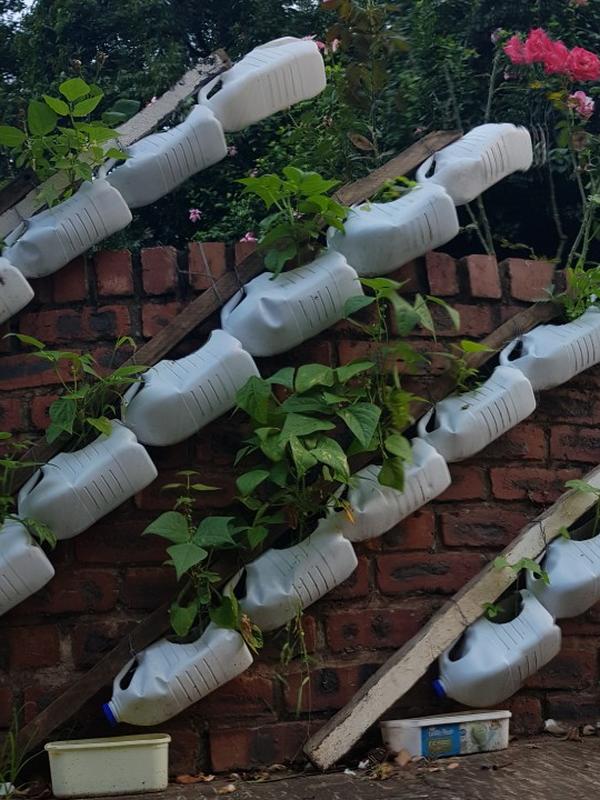
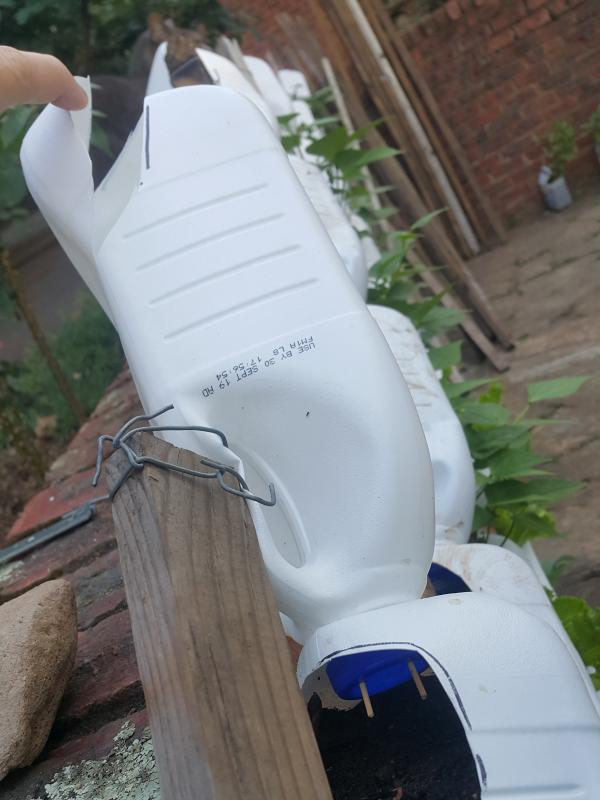
As for the bottles – after much head-scratching and fiddling, I came up with a much better system: a row of bottles, connected to each other and set up at an angle, like so:

The end bottle is the reservoir. Simply fill up this tank with water. The lid has holes punched in it. The water gently irrigates the first bottle, then dribbles slowly from one bottle to the next. Reduce the flow from the tank by blocking some of the holes with toothpicks.

A container at the bottom collects the overflow – a nutrient-rich tea, which can be poured back in the top, to recycle nutrients.

Watering is quick and easy, but the actual irrigation is slow, and the soil gets a thorough soaking. As a result it stays wet longer. You can even control the moisture level: the steeper the angle of the rack, the better it drains. If you lower the rack, more water pools in each bottle. This helps fully grown plants to cope in the heat of summer. (But avoid water logging.)

I have successfully grown several crops of vegetables: lettuce, spinach, various herbs (parsley, dill, chives, leeks, basil), celery, also green beans, radish. Even cauliflower – though the monkeys got to them first.

Cucumbers also grow very well in bottles: set up two racks about 2m apart, and zig-zag a string between them. This works for runner beans too. Just help each plant to find the right path.

Soil quality is something I am still learning about. Diluted urine, bone meal, wood ash and Epsom salt are organic alternatives to artificial fertilizer. But I have found it is easy to overfertilize, because nutrients cycle around this self-contained unit. It is probably best to replace the soil once a year, mixing in fresh compost, and rotating crops. The plastic bottles also become brittle from the sun and don’t last longer than two seasons.

On 1 November is World Vegan Day. We are not vegans, but I respect the choice. This blog is my salute to you, Douglas, Glenda, Shannon, Chloe and others. I share your love for veggies.

by Marlies Craig