Solar savings

It’s been two years since we installed solar power. How has it worked for us?

The details may be complicated, but the conclusion is not: PV works.

The biggest hurdle for many remains the cost – despite tax breaks and the lowest-ever prices. Before ‘splashing out’, they want to know: Does solar power really work? Money-wise and otherwise?

In this blog I answer these questions and others that came up in a recent climate change event, where the audience showed surprising interest in some of the finer details. I cover various decision about the design, wiring, settings on the inverter and geyser, and behaviour. Then I discuss our results in terms of power generation and use, money matters, and feeding back to the grid.

To me the biggest tragedy is that solar power dates back to the 1880s and has been mass-produced since the 1960s! What happened? Skullduggery? Knowing today about some of the dirty tactics fossil fuel companies have used to protected their interests, probably yes. Let’s end this injustice.

Next month is World Energy Day (22 October). I hope this blog will help some who are still unsure about PV, make a positive decision.

Design

Various suppliers and websites can help you design a system that matches your lifestyle, your needs and your budget.

We were lucky to have an expert friend, an electrical engineer who was involved in the design and construction of the de Aar solar farm. He gave us an initial design, along with all the numbers. His calculations included many engineering details, such as hourly data on solar irradiance (how much energy shines from the sky), based on the local latitude and altitude, and how much is collected by the panels, based on temperature, windspeed, albedo, and the angle and orientation of our own roof. After accounting for various losses, you get an estimate of the actual DC voltage generated by the panels, and the final AC power you can expect to get out of the system.

We had saved up for solar power, and were willing to spend a bit extra to get the most out of it.

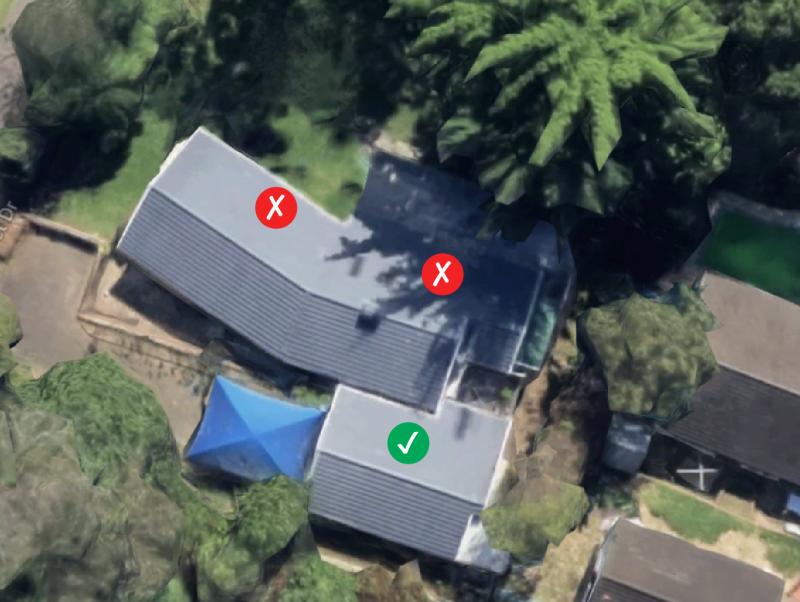
Panels: We installed our panels on the garage roof, as it was most north-facing, with the least shade. The panels are the cheapest part of the system, so we decided to install as many as would fit on the roof (17 panels).

Batteries: We did not consider a solar system without batteries. Apart from reducing our carbon footprint, power storage was the main attraction. Despite the price tag, we decided to get two 5kW batteries. We felt that the extra investment would pay itself off in avoided grid usage, and would help during loadshedding and longer outages.

This has definitely worked in our favour. Two batteries, once fully charged, supply our needs through supper time until well past midnight, often until dawn – depending on how much power we use in the evening. During the day the batteries help supply the geyser and other power-intensive activities, especially on cloudy days.

Inverter: we decided to spend a few thousand Rands extra on a large 8kW inverter, instead of the standard 5kW inverter recommended for households of our size. We reasoned that with 17 panels, peak power generation would be well above 5kW on a sunny day, and we wanted to harvest this power.

Was the 8kW inverter worth it? In retrospect, no. On a sunny summer day, power production reaches 8kW for many hours. This is far more than we can utilize, and most of it gets exported to the grid (i.e. ‘wasted’ from our perspective, as we don’t get paid for this). The 5kW inverter would simply have capped generation at 5kW.

Power production in mid-winter anyway peaks at just above 5kW, and on a sunny winter day we still have too much, exporting around 30% of the power generated. On overcast days the system never reaches the 5kW limit. So… a 5kW inverter would have sufficed. If the municipality paid us for the electricity we export, it would be a different story. Lesson learned.

This blog by the editor of TechCentral, has other useful details on the design side. A ‘solar for dummies‘ article by one of the solar company is also helpful. (We went with another company and were very happy with their service.)

The system flow chart as displayed on the inverter screen.

Wiring

If you install PV power, while remaining connected to the grid, the distribution board has to be split into ‘essentials’ (powered by PV during grid outages) and ‘non-essentials’ (not powered by PV during grid outages). The main decision is what is ‘essential’ and not.

We were advised to wire the geyser, stove/oven and pool pump to the ‘non-essential’ section. That is because together they can draw more than 8kW – the limit of what our PV system can supply. Over-loading the inverter would cause the system to trip.

We also decided to put the granny flat on the ‘non-essential’ circuit, because we cannot control what tenants do during loadshedding, and this might cause unnecessary conflict.

What does this mean in practice?

When the grid is available, everything is connected and can be powered by the PV system, even the ‘non-essential’ circuits. If ever the total load exceeds the 8kW limit of our PV system, the grid supplies the excess.

However during grid outages, the ‘non-essentials’ are not powered: the pool pump doesn’t run, the geyser doesn’t heat and the stove doesn’t work (even when there is plenty solar power).

Ok, so the geyser simply catches up when the grid comes back online, drawing on the PV system as before, and we don’t notice loadshedding in that regard. However I found it annoying to have no stove during loadshedding, when I could be running it on solar power.

So we got an electrician to install a special switch, allowing us to connect the stove/oven to the ‘essential’ part of the DB temporarily. We just have to be aware, and not use too many appliances at the same time, and then switch the stove back to the ‘non-essentials’ afterwards. This was a brilliant idea.

Settings on inverter

Another decision point is how to program the inverter. Like, whether to export or not, whether to charge the batteries from the grid, and especially, how and when to use the batteries.

You don’t want to run the batteries flat, as this reduces their lifespan. In fact, it is advised not to run batteries much below 20% charge. So one should program the inverter to switch off the batteries when they reach 20%.

We also made the decision never to charge our batteries from the grid, only from solar power. Converting grid power to battery and back just wastes energy. We can always get by until sunrise.
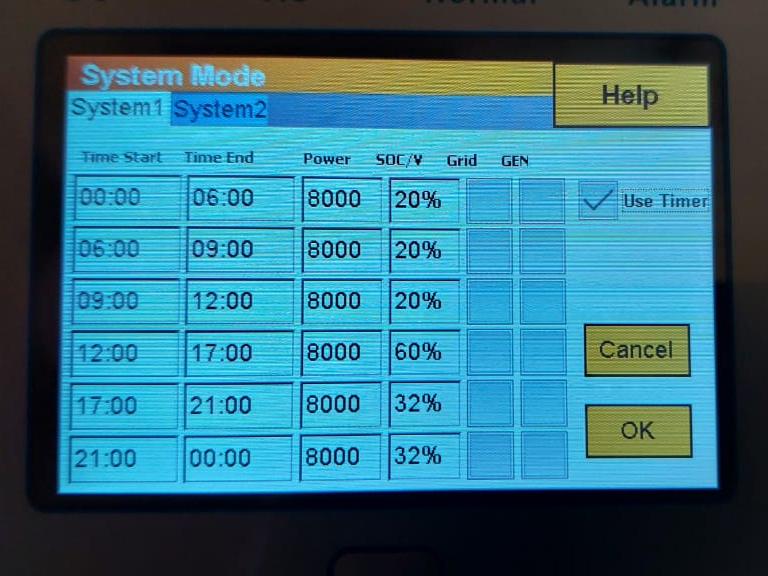
During periods of loadshedding, our inverter is set to run batteries down to 20% after midnight and during the morning. But between 12h00 and 17h00 the system will not let the charge drop below 60%, to ensure there is enough charge left for the evening. If by 12h00 the batteries have not to 60%, it’s a bad solar day. On such overcast days we would rather use the grid in the afternoon, and keep the batteries for later, in the case of loadshedding. After 17h00 the batteries may drain to 32% until midnight, and to 20% after that.

Geyser controller

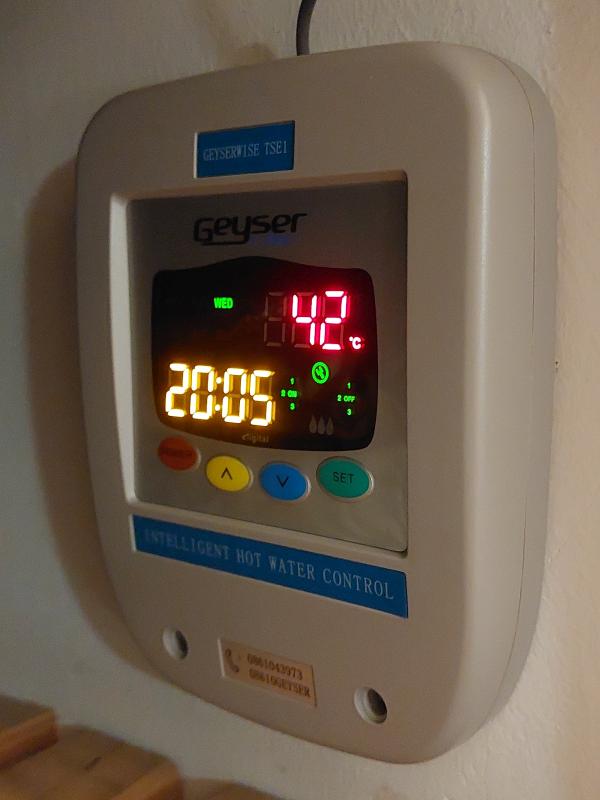
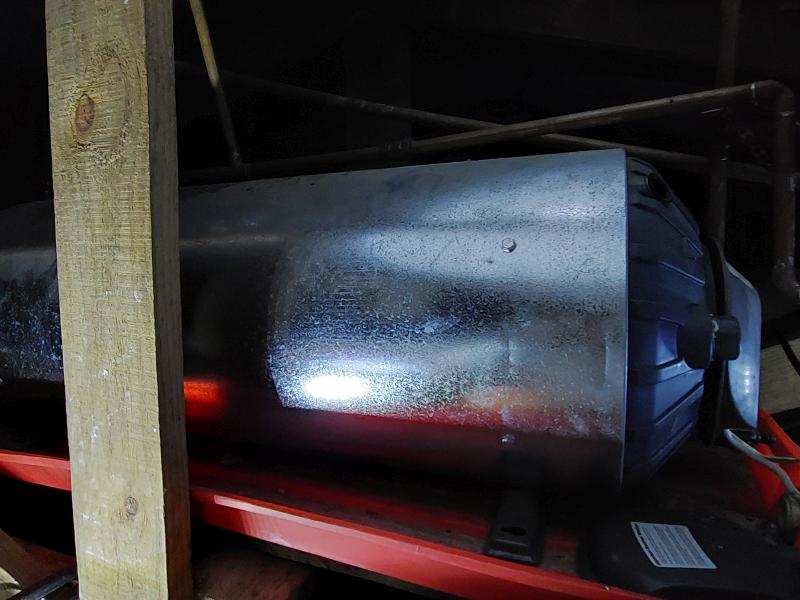
The geyser draws a huge amount of power, and we avoid using the grid for this, if possible. A digital geyser controller turns on the geyser during peak daylight hours. Keeping it heated all the time would be a complete waste.

Our geyser is set to come on at 10h30 heating to 55°C; and again at 12h00 heating to 65°C. This is enough for up to four hot showers in the evening. Spreading the heating over two periods gives the batteries a chance to charge as well, especially on partly cloudy days.

In the early morning hours the geyser comes on briefly to top up the temperature to 45°C, for one hot morning shower. Usually the water is still warm from the previous day and it heat for 10 minutes or less.

On weekends the settings are slightly different. We keep tweaking the timings to minimize our grid usage.

We also finally installed a geyser blanket, which cost all of R300, to reduce heat loss in winter.
Behaviour

Installing solar power was only the first step. Then we had to learn how to use it.

In the beginning we got on average 60% of our electricity from the solar system. Now we are getting over 80%, from the same system.

We have learned a LOT. From the graphs generated by the PV app we have become very aware how much electricity different activities and appliances require, how much power is generated in different seasons and weather conditions, and we have learned how best to utilize it.

We have shifted energy-intensive activities to daylight hours: washing machine, dishwasher, or when necessary, the tumble drier. We also use many of the electricity saving methods described on the climate change booklet checklist. It just becomes a way of life.

The pool pump draws a lot of electricity (yes we have a pool, eish!) We use a simple manual timer, set to the brightest times of the day: in summer it runs from 8am to 4pm, in winter from 10am to 2pm, which is enough to keep the pool clean. On overcast, bad solar days we turn the pool pump off.

Power generation and use

Through the seasons, days get shorter or longer, more sunny or more cloudy. Our best solar month so far was January 2023 (1124kWh generated), the worst was May 2023 (480kWh) – which had lots of cloudy weather and short days.

August-December 2022
January-June 2024

Comparing monthly graphs from 2022 with 2024, the amount of solar power generated (‘PV’ – green bars) remained around 800kWh per month, regardless of time of year. Our home electricity usage (‘Load’ – pink bars) was also fairly constant, between 600 and 700kWh per month.

However the amount of electricity exported to the grid (light orange bars), was a lot more in the beginning (400kWh), down to 240kWh per month now (meaning we now throw away less of the power that we generate).

The amount imported from the grid every month (dark orange bars), which we had to pay for at the usual rate, decreased from 280kWh to 120kWh per month, more than halving our remaining electricity bill.

In other words, in 2022 our solar system supplied 58% of our electricity usage, in 2024 it supplies over 80% on average.

How? Partly by making the various adjustments described above. But mainly by using our batteries throughout the day. In the beginning we only drew on the batteries at night (or during loadshedding), not otherwise. Now we use them whenever demand (load) exceeds PV generation.
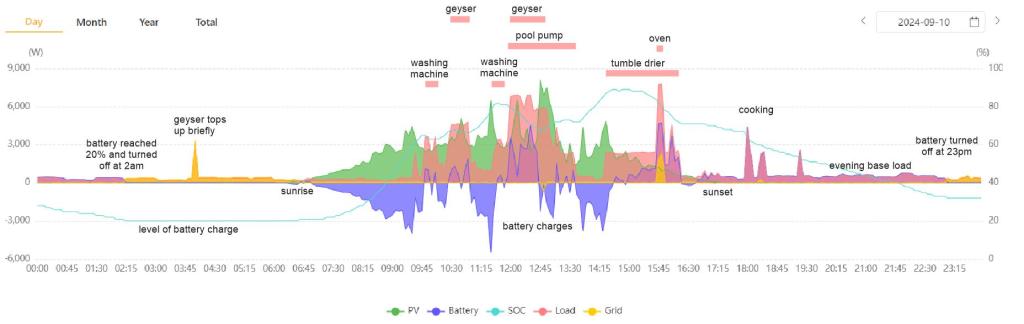
On this partly cloudy, busy day, the solar system nevertheless supplied most of our needs, which included two loads of washing, geyser, tumble drier, dishwasher, a few hours of pool pump, baking and cooking. The battery is alternatively charging and discharging throughout the day, never reaching 100%. It ran out before midnight. No power was exported to the grid on this day.
Despite the partly cloudy weather, 90% of our electricity usage on this day was supplied by PV (Import/Load), only 10% was imported from the grid.

Economics

Does solar power make financial sense? Yes.

In 2022, our electricity bill would have been on average R1600 per month, based on our usage. That first year we paid only R670 (imported from grid), thus saving R930 a month (58% savings).

In 2024 electricity would have cost us R1880, but we paid R350, saving R1530 a month (81% savings).

In total so far we have saved about R30 000. We could have saved more based on what we know now.

Our system cost around R210 000 to install in 2022. If we assume inflation remains at 6.4% (the average over the past 2 years), and that electricity prices increase at the same rate, the savings would pay off that amount in 10 years. However for the past 8 years electricity prices have increased by 12% every year, double the inflation rate! If this trend continues, total savings would reach R210 000 in just over 5 years (not considering the interest earned).

As mentioned, we had saved up for it, and paid in cash. Had we put the expense on our bond, the savings would pay off the expense plus interest, after about 12 years, without putting in a cent extra.

Embedded rooftop solar PV

When you install rooftop solar, you have to register – here are the guidelines.

In our experience, until our system was registered, the municipality continued to bill us at our pre-PV consumption levels, despite repeated confirmed meter readings.

Once our registration went through, the municipality came and installed a bi-directional meter. Our excess payments were then credited back to us (not paid out in cash), against our monthly bills.

Do you get paid for power you export to the grid?

Yes and no. eThekwini municipality allows embedded power, at least in principle. But in our case it makes no financial sense. Here’s why:

Currently, we pay R 2.97 per kWh, with service charges built in, same as everyone else. If we wanted to earn money on our exports, we would have to sign up for the Feed-in Energy scheme. However, the price structure is not in our favour.

According to the 2023/24 tariff booklet, we would earn R1.44 per kWh (similar to what the city pays Eskom), but we would have to pay an ‘Ancilliary Network Charge’ of R126.86 per kVA (based on the inverter size). On our 8kW inverter that would amount to R1015 a month. 1015/1.44=705.

In other words, we would only start earning on exports above 705 kWh, which is more than we export currently. So for us the feed-in system makes no sense financially – we would spend more than we would earn.

So we simply donate surplus electricity to the city (rather than dumping it) – say ‘thanks’, eThekwini! Subsidizing the city is ok for now, but if too many people pour their excess power into the grid, eventually it runs in reverse, and you get negative electricity prices, which is becoming a conundrum in other parts of the world. (I’m sure there is a solution for having ‘too much’ free energy! The market will respond, don’t worry.)

Back to our local situation: with a 5kW inverter, one would start earning on exports above 440kWh, but then we would probably export less, as the smaller inverter would simply cap production at 5kW.

Variable daily rates – with highest prices during peak demand, and lowest prices during low-demand and high-supply periods, can be a powerful incentive for users to shift their consumption. A system like this is in place already (‘Time of use’ fee structure), but the minimum charge of R234.24 again means this only makes sense for high end users and businesses. A variable fee structure would not be fair for low-end users who tend to have less freedom of choice and less flexibility.

Let me end there. I hope someone finds it useful.

Biodiversity Day 2024

Today (22 May) is International Day for Biological Diversity. This year’s theme invites us to “Be part of the Plan”. The Biodiversity Plan was an agreement reached by the United Nations Convention on Biological Diversity in 2022, signed by 196 countries, with a vision of a world of living in harmony with nature. It has 4 long-term goals, and 23 action-oriented targets, “to halt and reverse biodiversity loss to put nature on a path to recovery“.

We happen to live in the middle of the Maputaland-Pondoland-Albany biodiveristy hotspot. eThekwini municipality is a patchwork of amazing nature, interspersed with urban built-up and industrial and densely populated and even semi-rural areas – the annual municipal state of biodiversity reports, especially the full report from 2007, give a good overview. Our neighbourhood is exceptionally green and lush, located in the scarp forest on the boundary between the coastal belt and the endangered Sandstone Sourveld.

So what can I do to protect and restore the bit of nature that is my responsibility? In other words, my own back yard?

Here is a short to-do list:

  • Get to know the species that live in your back yard
  • Appreciate biodiversity instead of landscaping, garden for nature
  • Find out what doesn’t belong (aka invasive aliens), and get rid of them
  • Invite nature back, by planting more diverse, locally indigenous plants
  • Protect and restore the soil (make and use compost, cover bare soil with mulch and leaf litter)
  • Share indigenous seeds and cuttings, knowledge and passion with your neighbours
Our patch of swamp forest.

Our garden contains an extra-special little patch of swamp forest. Frankly, it’s why we bought this property rather than another. Of course I wanted to protect this lovely piece of nature, but at first I had no idea which trees belong here, and which don’t. So I signed up for a tree identification course with Geoff Nichols, a local tree guru, and took along branches from every tree in the garden. Geoff and other tree-lovers had great fun identifying them for me.

It turns out we have 15 different indigenous tree species growing here, and since then I have planted a few more. We removed a fan palm (its seeds are still coming up), an some inkberry trees. The indigenous trees and plants attract a beautiful variety of insects, which in turn attract a riot of different birds.

A large proportion of the photos in my insect book were taken right here in my own garden.
Our bird list must be nearing 100 – without really trying very hard.

Keeping on top of the invasive aliens however is a constant war. Why are these alien plants such a problem? I have presented many times on this topic, and my blog to celebrate World Environment Day 2020 during COVID lock-down has a video on this topic. Below are some of the invasive aliens that we constantly have to fight back:

This week, to commemorate Biodiversity Day, I will once again do battle in my own garden, removing invasive aliens that have come up since my last attack. Wish me luck! I also plan to reach out to my neighbours, and start a conversation about controlling invasive plants.

And then I plan to go around the neighbourhood, targeting the horrible catclaw creeper (see gallery below). Macfadyena unguis-cati is a particularly pernicious category 1b invasive species, very difficult to eradicate. Catclaw seeds blow in on the wind. Young seedlings immediately grow this fat little root, deep in the soil, which easily breaks off when you try to pull the plant out. Ignore them, and they grow melon-sized tubers. Thick rope-like vines snake up trees, along branches, and if you don’t cut and poison them, they soon cover and smother the tree crown. They were imported for their beautiful yellow flowers. Now we sit with the mess.

Drowning in plastic

Today is Global Recycling Day. So does recycling actually work?

Recycling is THE single best known ‘green’ concept, I reckon. Say ‘environment’ and the answer is ‘recycling’. It’s what kids are taught to do at school, it’s what labels on plastic products claim they (can) do, it’s what any environmentally-minded and nature-loving person is honour-bound to do.

But does it work??? No.

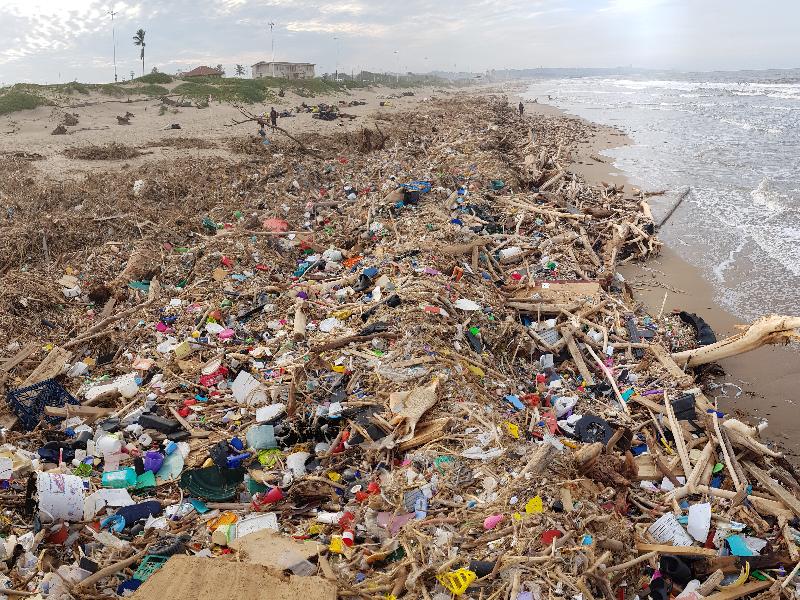
In South Africa, at least 90% of our 54 million plus tons of annual waste lands up in landfill sites, or is just dumped anyhow and anywhere, spoiling nature, and often ending up in the sea.

Sure, recycling generates income for nearly a quarter of a million waste-pickers and powers South Africa’s recycling economy, but… should it have to? Banning so-called problem plastics (including polystyrene containers, plastic cutlery, food sachets and snack packaging) would actually boost the economy.

According to Greenpeace, four years ago 34 out of 54 African countries had passed laws banning single-use plastics, or were planning to, but real-life results are far from encouraging. Even though South Africa made it onto that list, it is apparently the world’s 11th-biggest litterbug.

Recycling is NOT the solution to the problem of plastic. The Fraud of Plastic Recycling describes “how Big Oil and the plastics industry deceived the public for decades and caused the plastic waste crisis.” Separating fact from convenient fiction and plenty other online articles debunk myths around recycling. Even the word ‘litterbug’ was invented in “sophisticated marketing campaigns to shift blame from producers to consumers”, while plastics companies fought tooth and nail against anti-plastic laws and bans.

As a consumer I really struggle to avoid buying unwanted plastic with my groceries. Every time I challenge a shop manager on their excessive use of plastic, their excuse is ‘consumer pressure’ FOR small and tidy portions wrapped in duplicate or triplicate. I’m not sure if this is just an excuse, or if they really do get customer complaints like “I demand my food is wrapped in more plastic”. When will we as consumers put our foot down on this issue?

In the meantime, and even though I know it mostly doesn’t work, I recycle faithfully. What else can one do? For three years I collected all the empty milk bottles our family was using, planning to organize a ‘bottle garden workshop’ some day. But I never got around to it, and the bottles piled up. And up.

Luckily a friend told me that the local SPCA is collecting milk bottles and passing them on to a local family run business that turns plastic into furniture! So my bottle-mountain found a new home.

On the eve of EVs

Today, on World Consumer Rights Day, I make a wish to be able to afford an electric car. I would like manufacturers to stop reserving this innovation for the luxury niche, and produce models for the mass market. It looks like my wish may start coming true soon.

Last week I met a person who was adamant that electric vehicles (EV) are no better than ordinary cars (with combustion engines). I felt so helpless against their firm belief in this misinformation, and decided a quick blog on this was in order.

There is plenty of evidence that EVs are a huge improvement, from the the US EPA debunking ‘EV myths‘, to the detailed scientific account of the IPCC Working Group III chapter on Transportation. EVs win hands down – especially when charged using renewable energy (such as solar power or wind).

An ICCT report shows life-cycle emissions from different kinds of mid-sized cars registered in Europe. The graphs for other countries look very much the same.

Full life-cycle analysis takes account of greenhouse gas emissions of a product, during all stages of its existence: manufacture, storage, transport, retail, operation while in use, and finally scrapping or recycling – including powering and supplying all the raw materials and processes along the way.

Battery technology is also progressing rapidly – watch this space. The perceived issues with Lithium-Ion batteries will soon be moot. The more we invest in EVs, the more research and development will happen, and the sooner we’ll see even better solutions.

Having said all that, I must now confess that owning and driving a car is an environmentally unfriendly privilege for those who can afford it, that should eventually be phased out. Manufacture-related emissions are still considerable, and electric private cars are not the solution for a climate-resilient future. To achieve net-zero-emissions, electrified public transport is the way to go – of course fueled by renewable energy.

However, EVs have another potential use: vehicle-to-grid technology is an emerging solution to help solve the problem of variable power supply from solar and wind, providing power stability to the owner or even to the wider grid. EVs are plugged into the grid whenever they are not in use, adding to the total power storage capacity. They store excess power when available, and help supply the grid during high demand periods.

UPDATE (22 April 2022): in a recent article “The search for South Africa’s lost electric car“, the Daily Maverick reveals that already back in October 2008 an electric vehicle (the Joule) was unveiled at the Paris Motor Show. Full-scale production was supposed to start in 2012, “with cars in showrooms by mid-2013”. ‘Van Van’ replied that they saw the Joule displayed at Cop17 in Durban: “It was beautiful.” Jeffrey Barbee shared a link to a video:

This is so amazing! But for some reason the Industrial Development Corporation of SA pulled out, the government refused to provide funding, the idea was scrapped. Apparently one out of the four fully functional cars still survives. Now I feel deeply depressed that 11 years ago South Africa missed such an incredible opportunity.

Brown gold

Today, on World Soil Day, we celebrate the fact that healthy, living soil in nature is full of dead things, dung, fungi, gazillions of tiny creatures, bacteria and nutrients – just what plants need to grow, in their great variety, producing biomass, and generating food for everyone. Let us remember that in nature we all eat, poop and die.

This World Soil Day I want to share my experience with recycling human waste. Discarding our precious waste is such a waste! And flush toilets waste precious water. A human composting toilet saves both water and nutrients to fertilize the garden.

I’m not crazy, and I’m not the only one doing this! One can even buy human composting toilets online. But I didn’t want to spend loads of money on fancy equipment or install something I might regret. Instead, I attached an old broken toilet seat to an old plywood plank, and laid it across the bathtub which we never use anymore (because we take short showers to save water), with a bucket underneath, and another bucket with compost.

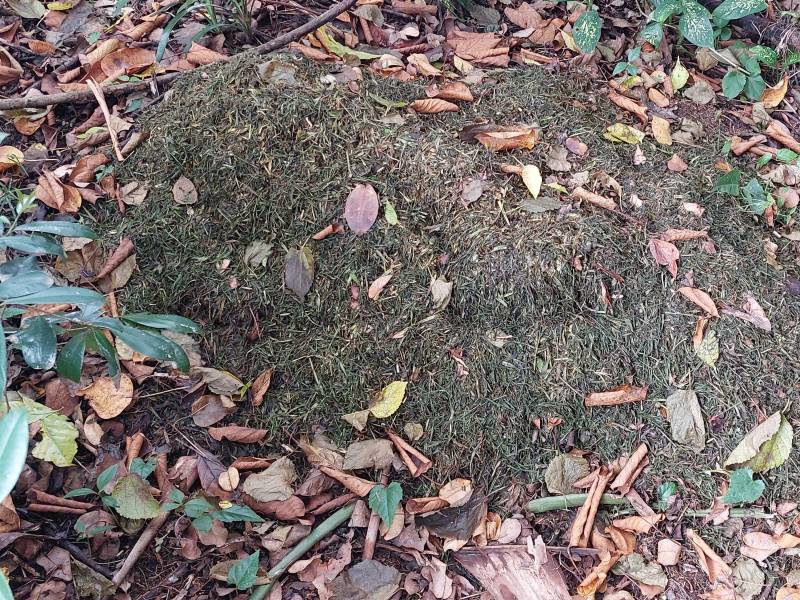
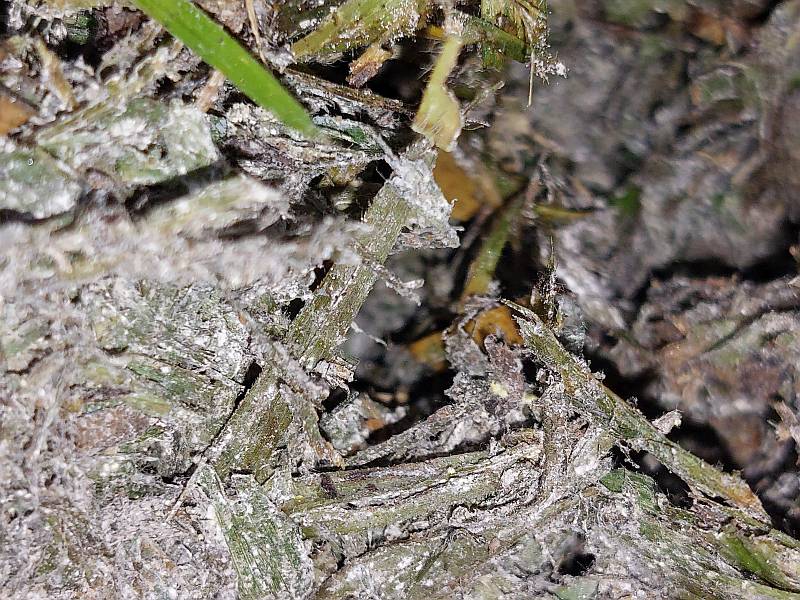
I tried both well-decomposed leaf litter from a compost heap in the garden, and fairly recently cut lawn clippings. (We dump cut grass in a pile under a tree. After 2-3 weeks it turns white, covered in mold.) Both kinds of compost worked fine.

My very own human composting toilet system (not copy-righted).

It’s very simple: 1) scatter some compost in the bottom of the toilet bucket, 2) do your business, 3) cover the business with another two handfuls of compost. Ok, and then put a lid on.

Surprisingly, it does not stink. The compost seems to absorb the bad odors. All you smell is the pleasant forest fragrance of the compost itself. It’s best to keep the solids and liquids separate, so don’t pee in the bucket with the solid waste. (Diluted urine can be used separately as fertilizer.)

Anyway, every week or two I emptied the bucket it into a compost box. This didn’t stink either. After several months I kind of lost interest in the experiment, but the pile of sh*t continued to do its job, and a year later I found a load of beautiful ‘brown gold’: high quality fertilizer for my garden.

Brown gold: rich natural fertilizer

To do this permanently, one would have to rotate through two or more separate compost boxes, to give each batch a chance to decompose fully.

What about contamination and disease? Helminth eggs and protozoa cysts die off at a certain rate, depending on various factors such as aeration, temperature, moisture and sun exposure, so the compost becomes safe after a certain time – anything from 6 months to 2 years. The climate, the setting, the material mixed with the waste, all play a role. Digging the compost under the soil instead of sprinkling it on top increases safety. I can’t help thinking my approach of adding ‘living’ compost from the garden would have sped up the natural composting process. For further information, this detailed report is a useful source.

My biggest problem was convincing my family to help collect this ‘brown gold’. They understand in principle why it is a good thing, but I suppose we have all been conditioned to consider our waste disgusting, rather than natural and useful. “Expand your mind, allow yourselves to think new thoughts, try work with me, this is just one more way to live sustainably,” I tried to motivate them. No success (yet). Maybe some day we won’t have a choice.

Seeing how that flooding event here in Durban damaged so much infrastructure, including sewers and water purification plants, and seeing how a year later raw sewage was still flowing in our streams and onto our beaches, made me think how with climate change we can’t take things for granted anymore. Perhaps I’m being over-dramatic, but there may come a time when we will have to manage our own waste, who knows. Best to be prepared. It’s called disaster readiness.

Hot box cooking

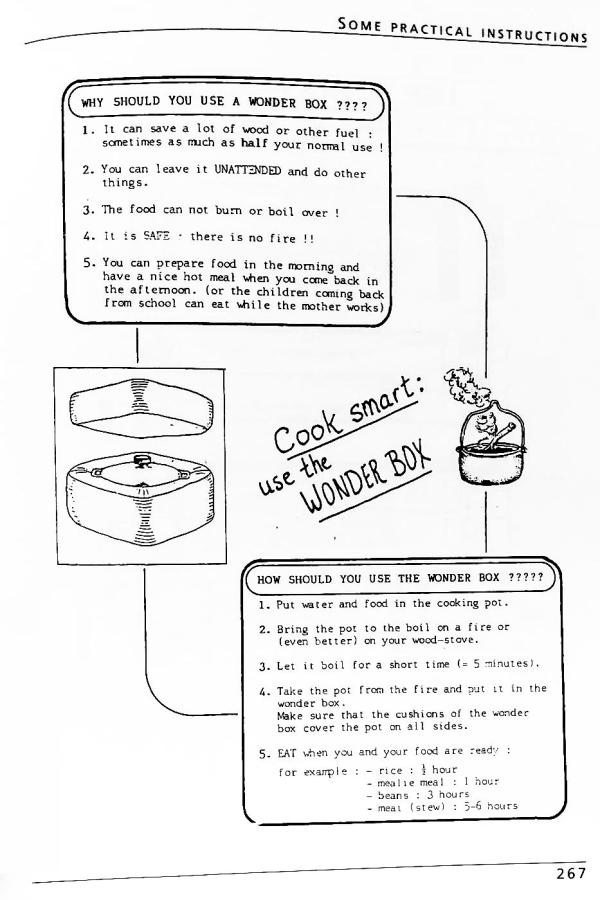
Cooking in a hot box / hot bag saves electricity while reducing our carbon footprint. Food takes only slightly longer to cook than on the stove, and can be left unattended (it doesn’t burn or boil over, and doesn’t need to be stirred).

I even find that stews and soups cooked like this tastes better and more fragrant. Rice is more fluffy and evenly cooked.

A hot bag can also be used to keep things cool – more efficiently than a cooler box.

This is the kind of hot box / wonderbag / hay box that one can buy, promoted here by the Department of Economic Development, Tourism and Environmental Affairs.

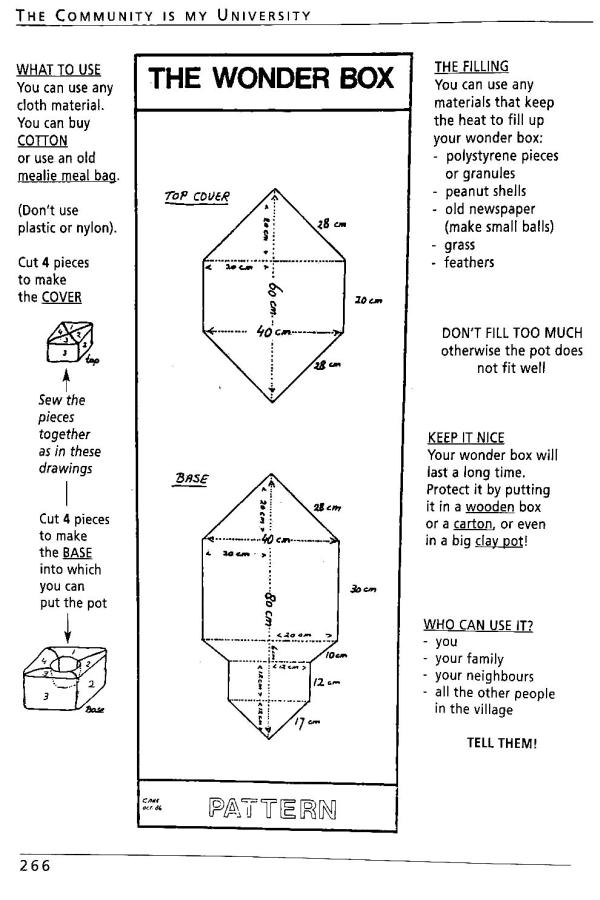
This beautiful book on community development and rural health, has instructions for rural women on how to make a ‘wonder box’ out of old cloth such as old linen mealie meal bags and stuffed with insulating peanut shells, grass, feathers or old newspaper.

You don’t need a box at all though. Some warm blankets work just as well. Hikers know this trick: you only need one little gas cooker for a 3-course meal. Boil a pot of rice, wrap it in your sleeping bag, then prepare your soya mince sauce (which cooks much better, without burning, in another sleeping bag), while you cook the dried vegetables (or make a nice cup of Milo).

Hiking and camping at Mont-Aux-Sources in the Drakensberg.

At sea level, water boils at 100°C. For every 300m rise in altitude, the boiling point of water is about 1°C lower. So at the top of Amphitheatre, at 3200m, water boils at 89°C. At high altitude food simply takes longer to cook – just something to keep in mind.

For my kitchen I recycled an old kiddies’ duvet that had gotten lumpy. I use this regularly to cook rice, stews, soups – anything that otherwise needs prolonged simmering on the stove. It really helps during loadshedding: as long as I get the pot boiled before the power goes off, no problem.

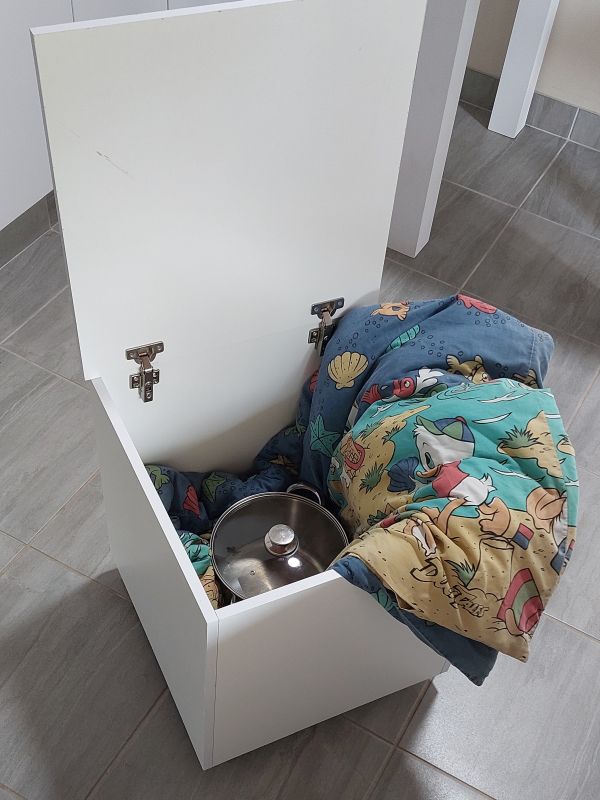
I got this fancy solid box made, on wheels, with a lid. It goes under the table, serves as a seat, and when needed, it comes out and becomes an oven.
How much electricity (and carbon dioxide emissions) does a hotbox avoid?

That depends on the kind of stove we are comparing it against, and the kind of food we are cooking. Since one needs to bring the food to the boil either way, the hotbox only saves on the simmering time. Food that only takes 15 min to cook on a stove would save only a little electricity; food that has to cook for hours, saves a lot. So the cooking box is particularly useful for meals that require longer cooking times.

1kWh electricity produces approximately 1kg of carbon dioxide emissions.

For those who like actual numbers, Eskom reports that it produced 198 281GWh of electricity in 2022, with 207.2Mt carbon dioxide emissions (plus 32.90Mt ash and 66.65kt particulate matter). Converted that is 198,281 million kWh and 207,200 million kg. Divide kg by kWh to get emissions per energy used.

A typical 1000W stove plate, if set to maximum heat, would use 1kWh per hour, and produce 1kg of carbon dioxide in emissions. So let’s say you simmer food (on level 3 out of 6) then you can assume a typical 1000W plate will consume approximately 0.5kWh per hour on half heat, which equates to about 0.5kg carbon dioxide. Now do that every day. Perhaps you use more than one stove plate at a time. All that adds up very quickly.

Please have a look at the total kWh on your last monthly electricity bill, and multiply that number by 12 to get the number of kg of carbon dioxide your household adds to the atmosphere every year. Now think: you can do something about that. Just dig out an old blanket and start today!

Previous posts:

Rag rugs

The Internet is full of fantastic ideas for upcycling generally (turning waste into something useful), and rag-rugs specifically. Old T-shirts too stained to pass on as second-hand clothing, still find a use. Stretchy fabric works best. Ideally the fabric should not fray.

Rags to strips

Start by cutting off any seams. Then cut the fabric into strips, in a zig-zag pattern to make one long continuous ribbon. You don’t need to cut straight either, curves is fine.

On fabrics that stretch in one direction only, it is better cutting in the direction of the stretch rather than across it.

The strips can be from 1 to 3cm wide. The thinner the fabric, the wider the strips.

The thicker the yarn, the thicker the final carpet will turn out.

Find a route that has the smallest off-cuts, for instance:

top
sleeve
pants

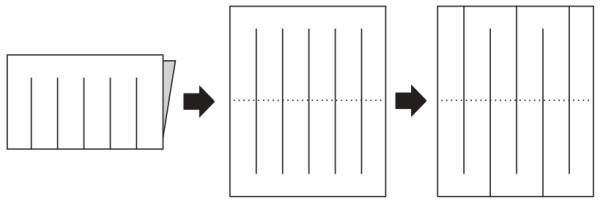
To save time, fold the fabric in half. Cut from the fold to within 1cm of the edge. Open up the fabric, and snip through to the edge, on alternating rows, to create a continuous strip, like this:

A lovely selection of matching colours.

Strips to yarn

To connect individual strips quickly and easily, loop them through each other. Cut slots into the ends; first push the end of strip A through the slot in B, then pull strip B through the slot in A:

Once I got a huge bag of off-cuts from a T-shirt factory. It took ages to untangle all that cotton Lycra – much longer than it took to crochet the rugs afterwards.

Yarn to rug

If you don’t know how to crochet, check out Sarah‘s blog for example. The simplest crochet pattern starts with a chain, and then works back and forth until the rug is long enough.

The last time I crocheted anything was at age 5.

Here is an alternative pattern for a rectangular rug. Hopefully the instructions make sense. (I am a complete novice and cannot read or write a proper crochet recipe.)

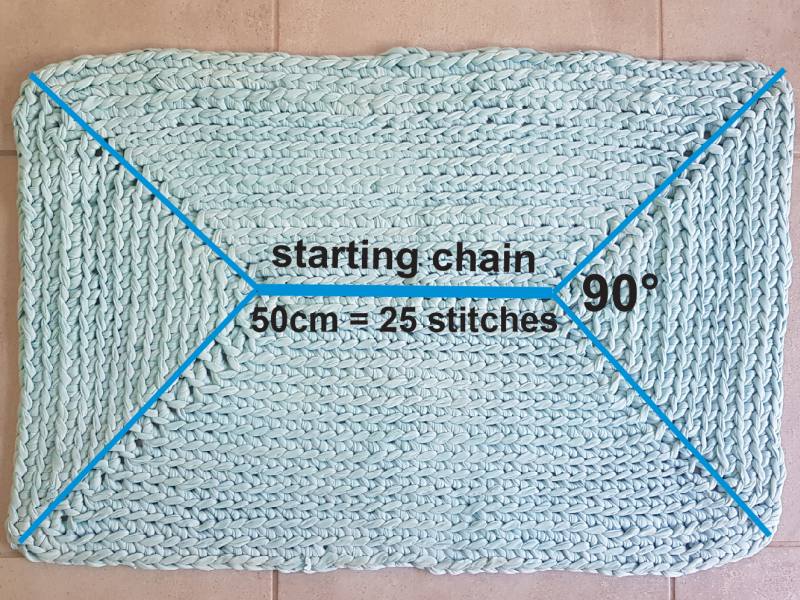
First, mark out on the floor how big you want the rug to be. Mark out two right-angled triangles on each end. Measure how long the starting chain needs to be. Calculate 2cm per stitch.

On this rug the starting chain was 50cm long, about 25 stitches.

Use a 10mm thick crocheting hook.

  • Create a chain (Step 4 on Sarah’s blog)
  • ‘Work into the chain’ (Step 5)
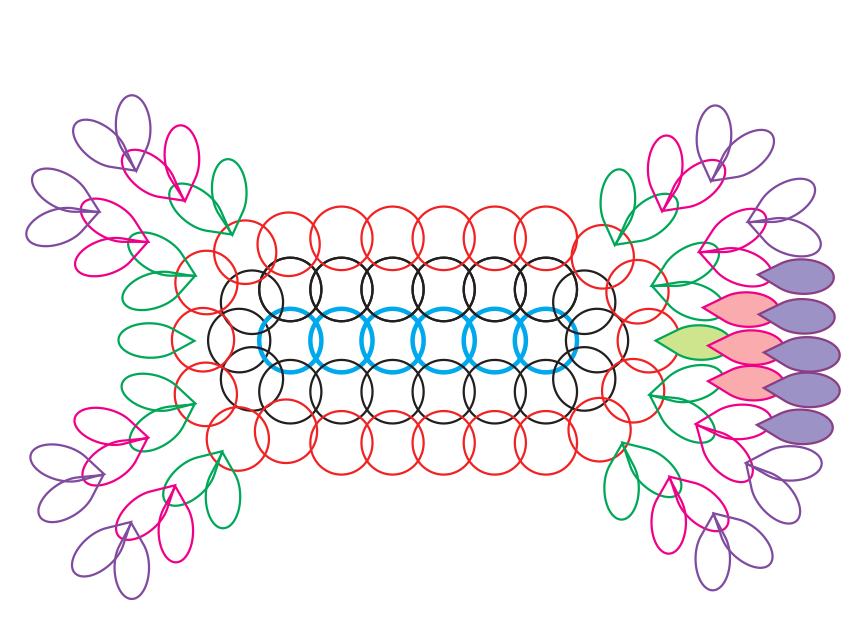
  • As you get back to the beginning, put three stitches in the end loop of the chain (figure A below).
  • Crochet along the chain and do the same on the other end (A).
  • On the next round, add an extra stitch on each of the four corners (B).
  • On the following round, and each round thereafter, add two stitches in each corner (C).
  • With each round, there are two extra stitches on each side of the rectangle (D).
  • When the rug is big enough, or you run out of yarn, fasten off (Step 9).

I love my colourful rug!

Bottle garden

In a city, one doesn’t always have access to a vegetable patch. But vertical gardens are a great way to grow food on hot, sunny walls.

Here is a 4min video of how to make this fully functional drip-irrigated vertical vegetable garden using recycled 2L plastic milk bottles.

On the Internet there are many different ideas and designs for vertical bottle gardens. Some of them are quite complicated, and need lots of hardware. My aim is always to spend as little time, money and energy as possible, and to recycle junk that is lying around anyway. Plus it must actually work. Tried and tested.

I started experimenting back in 2019. The first design was a flop. Ok I managed to grow a crop of veggies, but (a) each bottle had to be watered individually (groan!), (b) the water simply dripped out the bottom (leeching the soil), (c) the soil shrank in the bottle as it dried leaving a gap, so the water would just run around the soil without getting absorbed, (d) … anyway, there were other drawbacks that are not worth listing.

This arrangement was ultimately not successful.
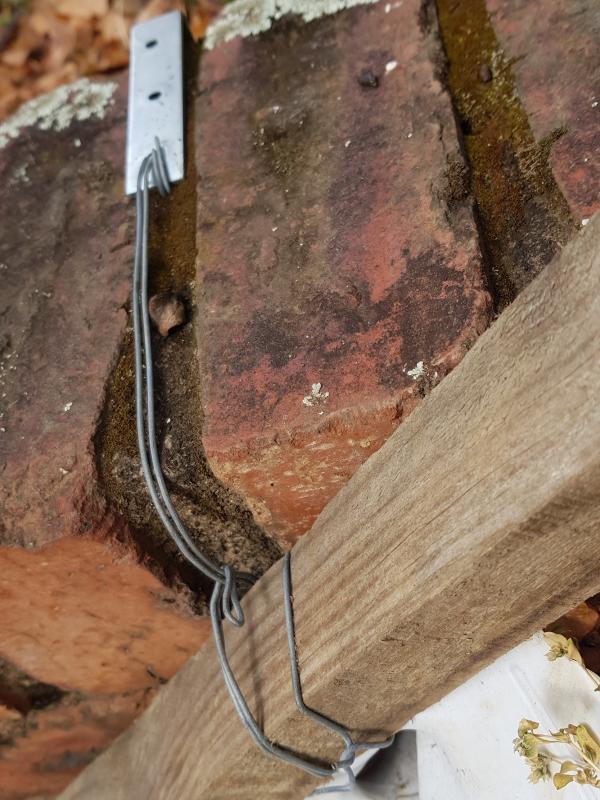
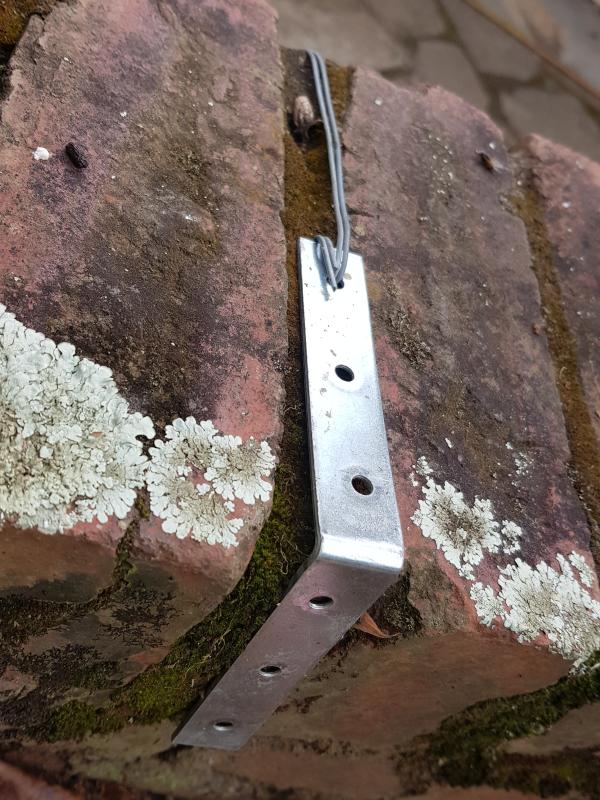
The only part that really worked was the idea to use wire and square metal brackets hung loosely over the top of the wall, to hold up the bottle racks, instead of drilling and screwing anything permanently into the bricks. This system was quick and easy to put up, move and importantly – remove. On house walls one could hold up the rack by wires attached to roof rafters or window sills.
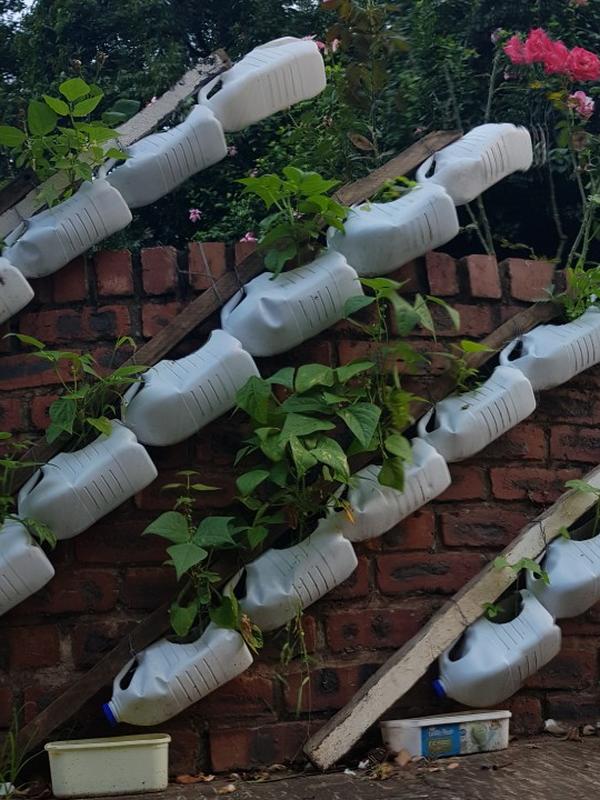
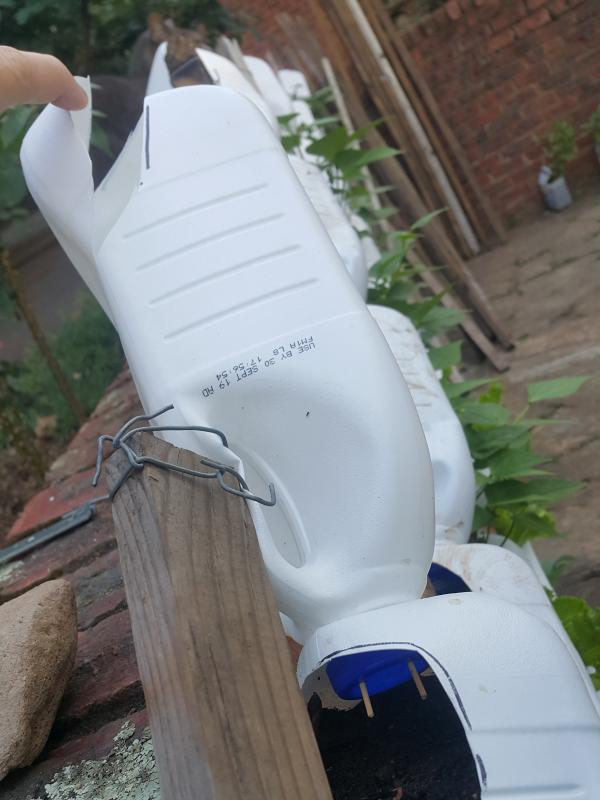
As for the bottles – after much head-scratching and fiddling, I came up with a much better system: a row of bottles, connected to each other and set up at an angle, like so:

The end bottle is the reservoir. Simply fill up this tank with water. The lid has holes punched in it. The water gently irrigates the first bottle, then dribbles slowly from one bottle to the next. Reduce the flow from the tank by blocking some of the holes with toothpicks.

A container at the bottom collects the overflow – a nutrient-rich tea, which can be poured back in the top, to recycle nutrients.

Watering is quick and easy, but the actual irrigation is slow, and the soil gets a thorough soaking. As a result it stays wet longer. You can even control the moisture level: the steeper the angle of the rack, the better it drains. If you lower the rack, more water pools in each bottle. This helps fully grown plants to cope in the heat of summer. (But avoid water logging.)

I have successfully grown several crops of vegetables: lettuce, spinach, various herbs (parsley, dill, chives, leeks, basil), celery, also green beans, radish. Even cauliflower – though the monkeys got to them first.

Cucumbers also grow very well in bottles: set up two racks about 2m apart, and zig-zag a string between them. This works for runner beans too. Just help each plant to find the right path.

Soil quality is something I am still learning about. Diluted urine, bone meal, wood ash and Epsom salt are organic alternatives to artificial fertilizer. But I have found it is easy to overfertilize, because nutrients cycle around this self-contained unit. It is probably best to replace the soil once a year, mixing in fresh compost, and rotating crops. The plastic bottles also become brittle from the sun and don’t last longer than two seasons.

On 1 November is World Vegan Day. We are not vegans, but I respect the choice. This blog is my salute to you, Douglas, Glenda, Shannon, Chloe and others. I share your love for veggies.

by Marlies Craig

Solar home

As I write, our neighbourhood is wrapped in darkness. At Stage 6 national load shedding, electricity cuts out several times a day. But we hardly notice. We enjoy the benefits of energy that shines down from the sky, for free, every day.

In August we installed a solar power system. After fretting for a while over the cost, we saved up and just did it, knowing that this investment will pay itself back in a few years. After that, electricity will be free.

Installed and pumping electricity!

Best of all, we reduced our family’s carbon footprint, making a major contribution from our side towards solving the climate change crisis.

The best location for solar panels was the garage roof, as it is the most nearly North-facing, with the least shade.

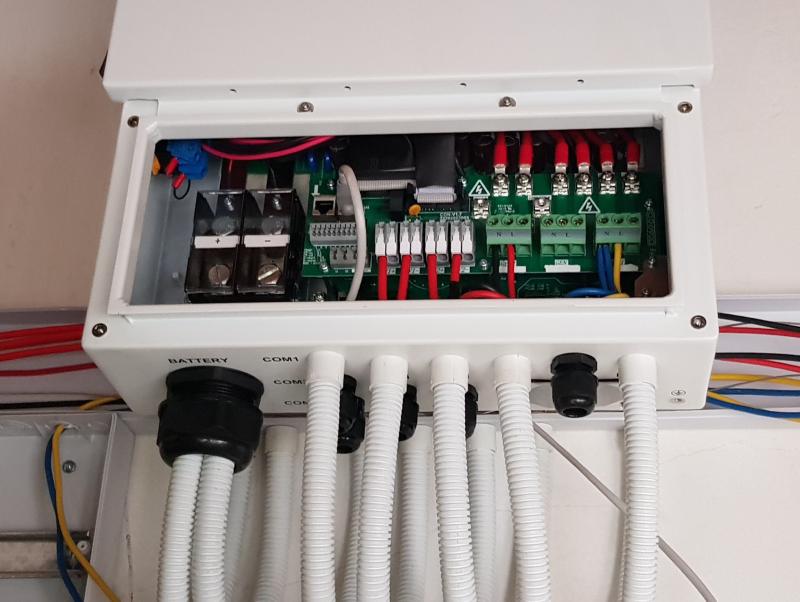
The solar panels convert sunlight into electricity. This power is variable, and it comes in as DC (direct current) while the home uses AC (alternating current). So the current has to go through an inverter.

The inverter receives electricity (from the panels, from the grid or from a battery), converts it as required, and sends it as required to the home or the battery or exports it to the grid. Beware: the inverter is noisy.

Batteries supply power at night. Without them electricity would only be available during daylight hours. They act as a storage tank, ensuring a steady supply while power production peaks and dips. The inverter also needs a battery to start up during power outages (it is a computer after all). This took me a while to understand. Without electricity from the grid or from a battery, the inverter cannot power up in the morning, and the solar panels are useless.

The Watt ratings on the panels indicate the maximum power produced per square meter. I don’t know if one ever reaches that maximum, but today at lunch time (a blazing sunny spring day) our panels produced 85% of their total rating.

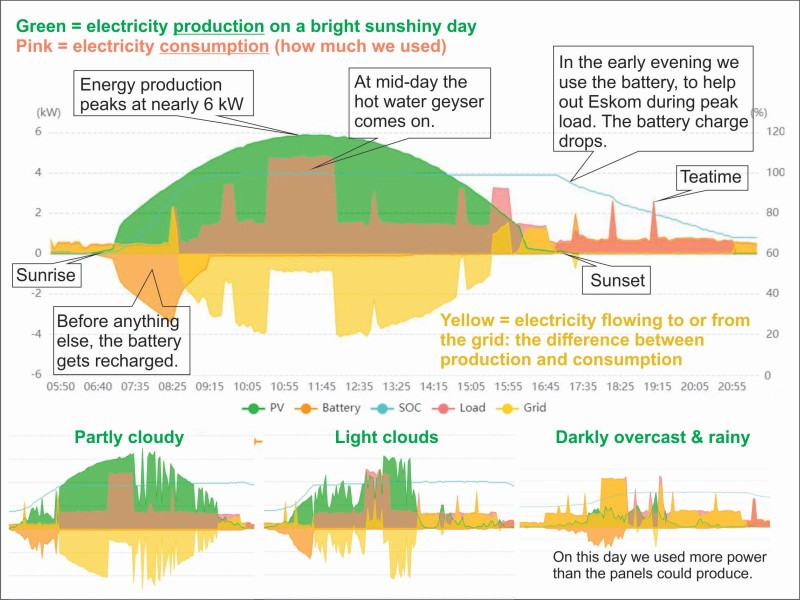
An online app records and makes pretty graphs of everything – the energy being harvested from the sun, our electricity usage, how much we import and export from and to the grid, even an estimate of total savings – in Rands (our monthly electricity bill) and in carbon dioxide (1.8 tons in under 3 months, or more than half a ton of coal). Wow!

Electricity production (green area) depends on the weather, the length of the day, and other factors.

At this time of year the weather is extremely variable, swinging from blazing hot sunny days to grey fog and drizzle, and back. Despite this, our solar system has supplied our needs, on average. On some days we import from the grid, on others we export. Even on the darkest days with heavy cloud cover, the panels produce at least enough electricity to keep the fridge and freezer going 24/7 (with two batteries). But this is good to know.

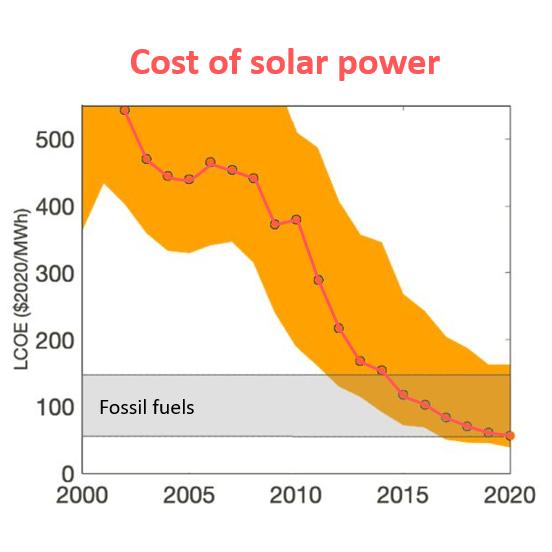
Back to question of money: these past few years the cost of solar power has come DOWN, to the point where it is now getting cheaper than electricity from fossil fuels (like coal power stations). At current electricity prices our system (which we paid for cash) would take about 10-11 years to pay off.

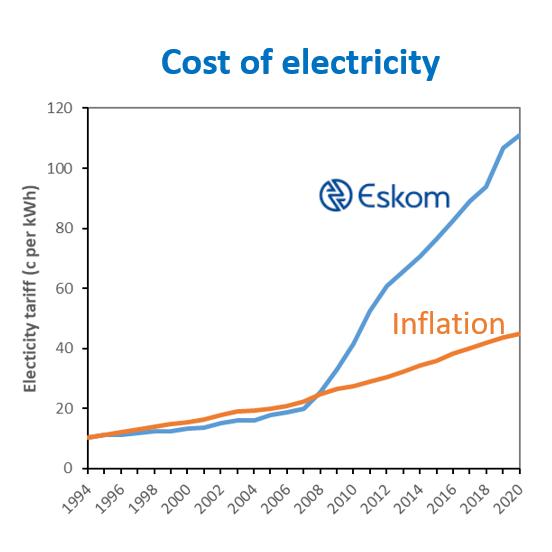
But electricity prices in South Africa have gone UP, faster than inflation (15% annual increase on average since 2008, which is 3x faster than inflation). If this trend continues (very likely) we will get our money back in about 7 years, after that, profit. So this is an investment that makes business sense. No wonder more and more businesses are installing solar power. In theory one can start small and add more over time.

I just discovered that 13 October was International Day for Disaster Reduction. On 11 October 50% of Durban city was without power after an explosion at a major substation. Half a large city! The Durban flooding disaster damaged electricity infrastructure and caused major power outages. Sometimes we lose power for several days due to local faults. And have I mentioned the load shedding?

In every way solar power makes sense. It makes sense for today, it makes sense for the future, it makes sense financially, it makes sense for disaster readiness and for peace of mind.

by Marlies Craig

Nature of cities

I recently visited Incheon where I was struck by the Korean government’s efforts to create a very dense and green city (featured image).

Trees in cities hold great potential for their cooling properties and carbon sequestration, for ground stabilization and water absorption, biodiversity and biophilia, food and fuel, etc. This article on urban tree-planting is part of a collection of opinion pieces on “empowering cities to plan for a positive natural future” recently published The Nature of Cities.

In this article I wrote, Plant indigenous trees! Everywhere, always, more! – Retrospectively, I would like to add “…but without thereby altering existing healthy ecosystems.” Planting trees in existing savanna or wetlands for example, does not benefit nature.

arum lily caterpillar experiment 1sm

The beautiful Common Striped Hawk moth (Hippotion eson) eats our local arum lily (Zantedeschia aethiopica), but refused a range of common, exotic garden plants of the same family (Araceae – below).

arum lily caterpillar experiment 2sm

So what?

Well, this was a little experiment in my own garden, that illustrates (1) what fussy eaters plant-eating insects are, (2) why exotic (non-native) garden plants always look so perfect (they don’t get eaten), (3) therefore, why they hardly contribute to the food chain, and (4) why, if you truly love nature, you should plant indigenous plants.