WICD – climate change chronicles (Part 2)

We recently completed another round of workshops with Grade 10 learners, in partnership with Umkhumbane Schools Project in Cato Manor, Durban. Two WESSA youth educators joined us this time, hopefully we’ll work together in future.

Over three Saturday mornings, in August/September 2025, we worked through the next few units of the What I Can Do (WICD) About Climate Change edu-action programme.

Since the last workshop series in March was a while ago, we started with a refresher exercise. Instead of me (the facilitator) doing the talking, we split up the learners into small groups, and gave each group a print-out of one of the videos we watched previously, to refresh their memories.

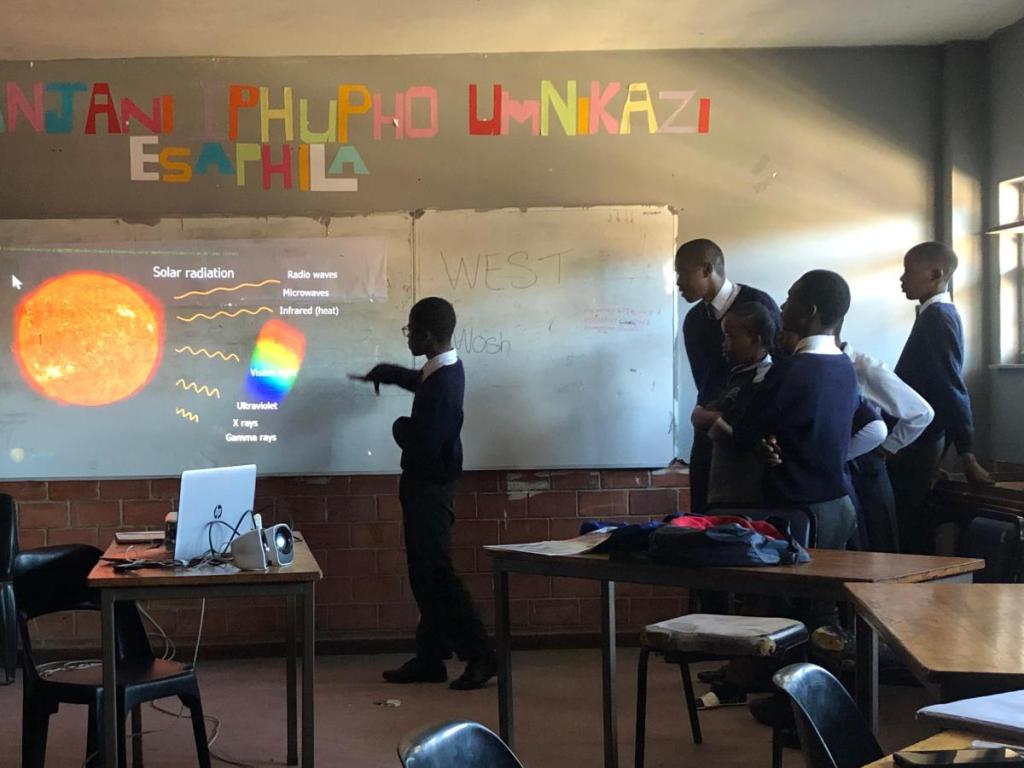
The learners then presented the slides to the larger group and gave brief summaries of anything they had remembered. I reminded them that this was not school and that there was no evaluation, that they should not feel pressured or stressed, but just quickly walk us all through some of the highlights. This was a fun and highly entertaining, the learners were very enthusiastic.
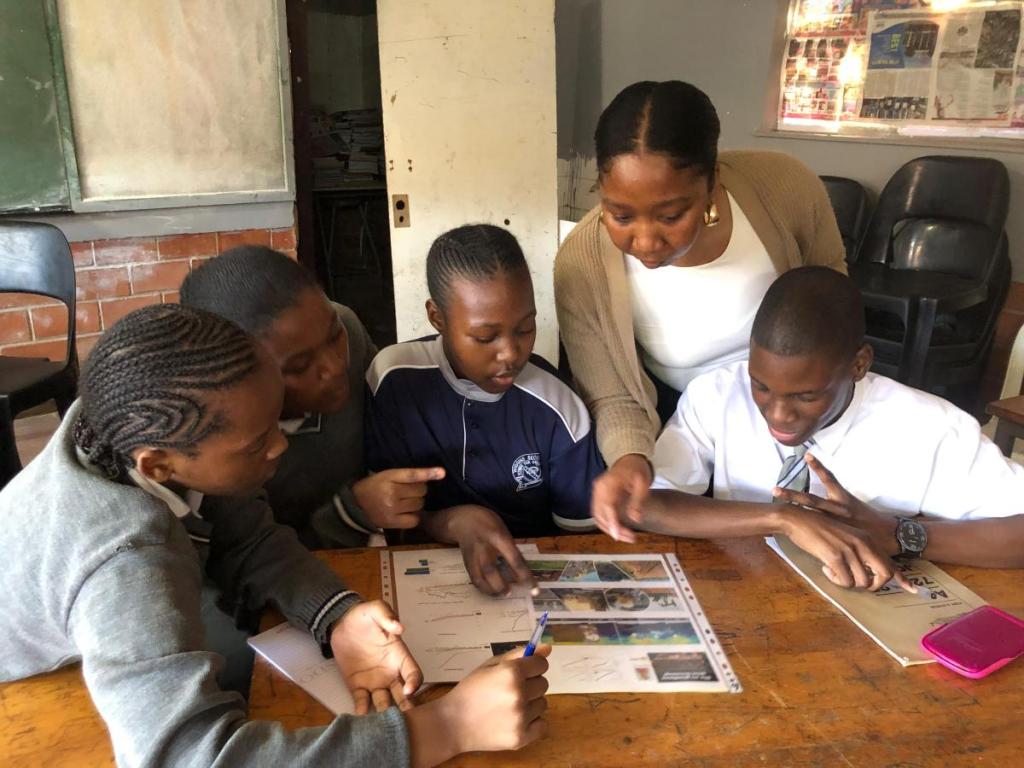
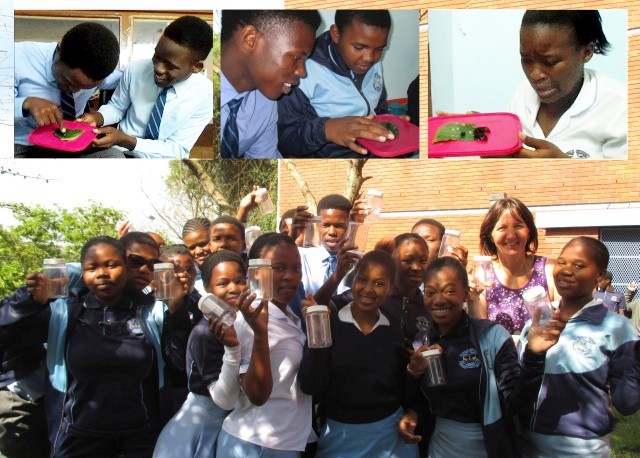
Learners refreshing their memories
Learners presenting a summary from the last workshop

Unit 7 “What does climate change look like”?

The video for this unit shows the many faces of climate change – changes in the weather, changes on land and in the oceans, changes in the frozen parts of the world, sea level rise. We all felt a bit depressed at the end. But everyone agreed when I said, “These things are happening anyway, whether we are aware of it or not. Myself, I prefer not to be ignorant of what is going on. I would rather know, because then I maybe do something about it, and also then I can adapt my life and not get caught by surprise.”

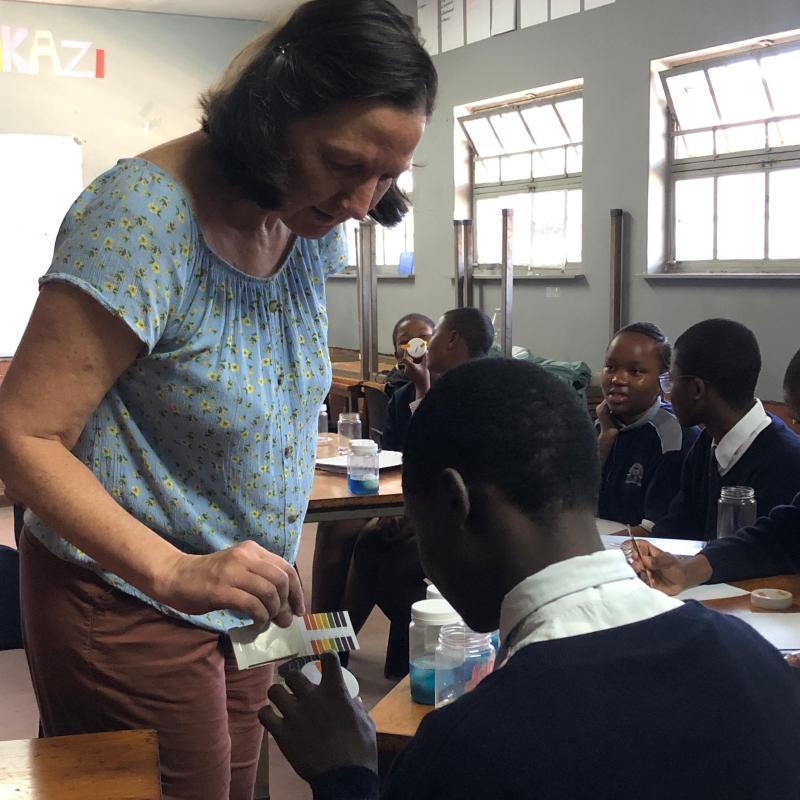
We then carried out two simple experiments about sea level rise caused by melting glaciers and warming oceans, and one about ocean acidification and the effect on calcium carbonate solubility.

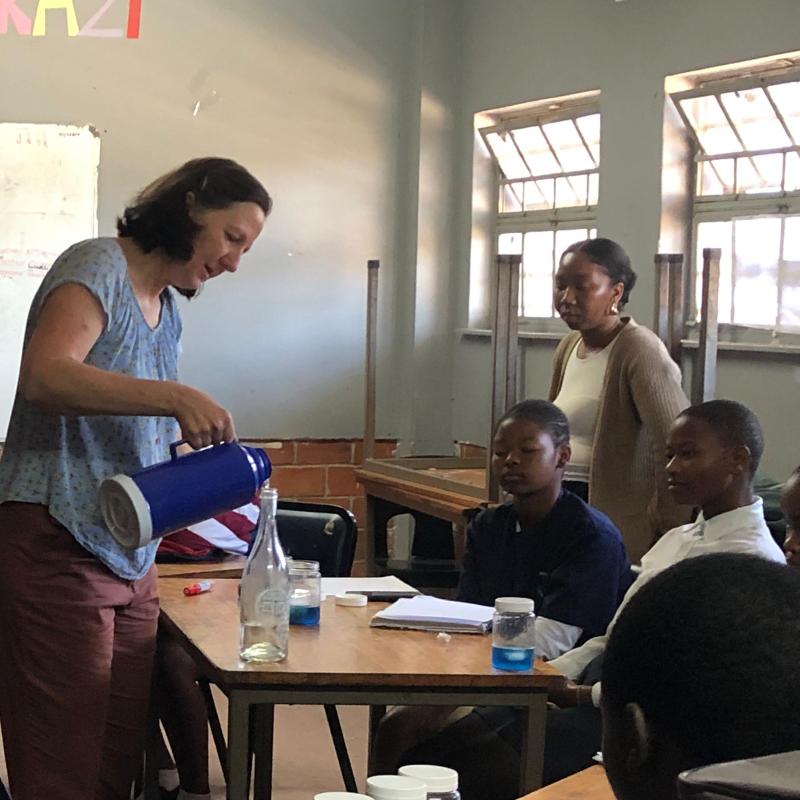
Do melting sea ice and land ice both cause a rise in sea level? Marking the ‘sea level’.
Demonstrating that hot water takes up more space than cold water.
Do sea shells dissolve in acidic water? Checking the pH.

Unit 8 “Why should I care? How does climate change affect me?”

On the first day the learners went home with a questionnaire, to interview an older person in their household. They asked about any changes or disasters they had experienced during their lifetime.

On the second day, learners interviewed each other, in a mock TV show, talking about their family’s – or their own – experiences and opinions. “Who has family or friends who may not have heard about climate change? What could you say to them? How would you explain climate change to your granny?” I was blown away with the confidence and enthusiasm with which the learners threw themselves into this activity.

The results speak for themselves!

The Unit 8 video covers the many ways that climate change affects us as humans – our food systems, health and wellbeing, the economy – and how it can cause poverty, displacement and conflict. It explains how we depend on nature and how climate change threatens our entire society, often in complex ways.

While watching the video, learners listened out for facts that might answer the question: “Why did the Nobel Prize for Peace get awarded to people who spread knowledge about climate change? How could climate change disturb the peace, between individuals, communities or countries?”

Learners paired up to discuss this question, we collected ideas from the floor and discussed them in the big group. Responses included: communities or countries fight over scarce resources, such as food, wood or water; people fight with their governments over policies or unfair food allocations; activists fight with law enforcement; ‘false activists’ turn environmental causes into terrorism. Another two short videos, by international peace organizations, rounded off this section.

The learners’ responses were very insightful and thought-provoking.

Unit 11 “What can I do about climate change?”

Finally we get to the most important part: action. The interactive video highlights the top priorities, based on where the most greenhouse gases come from, and where action would therefore have the greatest ‘bang for buck’. It also talks about climate justice, an important topic for young people living in underprivileged conditions.

Unit 13 “Electricity”

The third day was devoted to the top action area: energy – more specifically, electricity. We started with a game called ‘Circuit Breaker’, where we passed ‘electrons’ from a ‘battery’ around a ‘circuit’. One person was the ‘switch’, another the ‘radio’, another a ‘resistor’. When things got out of hand, and ‘sparks’ started to fly, the ‘circuit breaker’ tripped, and the game had to be ‘reset’.

How fast can you make the ‘current’ flow?

Then we talked about electricity in the home: the distribution board, the electricity meter, different ways of purchasing electricity.

It’s easy to save electricity in the home, just by doing things slightly differently. Thereby we can reduce our energy carbon footprint as well as our monthly electricity bill. So how much power does it take to boil a cup of water – in a kettle? On a stove? In a microwave? We timed boiling water with different appliances, and converted the answers to kWh, grams of greenhouse gas emissions, and into Rands and cents. Then we cooked a pot of rice by wrapping it in a blanket.

Boiling water in a kettle used the least power.
A pot of rice, once boiled, can cook in a hotbox without further power.

On a personal note: I (Marlies) would like to thank Martha Bishai and her team at the Umkhumbane Schools Project – especially Precious, Nokwanda – from the bottom of my heart for their support and partnership. Years ago Martha invited me to engage their biodiversity group. Since then Martha’s encouragement and participation inspired me to keep going forward, and to dare think bigger and aim higher. I am deeply grateful for believing in this work and investing in EASTER Action!

WICD – climate change chronicles (Part 1)

With this blog I’m happy to share the experience from the first three sessions in a series of climate change workshops with Grade 10 learners, in partnership with Umkhumbane Schools Project in Cato Manor, Durban.

The plan is to work all the way through the What I Can Do About Climate Change edu-action programme, with the same group of learners, firming up the contents, seeing how it is received, and refining the program so it can be implemented by other facilitators in the future, making it more accessible and impactful.

Over three days in March 2025, we completed six units with the same group of students, allowing us to gauge their feedback and see how the material was received. We ran three 2-3 hour sessions over consecutive days, with a mix of short video presentations and interactive, hands-on activities. We covered 6 units, and plan to carry on later in the year.

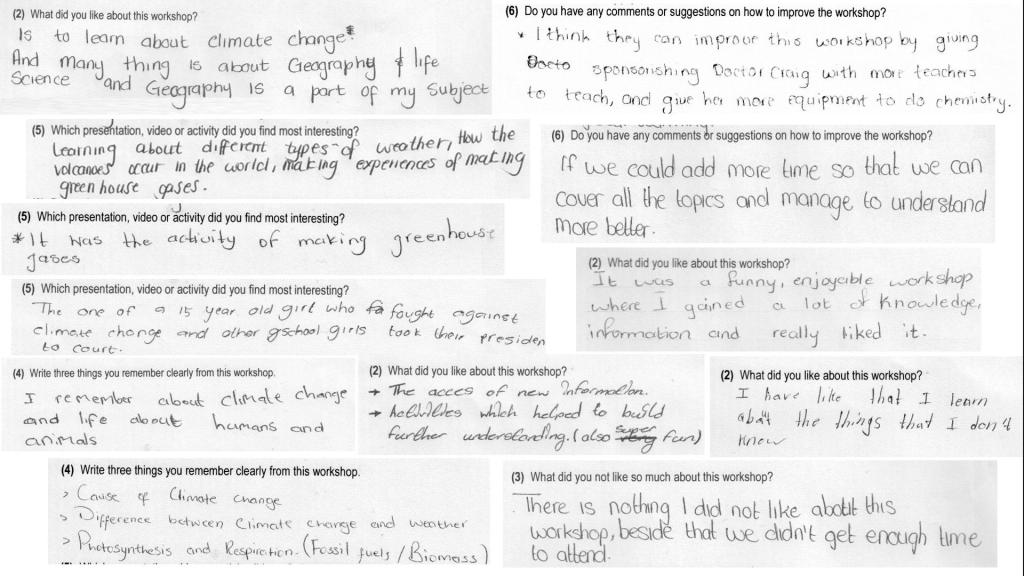
Based on the heart-warming and enthusiastic feedback from the learners, it is clear they found the sessions enjoyable and valuable. As the facilitator, I also had much fun, and learned things that will help me update the activities, and add some more teaching material. 

Here are a few samples from learner feedback. My favourite: “It was a funny, enjoyable workshop where I gained a lot of knowledge, information and really liked it.” – If even one learner felt like that then mission accomplished!

Keep on reading for a more detailed account.

Unit 1 “What on earth is going on?” – about youth activism

The programme kicks off by empowering learners, showing them that before we are individuals, we are citizens of the world. Before even mentioning climate change, this introductory session places the youth at the forefront and shows the role they play in world affairs. It encourages young people to think at the global scale, rather than taking the small-scale view of ‘me, here, now’. Hopefully this arouses an inner sense of importance, relevance, empowerment and capacity.

The interactive video followed by two activities always work well. I have done this many times so there were no surprises. The fun quiz, using Plickers, is always a favourite.

Unit 2 “What is climate change?” – a brief overview

The video gives a very brief overview of climate change. It explains how the world is getting warmer, how this is causing record-breaking global warming and devastating world-wide impacts. Climate change is caused by a sudden recent rise in greenhouse gases to levels which humanity has not seen before. It is a human-made crisis, and it will get a lot worse unless we urgently do something about it.

The activity involves a community survey. The survey is not about gathering information or finding out what people know, its purpose is to give learners a way to ‘interview’ friends or family and so introduce the topic of climate change respectfully and in a neutral and engaging way. At the workshop, learners filled in the survey themselves. They said it was ‘easy’ and were confident and keen to take a second form home.

Two days later, their feedback was very positive. They enjoyed doing it. Some learners had interviewed school mates, or the whole family, or a brother. One learner who had interviewed a cousin at university, felt pleased that she knew more about the subject than the university student.

The feedback they got in turn, was also encouraging: they encountered positive interest rather than any negative responses, and it helped them to talk about the information that they had learned in the workshop.

Unit 3 “Weather or climate?” – the water cycle

The video explains the difference between weather, climate and paleoclimate, and the science of the water cycle. While we couldn’t get the students’ tablets online, we managed to do a live demonstration using Windy.com to show real-time global weather patterns. The learners were fascinated, especially when we located a cyclone over the Indian Ocean.

Unit 4 “Why is the world getting warmer?” – the greenhouse effect

The video starts relatively simple, but then gets increasingly technical. The learners were surprisingly interested in the science. I had planning to stop the video before it got to some really advanced topics (such as the radiation absorption patterns of different atmospheric gases), but they were all keen to carry on.

The learners all take science as a subject, so they had a reference point, and this lesson must have connected with things they already knew, they were just hungry for more! It was delightful seeing in them this appetite for scientific knowledge that also drives me to dig deeper into a topic until I am satisfied and my questions have been answered. 

One activity explains global warming in terms of body temperature, to illustrate the importance of one degree of warming. Except for two willing volunteers, most felt too old for the ‘running around’ part, but they were deeply interested in all the information about ambient and body temperature. 

It was really sweet: when I gave some learners a lift back to their school at the end of the workshop, they started rehearsing in the car the different temperatures: healthy body temperature, what is a fever, when you should go to hospital, what temperature is deadly. They found it fascinating that feeling hot is not the same as being sick. Well, it IS fascinating, isn’t it?

I had also pointed out how important this knowledge is for when they are adults and have their own children. It had little to do with climate change, but I love bringing real-life knowledge into these lessons, to show how science is not just something you learn at school, but something that is important in life – quite literally!

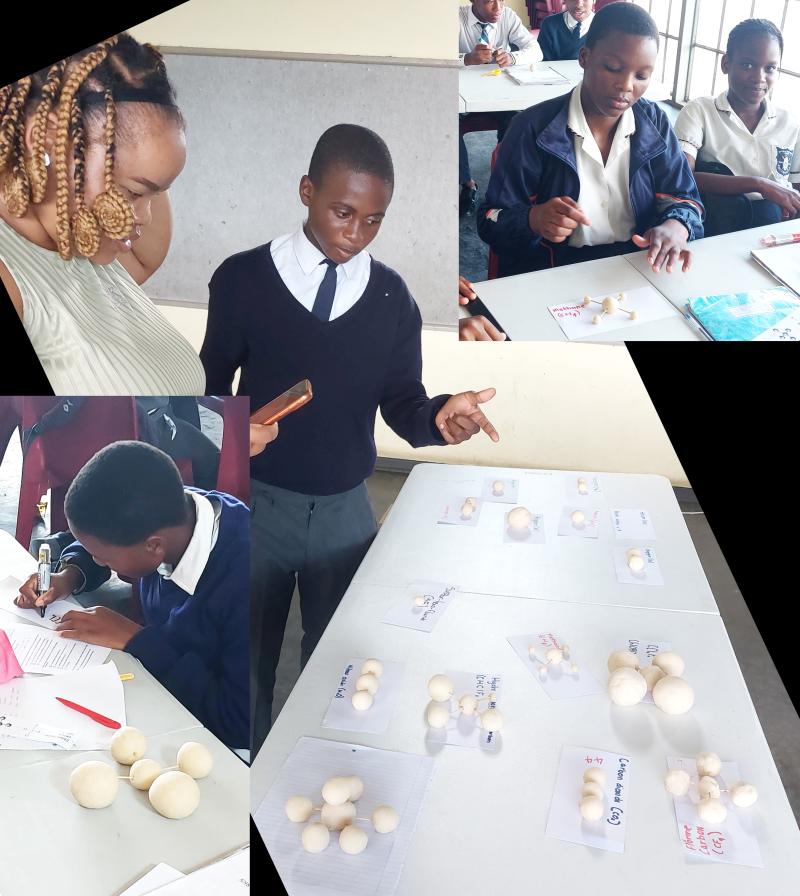
In another activity, learners created molecular models of atmospheric gases with playdough and match sticks, and we discussed which are greenhouse gases – or not, and why.

Unit 5 “Where do greenhouse gases come from?” – the carbon cycle

The next video shows how the main three greenhouse gases are deeply connected with life and living things. It turned into an impromptu science lesson, as I realized that some of the information in the video assumed prior knowledge they did not have.

We burned biomass (a dry twig) and watched the wood turn to black coal, we demonstrated how white wax and clear paraffin are indeed carbon-based fuels (by catching soot from the flame on a white saucer), and how burning a candle under a jar does indeed use up the oxygen in the air (the flame dies), producing energy (the flame) and water (steamed-up jar) – we could have tested for CO2

The biggest thrill was a methane experiment. I had brought a bottle of gas, and showed them pictures of how I had produced this from kitchen waste and pond water. (Ideally they should do the experiment themselves.) We bubbled the gas through soapy water and ignited the foam, creating a little fireball. We all got terribly excited! What a memorable moment!

Unit 6 “Why are greenhouse gases increasing?” – the root causes of climate change

This unit explored the root causes of climate change, specifically fossil fuels. This led to an important side lesson, and I realized we need another video on what fossil fuels are and how they are formed.

The session wrapped up with a highly interactive game, ‘Fossil Fuel Bingo,’ about which everyday fuels are fossil fuels and which are biomass fuels. It was so much fun they asked to play it a second time.

This workshop was a powerful reminder of how eager young people are to learn and get involved. We’re looking forward to continuing our journey with them later this year. Stay tuned for our next workshop as we continue to build a generation of climate-doers.

On the best-attended day we had 35 learners, the very limit of how many one facilitator can interact with effectively.
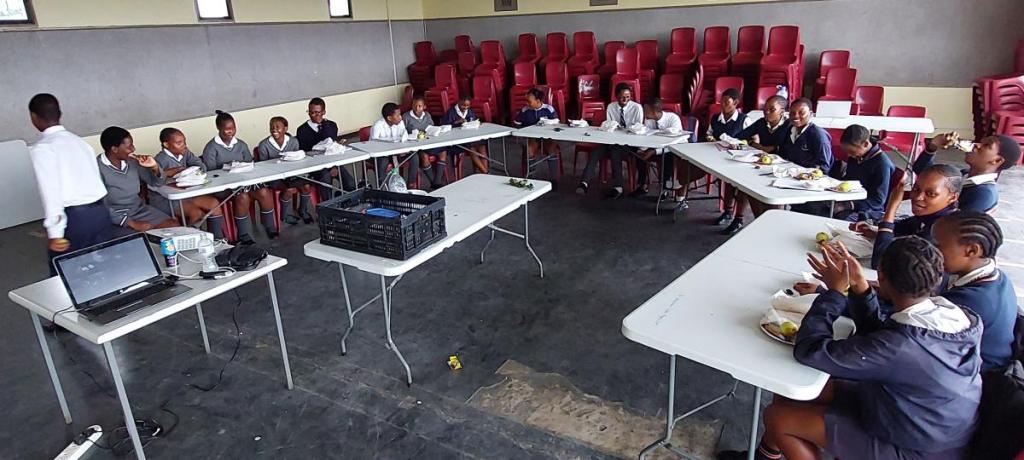
With fewer learners one can sit in a circle which is more intimate and feels less like school.

Progress with partners

Let me report back briefly on three recent events with Kloof High School, which have been extremely rewarding and motivating.

After attending the recent WESSA KZN EcoSchools Prizegiving, where Kloof High got their first Green Flag for environmental activities, Corné van Vollenstee (Life Science subject head, who also heads up the environmental club) reached out to me with a request to help the school introduce environmental education across all subjects.

Wow! This was so proactive of Kloof High, and such perfect timing for EASTER Action!

Having finalized the first four units of the What I Can Do About Climate Change programme, and piloted them from my side, it was time to test the hand-over process. One-by-one we will never reach enough people to make a measurable difference. Knowledge, know-how and determination to act – these have to spread throughout society, and urgently!

Introductory session

To begin with, Corné wanted to engage her fellow teachers, to try and get everyone interested and on board. So, end of May, we had an interactive session on climate change with the entire staff of 65, to raise this critical global issue.

The teachers were very interested and responsive, which was encouraging. Positive feedback included: “Very interesting and informative… interactive and engaging… Activities were an eye opener… A real wake up for me!… The practically and relevance of the topic and how it relates to the educational space… Very user friendly advice… Thank you we enjoyed. Please come again. It was so educational.”

Some asked for “more activities that we can do at home to help with eco systems… a digestible version of the presentation to direct towards learners/youth… should be an ongoing initiative.”

Getting ready for the ‘WOW’ moment that never fails to leave a lasting impression: which sector produces the most greenhouse gases – and by how much…

Co-production workshop

Being very supportive of this new initiative, the headmaster agreed that we should pursue a partnership to take this work forward. The plan is to run drafts of the 80-or-so activities that form part of the WICD programme through a process of co-production and review, and for the teachers to try out some activities with their learners.

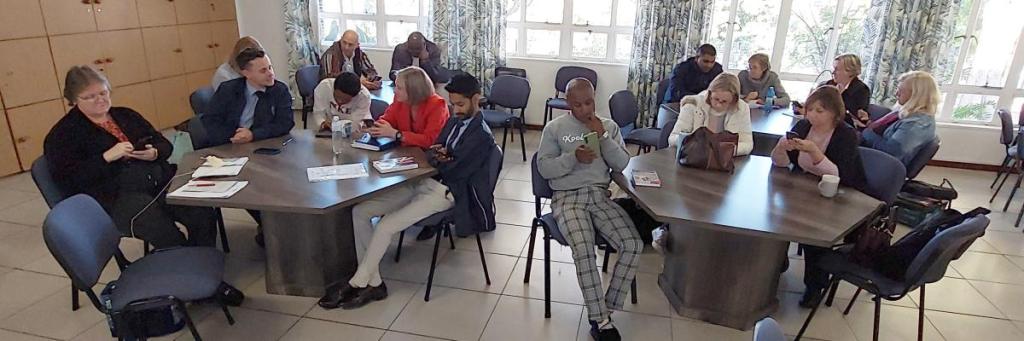
End of July, the 16 subject heads participated in a 1 1/2 hour workshop, where they received a more detailed introduction to the WICD programme. Then we spent an hour watching the first four little videos, and going over the first batch of activities. There was something for almost every subject.

The teachers each picked an activity that might be relevant for their subject, reviewed it and filled in a detailed feedback form. They responded to questions such as: What do you like about this activity? Pros? – What do you not like? Cons. – What practical or other challenges do you foresee? – Does the Aim make sense as stated? If not please suggest alternative. – Can it double up as a school project or practical? – If it allows assessment, how would you assess it? Draft a rubric. They rated, if applicable, the suitable age or grade level for the activity, and in some cases indicated a particular part of the curriculum the activity speaks to.

The very helpful comments and suggestions are being incorporated into the programme currently.

Even though it was just a short session, and only a limited number of activities could be processed this time round, it proved that such a co-production workshop can generate much valuable feedback that draws on the practical expertise of in-service educators.

Subject heads logging into their private page on the EASTER Action website.

Multiplier workshop

Apart from expanding environmental education within their own school, Kloof High also expressed a wish to increase their environmental activities in the wider community.

It was time to test the ‘Multiplier’ concept, which takes the ‘train-the-trainer’ idea one step further: yes, empower educators to engage their learners, but then also empower learners to engage their families. By introducing activities that involve real-life activities in the home environment, we hope to spread knowledge and know-how way beyond the immediate participants, building climate literacy, and hopefully stimulating citizen climate action in the wider society.

Each participant received access to the videos and activity guides for the first four units, to use with their learners, via a private workshop page on the EASTER Action website. We have set up various feedback forms, to harvest comments and experiences, and we look forward to finding out if this approach works. Ultimately we hope that showcasing what others are doing will help motivate engagement and participation. It is a work in progress.

The workshop was attended by 11 amazing people: 2 school teachers (Hillcrest High, St Mary’s) and 9 environmental educators (including from WESSA, Wild Trust, Umkhumbane Schools Project, DUCT).

Feedback from participants: The small group format was much appreciated, as it gave everyone a chance to meet properly, network and hear about what others are doing. It also allowed ample time for questions and discussion. The programme content was described as “outstanding, especially with the short videos for each section… clear and easy to understand… useful… well-presented… Having the chance to go through each of the highlighted modules, watch the videos, and try the activities, was very beneficial… The activities were very useful in giving me ideas on how to better facilitate a lesson on climate change.”

Participants suggested keeping future workshops short and small, and also providing teaching tools (activities and videos) that speak better to younger learners at their level. The current content is aimed at high school learners, and is also suitable for grade 6&7.

Thank you everyone who came and made this such a memorable and pleasant day! And thank you Corné for your passion, and Kelly for your help with the organization!

The wonderful participants of Multiplier Workshop ‘Aardwolf’ – hopefully the first of many.

Join us for a climate change edu-action workshop

This workshop offers training and resources on climate change, to empower educators to engage learners (and their families), to build climate change knowledge and know-how and stimulate action.

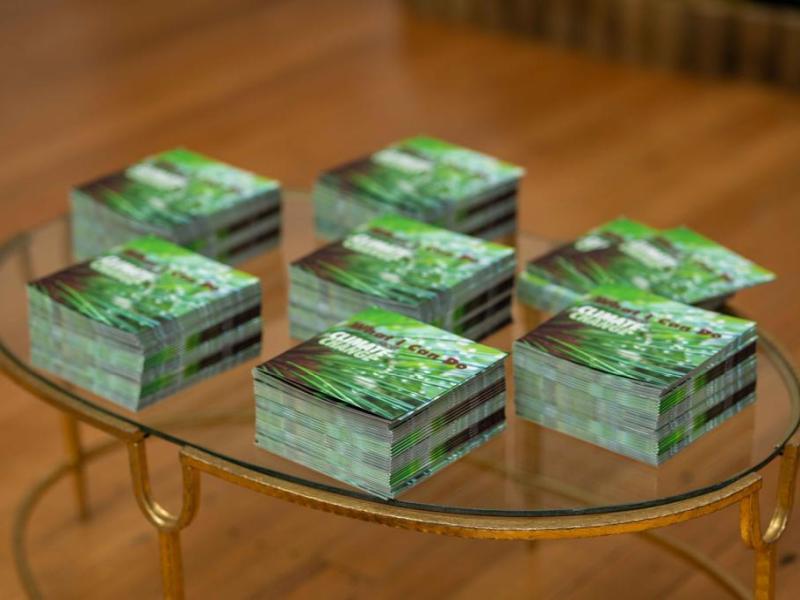
Participants who would like to engage their learners using the resources provided, receive up to 200 climate change booklets for distribution to learners (while stocks last – so don’t miss this unique opportunity). Participants also receive an activity guide and access to online video material.

WHO IS IT FOR?
Teachers or other educators of high school-age learners and upwards

PRESENTED BY:
Dr Marlies Craig (Click here for BIO)

HOSTED BY:
Kloof High School, in partnership with EASTER Action

PROGRAMME:
3 interactive 1-hour sessions with tea and lunch breaks

COST:
R500 per person (Includes resources, tea, and lunch)

WHERE:
Kloof High School, 34 Emolweni Rd, Kloof, KZN

Go back

Your message has been sent

If you are interested, but the timing does not work for you, please tick any options that would suit better for a future workshop. (required)
Warning
Warning
Warning.

Background information:

The booklet ‘What I Can Do About Climate Change’ was produced by the Durban Office of the Intergovernmental Panel on Climate Change (IPCC) Working Group II Technical Support Unit* (free download). The booklet was prepared to increase the accessibility of IPCC science to help inform personal climate action in Durban.

The What I Can Do (WICD) Action Programme* was developed by the lead author of the booklet (Marlies Craig) to increase active engagement with the booklet. It contains brief lessons (videos), and guidelines for hands-on activities that are suitable for different ages and school subjects. Some are immediately relevant to different parts of the school curriculum. The programme is designed for schools, nature and conservation clubs or educational organizations, adding interest and giving ideas for things to do – in the classroom, on campus, ‘out there’ and at home.

This workshop presents four key units of the WICD Action Programme. In the following months, participants engage their learners (and families, achieving a ‘multiplier effect’) and provide feedback on activities and results. In other words, this is not a workshop that ends when everyone goes home. At a later stage, we hope to host a follow-up Climate Action Expo, where participants can showcase their projects and activities.

*Not an official product of the IPCC. Neither the booklet, nor the programme or training, are reviewed or endorsed by the IPCC.

Go back

Your message has been sent

Warning
Warning
Warning
Warning

Celebrating with WESSA Eco-Schools

On 16 March, the Wildlife and Environment Society of South Africa (WESSA) Eco-Schools celebrated the transformative impact of the Eco-Schools programme in South Africa. The KwaZulu-Natal provincial award ceremony brought together teachers and learners to recognize two decades of environmental education.

EASTER Action would like to congratulate WESSA, the Eco-Schools programme, and particularly, this year’s recipients of notable awards: Epworth School and The Birches Pre-Primary School in KZN, for consistent environmental action over 20 years, plus the 40 schools from across the country, who received International Green Flags for their outstanding environmental efforts. Well done! Heart-felt congratulations also to Margaret Burger, who was honoured for her longstanding dedication in this area!

The organizers had asked me to do the keynote presentation, which was a wonderful opportunity to try out the pilot session of the What I Can Do (WICD) action programme with this audience of teachers. Based on observations and feedback, they found the interactive presentation as interesting and engaging as learners had done previously. This bodes well for the teacher workshop we are organizing for the near future.

WICD Pilot

Nearly a year ago, the opening session of the What I Can Do (WICD) About Climate Change Action Programme got piloted at a local high school. The introductory session is designed for really large groups, such as an entire school assembly.

Before even mentioning ‘climate change’, the programme starts by introducing young climate activists, showing the role that the youth play in world affairs. It encourages learners to think at the global scale, rather than just thinking about ‘me, here, now’. Climate change is a global problem and we are world citizens. This introduction hopefully arouses a sense of importance, relevance, empowerment, and capacity: “Look what others have managed to do, we can also do something!”

Climate change has been called a ‘wicked problem’: so complex, with so many interacting causes and symptoms, that it seems impossible to solve – or at least wickedly difficult. ‘Wicked’ means evil, and climate change is that. But in slang ‘wicked’ also means excellent, brilliant. The ‘wicked’ problem of climate change needs ‘wicked’ solutions. The acronym WICD fits perfectly.

So where does one start? We want to start with actions that are easy to do, that have a big impact quickly, and we want to involve as many people as possible. That is the key message of the first session. The second session – with related activities – does just that. It is designed for smaller, class-room sized groups, and involves the learners’ families back home.

We are now planning to pilot the first two sessions with a group of educators, who will then involve their learners and their learners’ families.

Watch this space…

Walk the talk

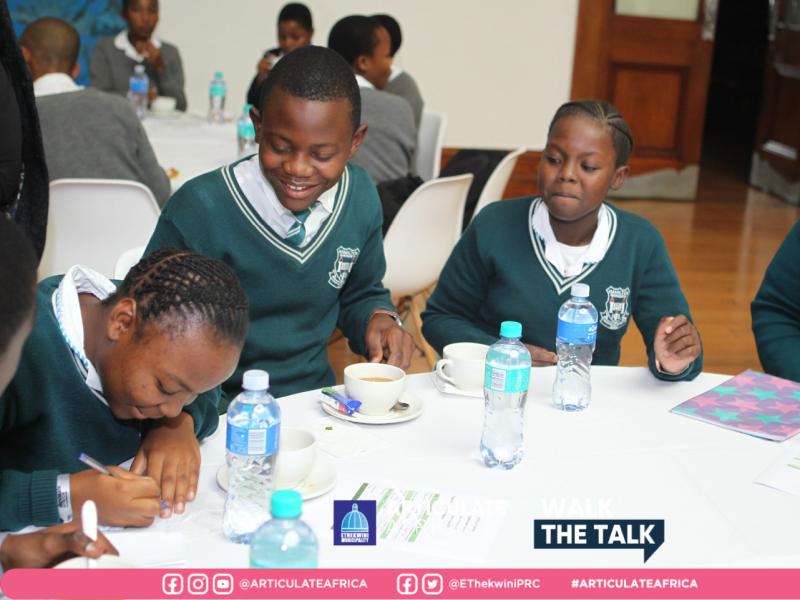
On 19 May I presented at a Climate Change Seminar, under the slogan ‘Walk the talk’. It was part of a three-day-long Articulate Africa Art and Book Fair, hosted by eThekwini Municipality’s Parks, Recreation and Culture Unit. The seminar was attended by around 60 learners from 6 schools, along with around 40 teachers and local stakeholders.

The learners proved that they already know a lot about climate change. They got top scores for quiz questions about what the greenhouse effect is about, about the causes and effects of climate change, and whether scientists agreed on what was going on. Impressive!

BUT, as we reflected before, knowledge does not automatically lead to action. Despite two centuries of climate science, and decades of international negotiations and agreements, government policies are still taking us to 3°C global warming or more. Yet the dangers even of current levels of warming (1.1°C) are clear, just read the news.

The climate crisis is much too serious to wait for governments to act, or to tell us what to do. Instead we, civil society, need to act of our own choice, and put pressure on government and industry to do the right thing. Democratic governments may not listen much to the science, but they do have to listen to the people. So let us ‘walk the talk’.

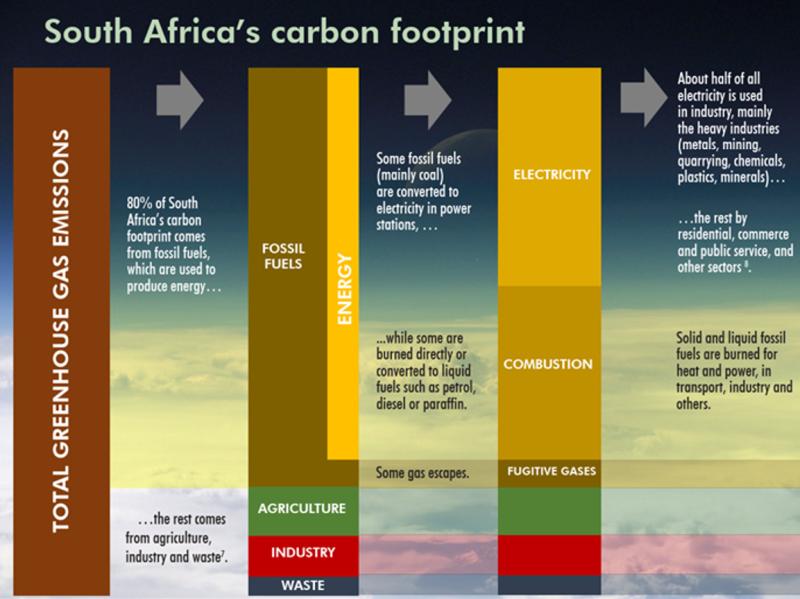
South Africa is the country with the 15th largest carbon footprint in the world. Climate change is not just someone else’s problem, but also ours. Page 6-7 in the booklet illustrates where all our country’s greenhouse gasses come from: 80% come from fossil fuels, about half of which goes to producing electricity from coal. To make a meaningful dent in our national carbon footprint, we need to reduce electricity consumption.

The residential electricity-related emissions can be very high, especially for appliances that are left running for many hours, such as air conditioners, heaters or geysers, and for those that involve heating.

The bar graph (on page 13 in the booklet) shows that electricity use in the home can generate many tons of carbon dioxide per year. How much is a ton?

In an interactive session, the learners at the seminar found out how to read and interpret a municipal electricity bill, and to calculate the electricity-related carbon footprint for a household.

Until renewable energy becomes a reality for all, we can respond to the climate crisis by reducing our electricity consumption. This also saves lots of money, given how electricity prices have sky-rocketed, and relieves the pressure on our struggling power grid. The checklist in the booklet shows many effective ways of reducing those kiloWatt-hours.

Let’s ‘walk the talk’ and save our planet!

Edu-ca/ac-tion Indaba

Ten days ago, supported by EThekwini Municipality and Green Corridors, around 100 environmental education / public awareness practitioners met for an Indaba to discuss how we can accelerate our joint response to the intensifying climate crisis, and to pull together an Environmental Education & Action Network.

The organizers invited me to open the discussion by talking about “What triggered you to start acting or doing what you do?” The same question was discussed among attendees later.

So here is the mystery: Why does knowing about a deadly danger not automatically cause action, or a change in behaviour? When and why do we act (differently)?

At a recent FAO webinar on environmental education, the presenters explained how knowledge about human behaviour can contribute to pro-environmental action.

According to Self-determination theory, humans need 3 basic psychological foods: Competence: being able to do things. Autonomy: having the freedom and power to be and do. Relatedness: being connected with others.

We do things, when we feel able, when we have courage to try: “I can do this, this is not beyond me. I have the capacity. I know what to do.” Knowledge and practical know-how are also part of it. Competence.

We do things when we have the freedom to do and act. “I can choose, nobody is forcing me, I can look and judge for myself, I can evaluate and make good decisions. I can find the means to do this.” Autonomy.

We do things when we can do it together. We need to know we are not alone, that there are others doing it. We even experience FOMO, the fear of missing out. Humans love getting together, agreeing on things, doing things with others who feel the same way, or doing things that bring us closer together. Relatedness.

One can design education programmes around this.

Individual behaviour can also change when systems are set up to make it easy.

“Environmental problems are collective action problems. Targeting individual attitudes and behaviours is not enough. We need to change the systems that influence our behaviours.” (S. Hanisch)
“Nudges: positive and gentle persuasion to encourage sustainable behaviour… Nudging is based on an understanding of the psychology of decision-making… We use mental shortcuts – do what everyone else is doing or take the easiest way… we follow ingrained routines or act on auto-pilot.” (from th booklet)

UNEP has published a downloadable Little Book of Green Nudges, that shows how this principle can be applied to encourage people to make sustainable choices. If you can offer pro-environmental, sustainable behaviour options that are easier than unsustainable ones, that are attractive, that promote togetherness or that show how you can join others who are already doing them, and if you offer these options at the right time and place, then there is a good chance sustainable behaviours will win over unsustainable ones.

E=Easy, A=Attractive, S=Social, T=Timely spells out EAST.

As EASTER Action, we would like to add ER: E=Effective and R=Responsible.

E for Effective. Lets make sure the ‘sustainable’ action is truly effective, no ‘green-washing’ please. For example carbon trading gone wrong. Or ‘recycling’ that does not work as promised, and only excuses the abuse of plastic. Or thoughtless ‘tree planting’. Or switching off every little LED light, while leaving the geyser set to 70°C day and night.

R for Responsible. Those of us who have the most and spend the most, are most responsible for the problem and therefore most responsible to act (differently). People cannot consider the environment or the climate when their families are hungry, or plan for tomorrow when today is not taken care of. “Leaving no-one behind” is a key principle of the Sustainable Development Goals.

These were mentioned as caveats, but are best included up front.

So when did I start acting on climate change and the environment? I started eradicating exotic plants when it was my little part of nature, not someone else’s (ownership? custodianship?) and when I learned to tell alien from indigenous plants. I started acting on climate change once I realized just how big and bad my personal contribution was, and when I knew what actions would make a meaningful difference.

My little patch of indigenous swamp forest. My piece of nature. Mine to cherish and to protect. (Not as in ‘mine mine‘, but more like ‘my’ family, ‘my’ children: I love them and I am responsible.)
Oh the shock, realizing that one short drive into town and back home produces 10kg CO2 emissions! … Oh the joy, being able to avoid several tons of CO2 emissions per year for electricity!

Climate Action Programme

On Youth Day (24 June 2022) the South African Youth Climate Change Coalition (SAYCCC) ran a workshop in Durban to strategize how to ramp up climate change action and activism, now that Covid-19 restrictions have been relaxed.

It was a timely opportunity for EASTERaction to hand out copies of What I Can Do About Climate Change booklet, and to present our plans for a brand new Action Programme to go with it, which we hope to roll out over the next year.

Participants included representatives from SAYCCC-affiliated climate action groups such as Durban South Peacebuilders, Durban Youth Climate Council, eThekwini municipality, Green Anglicans, Ray Nkonyeni Municipality, uShaka Marine World Education, Vascowiz, and our lovely local beauty pageant, Miss Petite Globe SA, Zoe Nyandeni, who wants to help spread the word on climate change and sustainable living. Go Zoe!!

The booklet was originally written to inform eThekwini municipal councilors about personal climate action. One day before our workshop, the booklet was distributed at a climate induction workshop run by the Environmental Planning and Climate Protection Department.

Thank you SAYCCC for this opportunity and for your enthusiasm! We very much look forward collaborating on ‘the biggest challenge facing humankind ever’.

Exhibition at Durban Natural Science Museum

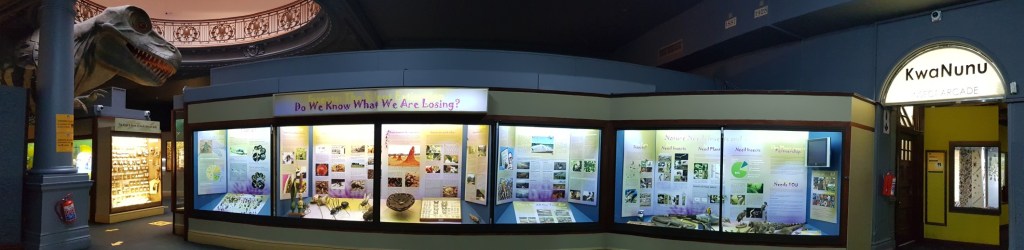
It was a bitter-sweet experience, seeing (yesterday, for the first time!) the temporary insect exhibition at the Durban Natural Science Museum. Charles (aka Andrew) Carter and I had spent so much time working on this back in 2018 and 2019. In January 2020 he was still putting the finishing touches on it… when Covid-19 struck.

Entitled Insects: the silent extinction. Do we know what we are losing?

It will still be up for a week or two. For directions click here.

One of the world’s largest insect: the Goliath beetle.
Content from the book What Insect Are You? and specimens from the museum’s insect collection.
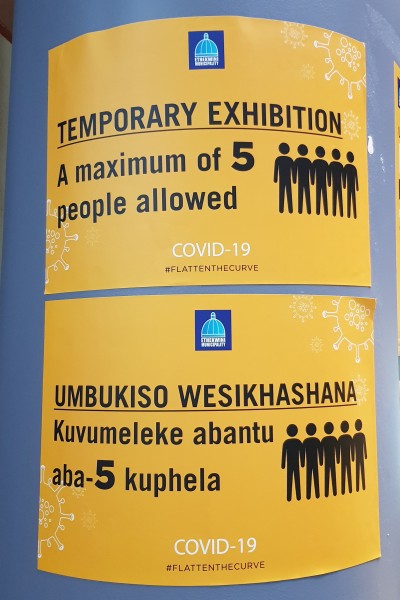
Covid-19 restrictions prevent group events

The information came to a large extent from the book What Insect Are You? and from follow-up educational events offered under its banner. The specimens came from the museums’ amazing insect collection. (It so happens that the curator of this collection used to be Kirstin Williams, one of the experts who reviewed the book.)

T. rex wonders “Why did those things survive and I didn’t?”

The exhibition went up without warning or fanfare in 2020. It was mentioned briefly in Thola magazine Volume 21 (page 23), but due to Covid-19, visits to the museum by school groups slowed to a trickle. It would have been great to run educational events there, for school children and the public. But alas!

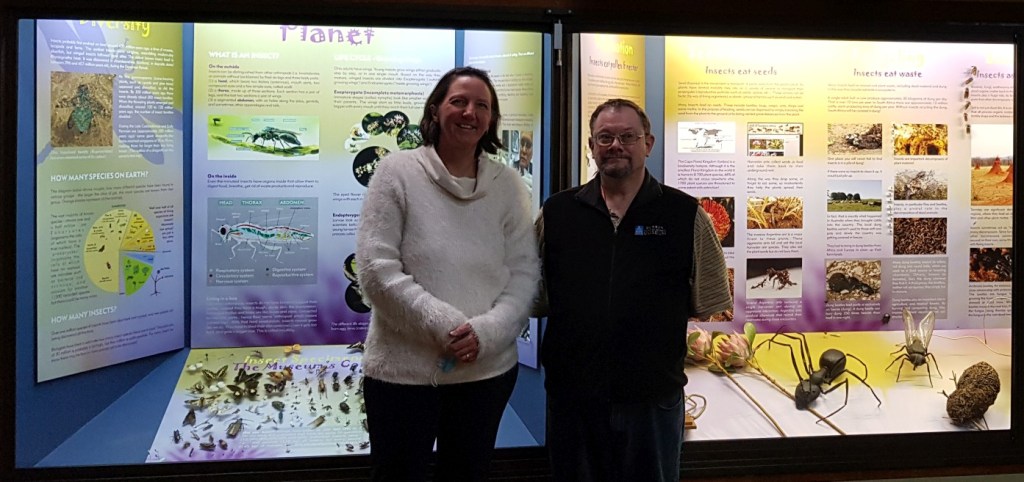
Marlies Craig (of EASTER Action) and Charles Carter (of Durban Natural Science Museum)

By the end of this month (August 2021) the exhibition will be removed, to make space for the next. Perhaps we can find a new home for it? Thanks again Charles for your hard work bringing it to life. And thanks to Durban Natural Science Museum for spreading the word that insects are our life support!

Children and Youth Festival

The UKZN School of Education “recently hosted its inaugural two-day Children and Youth Festival on the Edgewood campus where participants were able to explore … an insect display” among other things.

Luckily I had managed to find a couple of specimens in the garden that were featured in my book. Apart from the caterpillar, they were all predators: the antlion larva, a young flower mantis, an assassin bug, aquatic elephant mosquito larvae and aquatic dragonfly larvae. (Click on the links to read the respective pages in the book.)

So the kids could not only hear amazing stories about them and see them in the book, but also meet them live and study them closely, aided by a digital endoscope which magnified them on a laptop screen.

Children got a magnified view of live insects on a laptop screen, with the aid of a digital endoscope.

Insects at the do-ference

During an educational event at the Environmental Sustainable Action and Community Development Conference/Do-ference in April 2018, I asked a group of grade 11 school kids this very question. Like many folks, most of them had not thought much about insects until that moment.

insects doference

They are irritating. They sting. They eat our vegetables. They make honey. They pollinate flowers.

That was kind of it.

It was such fun telling them about the many crucial roles insects play in nature, how we couldn’t exist without them, and then sending them on an insect treasure hunt outside. There was a map to follow, instructions to read, insects to spot, questions to answer…

treasure hunt doference

Now watch this:

Don’t you love it? The entomologists of tomorrow…

This is the result you get when introducing children to insects.

2020Vision was an official partner of the Environmental Sustainable Action and Community Development Conference/Do-ference 4 – 6 April 2018.

doference

Insect photography 2 – Shoot ’em Live

When shooting insects in nature, one faces a number of challenges. One challenge is the eternal trade-off between motion, light and depth of field. Another challenge is focusing on a small moving target.

shooting insects.jpg
Hillcrest Camera Club insect-hunting

Depth of field

When the camera is very close to the subject, as in macro photography, the depth of field can shrink to a mm or less, and it becomes difficult to get the whole insect, or even part of the insect, in focus. Here are several solutions:

1: Set the F-stop as high as possible: nothing less than 11, better nearer 20, ideally more – depending on other factors, like the size of the insects and available light.

Fstops.jpg

2. To get more of the insect in focus, align it side-on.

side on caterpillar.jpg

3. Line up all the important bits so they are the same distance from the lens, and allow ‘extraneous’ bits get out of focus.

side on wasp.jpg
In this (braconid?) wasp the feelers, eyes and sting are all essential features. Lined up exactly at 90 degrees to the lens, they all end up in focus. The feet are less important.

4. Stacking: take two (or more) photos of the insect in the same position, but focus at different levels, then copy the sharp bits from one photo to the other. This usually only works when the insects is sitting still.

stacking.jpg
1+2=3

A form of ‘stacking’ can even be done on two completely different images:

firefly.jpg
The firefly’s face was pretty in (1), but its bum was better in (2). So I copied and pasted the rotated light organ from (2) onto the behind of (1). Cheating? Yeah. I guess so. A little.

Motion

Macro photography magnifies movements: whether it is the insect that moves, or a breeze blowing the leaf it is sitting on, or your hand that shakes because you are squatting in an awkward position…

1. Speed: turn up the speed, ideally to over twice the focal length of your lens (i.e. a 100mm macro needs at least 1/200th of a second, ideally more).

movement.jpg
This photo, taken with a 100mm lens, at 1/200s, shows different levels of movement: the flower is stationary, the beetle wiggling slightly, the butterfly in full motion.

2. Fridge: some people like to refrigerate insects to slow them down temporarily. I don’t find this method very useful. One, where are you going to find a fridge when you are out in the bush? Two, how long do you leave it in for? Three, they end up in unnatural, dead-looking postures. Four, they warm up real fast, so by the time you have ‘arranged’ their limbs to look more ‘natural’, they are waking up. Having said that, I have used this method successfully on one or two occasions.

fridge beetle
By the time I had taken this beetle from the fridge in the kitchen out into the garden and arranged him comfortably on a leaf in the sun, I had a few seconds left before it woke up and scuttled away.

3. It is more useful to trap the insect under a glass, on a suitable substrate, and then simply watch and wait. They do eventually get tired from all the rushing about. In the meantime, get your camera ready and focused. When the insect stops to catch its breath, carefully remove the glass and shoot. When they start running, simply put the glass back. Repeat, until you get the perfect shot…

mutillid.jpg
This busy mutillid wasp – a wingless female – was running errands. Under a glass she eventually paused – just long enough for a photo or three.

4. Hyper-active insects can sometimes be subdued with a bribe: place a drop of sugar water on the substrate (in this case I had chosen a smooth stone) and move the jar over the drop. Wait for the insect to start drinking, then carefully remove the jar and take your shot.

fish bowl.jpg
Is it wrong to shoot wildlife at a watering hole?? An energetic mutillid wasp – this one a winged male – did not stop buzzing around until I gave him a drink .

5. To shoot insects on flowers or leaves, when there is a breeze, operate the camera with one hand and hold the flower with the other. Just don’t jerk the flower in an unnatural, non-breezy way that will startle the insect.

hold the flower.jpg

Light

sunlight.jpg
Bright sunlight is nice, if you can get it. Here are three different amazing flower chafers. Yes, it is spring time!

High speed and high F-stop settings reduce the amount of light available, resulting in an underexposed photo in all but the brightest sunlight. What to do?

1. Increase the ISO setting. At super-high ISO the picture ends up grainy, but often photo clarity is still totally acceptable at ISO 2000 or even higher. Play around with your camera so you know what results to expect.

2. Insects often have shiny exoskeletons which reflect the sunlight unpleasantly, hiding interesting patterns and colours. In such cases muted sunlight or light shade works better, if you can arrange it.

reflected sunlight
When bright sunlight doesn’t work.

3. In the absence of sunlight, the obvious – and often the only – solution is using a flash. However, the flash comes with its own set of problems (more about this in the next installment).

metallic darkling
Problem situation: a busy, dark, shiny, metallic beetle on a darkly overcast day. The flash fails completely. The dark integument absorbs most of the light, except for a few brilliant reflections, and masks the beautiful metallic sheen. But without flash, automatic settings (in this case 1/125s, F6.3, 400 ISO) simply don’t work: the colours are fine, but depth of field and motion is hopeless.
shiny beetle.jpg
The next time went better: 1/160s, F10, 1250 ISO.

Combining these in the field

I usually start by taking a ‘recording’ photo’ (“I saw this insect”) using a flash with the following settings: F22, 1/200s, 200 ISO (on my 100mm macro lens). Easy numbers to remember.

Then, if there is enough light, I set ISO to auto, and take some more photos at F11+, 1/200s (or more if there is a breeze) – assuming the insect is still there of course.

If light conditions are such that the ISO goes above 6000, I set the camera to manual: 1/200s, f-stop 11 (or 8 in an absolute emergency), ISO as high as possible without ruining the photo due to graininess. If the photo ends up vastly under-exposed, this can often be fixed in an imaging software.

chafer.jpg
An extreme case of bad photo conditions: overcast day, deep shade in the undergrowth, strong wind, busy beetle. I maxed out the ISO (6400), upped the speed to 1/400s, set the f-stop to 10, and then processed the grainy and under-exposed photo. Result: not perfect, but usable.

Focus

I use the auto focus only on large insects that are sitting still. For instance when shooting basking butterflies with a tele lens.

The rest of the time I ‘lock and rock‘ in manual focus. Meaning I focus approximately, then fine-focus by moving the camera back and forth ever so slightly, closer and nearer to the insect. (I don’t try move my entire head with the camera. Such movements are too clumsy. I keep my body still and move the camera closer and nearer to the eye.)

If the insect is perching on a branch or flower, I may operate the camera with one hand, and fine-focus by moving the perch with the other.

It is terribly easy to jerk out of focus just as you ‘pull the trigger’. The trick is to keep  one’s body dead-still, by sitting or kneeling good and proper, not squatting precariously, by leaning on elbows or against something, by leaning the camera against a solid object, or using a spare hand, wrist or knee as a temporary tripod.

Biodiversity in the school yard

Biodiversity.JPGWhat a wonderful topic: the endless variety of life forms and living spaces.

After a presentation on the subject, the grade 11s from the Umkhumbane Schools Project biodiversity group explored what lives in the car park at their school. The flowers on the waterberry trees were being eaten by a gazillion garden fruit chafers – a very common but nevertheless spectacular beetle.

Someone had donated a microscope to the group. That was a big hit! There is something special about seeing the life forms that exist beyond our immediate experience – and it so happens that the vast majority of species, numbers and biomass is on the tiny to microscopic end of scale – like this springtail which is less than 1mm long.

What a bunch of enthusiastic, fun young people! They give me hope for the future.

Outdoor Classroom Day

How does Outdoor Classroom Day work in densely populated areas of low-cost and informal housing? Just fine, thanks.

CatoManor 3

A wonderful afternoon with Umkhumbane Schools Project in Cato Manor, Durban, proved the point.

“Do you know what an insect is?”, “Have you ever seen an insect?”, “What insects do you know?”, “What do you think of insects?” The answers made it clear some of the kids had not even thought about thinking about insects.

Then they got a chance to stroke my enormous pet hawk moth caterpillar, to hold it, look it in the eye, they were both thrilled and ‘grilled’ (an Afrikaans word that means exactly the sort of shudder you get from a close encounter with an insect).

CatoManor
CatoManor 2

By the time we went outside to hunt for some insects in the school yard, they were totally excited. They whooped with joy when they caught an ant. Or a common house fly. One boy found a lovely stinging caterpillar, and so won for his school a copy of What Insect Are You, kindly donated by a member of Hillcrest Conservancy.

First “Half Earth Day”

Half Earth Day 2017

Today I stand with EO Wilson in heart and spirit, as he and his team celebrate the first ever Half Earth Day, and as they set out to protect and preserve half the earth’s surface to ensure that 85% of species have a chance to survive.

Watch a video at:

Half Earth Day 2017 video

HalfEarthDayKids

To mark the day, I visited a local school primary school and spoke to the Grade 6s about the environment, Half Earth Day and of course… insects!

Why do we need the Half-Earth Project?

Sixth extinction Time.jpg

Just so we are clear: things are really looking dismal. Extinction rates are 1000 times higher than before we spread across the globe.

Yesterday my mom asked, “Exactly why is that a problem?” (that from a life-long nature lover and bird-watcher!) Answer: because we are part of this vast interconnected web-of-life. If they go, we go. Perhaps not all of us, but too many to contemplate. And being left behind in a world depleted of biodiversity is, quite frankly, unimaginable.

For example, are you aware of how many of our food plants are animal pollinated? Do you like fruit and vegetables? Could you do without your morning coffee? Or chocolate? That was enough to convince my mother. Find out more.

Of course that is only one tiny part of it. The fact is, we do not exist APART FROM other life forms, but we are A PART OF life on earth. Read more:

Sixth extinction NatGeogr.jpg

Teachers: the door to a nation

Last week I gave a lecture to over 300 1st and 2nd year student teachers at UKZN School of Education, Edgewood Campus. What a thrill! I was delighted to discover that – truly – insects have universal appeal. The students exclaimed, laughed, participated enthusiastically, happily swept along by insect stories, which are always fresh and new and bizarre. The antics of insects can enthrall anyone!

They were particularly intrigued by different romantic strategies: from elaborate courtship dances in micropezid flies to the ‘run-and-jump’ manoeuvre of a male darkling beetle, from complicated sperm-transfer mechanics of damselflies to male-less, sperm-less cloning in aphids.

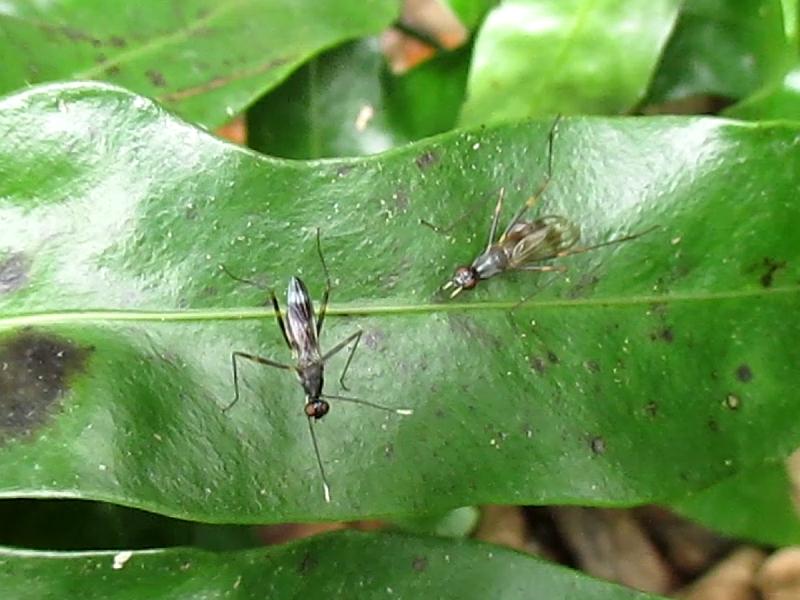
Micropezid flies: the female dances excitedly around a male, who looks like he is conducting the music and choreographing her moves.
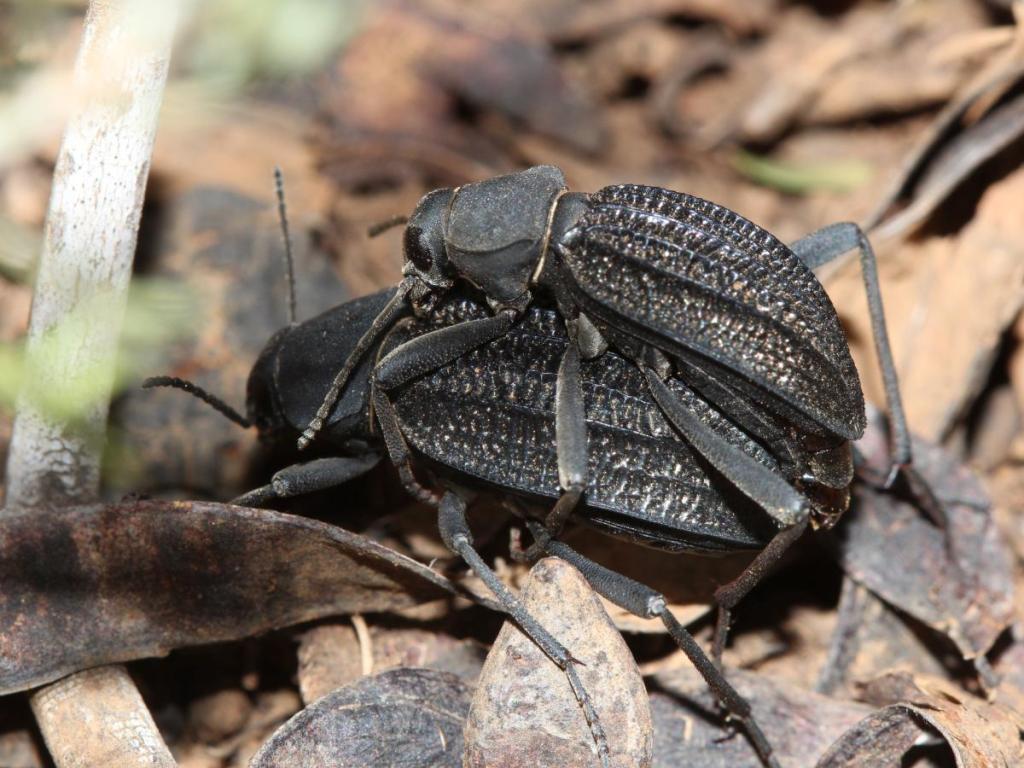
Darkling beetles mating

What really excited me that day was knowing over 300 young teachers are going out into the world, understanding that insects are the food base for most vertebrates, that insects need indigenous ecosystems to survive, and knowing of a few, simple things we can do to make a difference.

When teachers know something, there is the very good chance that very soon very many children will know the same thing. Teachers are the door to the nation.

In the light of this, we are soon announcing an exciting new project. Stay tuned..

Showing and wowing

Kids amazed

Last week I teamed up with CASME for two days of educational outreach at the American Corner in Bessie Head Library, Pietermaritzburg. Talking about biodiversity with about 150 high school kids was so much fun. Are you wondering what they are all getting so excited about? Science! Nature! Insects! Genetics!

stalk eyed flies
Stalk-eyed flies sizing each other up.

Insects are full of surprises, and there are so many of them, that one can never run out of fresh, interesting material. For example, we kind of know about courtship displays in birds. We may have seen male impalas battling it out to win the favour of their ladies. We know mammals feed their young with milk. But courtship, territorial battles and suckling of young – in flies???

The children were riveted by the idea that female aphids make ‘photocopies’ of themselves, then giving birth to these clones, which already have the next generation developing inside them. I mean, that’s just CRAZY!

Local Stalwarts of Conservation

I was recently invited to speak at the Hillcrest Conservancy AGM. It was extremely humbling and heart-warming to meet so many dear people (mostly pensioners), who for decades have put their time and effort into preserving parcels of our natural heritage. The current chair, George Victor, for example was instrumental in getting Springside Nature Reserve declared and protected (featured image).

These amazing people regularly go in, remove rubbish, clear out invasive aliens, organize walks and public events. They even run training courses for gardeners. Thank you! I salute you!

kloof gorge
Enjoying the beauty of Krantzkloof nature reserve, just 15min drive from our home!
nature reserves durban

There are many other amazing nature reserves in and around Durban (see map).

Kids just love nature

Yesterday I ran a small, intimate educational event with members of the environmental club of Danville Park Girls’ High School. There was a kiddies birthday party happening in the next clearing. Some of the children (arrow) left the party, and instead came over and watched.

They were very interested, participated in the insect hunt, stayed for the mini-SASS presentation by Lee D’Eathe, and were thrilled to look at the water creatures Lee had brought with him, through a digital microscope.

It was just plain wonderful, and tickled me pink, to witness such spontaneous enthusiasm. It confirmed everything I believe about children’s innate fascination with nature, and is exactly what we need to tap into when it comes to life sciences and environmental education.

Biodiversity Hotspot #27

Biodiversity_Hotspots

This weekend I participated in the Illovo Wagtail Conservation Festival. A local community concerned for their local environment, are trying to conserve the tiny little bit of it that is left.

Here in Durban we are privileged to live in the middle of one of 34 global biodiversity hotspots: the Maputaland-Pondoland-Albany ecosystem.

Continue reading “Biodiversity Hotspot #27”

The great insect hunt

Educational event with around 50 school kids grades R-9 at Paradise Valley, with extended insect hunt along the river. Thanks kids for being so enthusiastic!

One boy said, “I thought it was going to be boring, but it was so interesting!” I hear they went back to school and started digging for antlion larvae… That’s the idea, isn’t it?

The winning insect was a large longhorn beetle, the same species as on the back cover of the book.

However, I found my own special beast that day, crawling across a rock in the river: a rove beetle of the genus Paederus.

Some members of this group are loaded with pederin, a nasty toxin that causes painful burns and blisters when the beetle is crushed on the skin. In fact, these insects could be the culprits behind the sixth plague of Biblical Egypt.

Um, I didn’t check whether this particular individual was toxic… I let it live.

Insects in the food chain

The presentation at the Bird Life Forum meeting (at WESSA, Howick) again started by explaining the role that insects play in nature, but then looked more closely at who else in the food chain relies on insects.

It turns out insects are on the menus of the vast majority of other animals. But even pure herbivores rely on insects indirectly, because around 80% of plants need insects to pollinate them!

Insects and plants are locked into a close partnership. Together they form the bedrock of every ecosystem outside of the oceans. This world cannot exist without insects. 

The problem is, often we expect it to…

Insects eat indigenous plants – just about only. By allowing our land and gardens to be overgrown by exotic plants, we deny insects their food. No insect food means no insects, which means no food for other animals. In some places the food web has as good as collapsed.

The solution is to get rid of the aliens and to plant indigenous trees. Trees are the key: their size and biomass provide insects with a banquet of suitable food. More food means more insects, which means more birds, reptiles and other insect eaters.

Now we have the beginnings of a healthy ecosystem, where many species co-exist and keep each other in check. Suddenly one can plant all those lovely indigenous flowers and bushes, that only get eaten if one tries to plant them in an otherwise exotic garden. It all starts with trees!

Several members from the audience said afterwards they planned to go home and take a fresh look at their own gardens. Yay – mission accomplished!

Insects are everywhere… or are they?

An educational event for Botanical Society, at Durban Botanic Gardens.

The first talk, entitled “Insects at work”, showed the important role insects play in nature, as farmers (pollinating flowers and dispersing plants seeds), in the food supply chain (eating each other and being eaten), and in the waste management and recycling department. Insects, in a tight partnership with plants, are the bedrock of the rest of nature (outside of the oceans).

Most of the folk then took part in an insect hunt experiment of sorts: the aim was to spot and record as many insects as possible in eight designated sampling sites, half of which were indigenous, half exotic plants.

What’s the big deal with invasive alien plants? Why all the fuss? Well when you look at the role insects play in nature, and how invasive aliens stop insects doing their job, it all starts to make sense. This was the subject of the second talk, which asked the crucial question, “So DO insects live everywhere?”

Learning nature

A paper published on how Grade 10-12 kids respond to the school life sciences curriculum concluded that more emphasis needs to be placed on what learners are interested in.

The most important aspect of science and environmental education is to tap into children’s natural curiosity. As homeschoolers we know that children love to learn. They are programmed to learn. Tell them interesting stuff, in an interesting way, and they want to know more.

The better we know something, the more we appreciate it. And the more we appreciate it, the more invested we become: we want to protect it, preserve it. “Why do we harm nature? Because we are ignorant.” (P Cafaro*)

Insects make up well over half of all known life forms. They are also the most accessible of wild animals: they are everywhere, no trips to game reserves required. They are small enough to get close to and handle, but large enough to observe clearly. And they are infinitely fascinating.

So I reckon telling kids – as many as possible – about insects, is the best way to breed the next generation of ‘keepers of Mother Nature’. And she will need many many keepers to survive.

* PS: The full conclusion to Philip Cafaro’s brilliant essay reads: “Why do we harm nature? Because we are ignorant. Because we are selfish. Because we are gluttonous, arrogant, greedy, and apathetic. Because we do not understand our obligations to others or our own self-interest. We falsely assume that we can keep separate harms to nature and harms to humanity, harms to others and harms to ourselves. We do not see that environmental vices do not just harm nature; they harm us and the people around us. As I have shown in this essay, many of these harms are scientifically verifiable; the rest can be understood by anyone with open eyes and an open heart. The environmental vices are bad for us and bad for the Earth. For better and for worse, we really are all in this together.”

Homeschoolers in Paradise

The first educational event for local home-schoolers, at Paradise Valley Nature Reserve was a great success. The children (and parents!) were such a joy with their interest and enthusiasm. 100 people came!

With lots of insect photos and videos, the presentation shows how insects hatch and grow up, how they breathe (in air and in water), how they feed (different diets, different equipment) and how they stay alive (mimicry, camouflage and other more exotic predator avoidance strategies).

By the end of the presentation everyone was just itching to go insect-hunting. No killing of course, just catch, look and release.

There were some lovely results. Many kids found the skins of cicadas clinging to tree trunks, which have been emerging from their long underground existence, in time for Christmas. Others found crane flies, a soldier fly, a miniature ladybird, damselflies, antlions – both pit building and roaming, some interesting bugs, and many more.

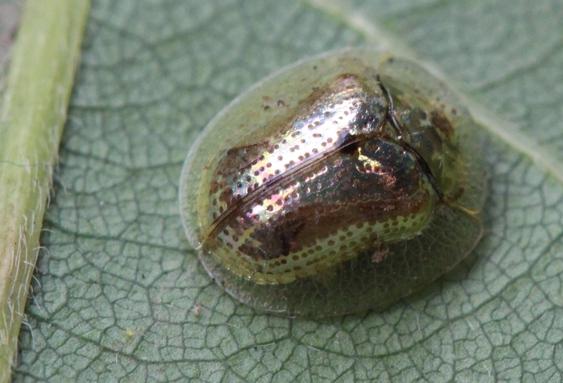
The hands-down winner: a Fool’s Gold Beetle. This is a tortoise beetle of the leaf beetle family.

A fool’s gold beetle.