With arbour week coming up, this is the perfect time to share the fourth and final instalment on the temporary insect exhibition, which went up at the Durban Natural Science Museum back during the COVID pandemic.
The message is (spoiler alert): It’s all about plants!
This last article will cover the last major role of insects: being food for others. Then we ask: if insects are so important for the survival of nature as a whole, what do insects need to survive? How important are insects in nature, as a sum total of all the roles they play? And what is our role in all of this?
Recycling is THE single best known ‘green’ concept, I reckon. Say ‘environment’ and the answer is ‘recycling’. It’s what kids are taught to do at school, it’s what labels on plastic products claim they (can) do, it’s what any environmentally-minded and nature-loving person is honour-bound to do.
But does it work??? No.
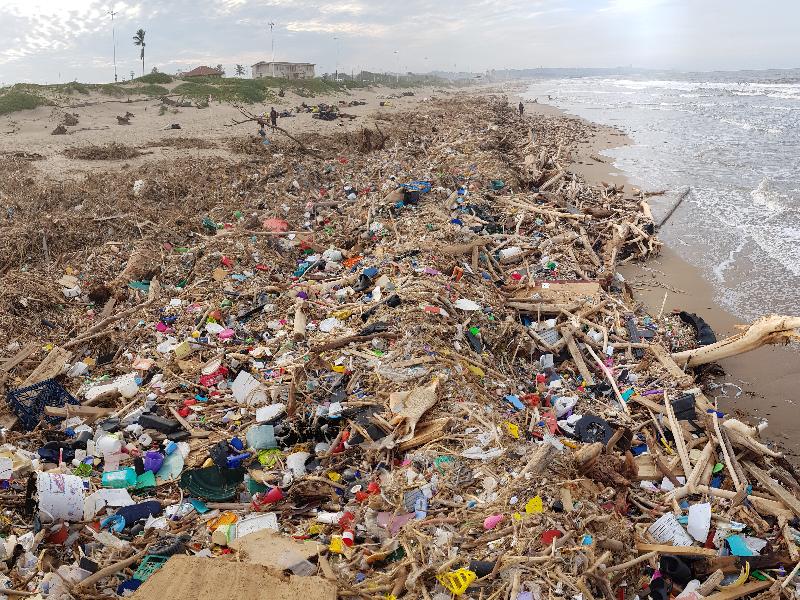
In South Africa, at least 90% of our 54 million plus tons of annual waste lands up in landfill sites, or is just dumped anyhow and anywhere, spoiling nature, and often ending up in the sea.
Durban beach after the April 2022 floodsPlastic, Styrofoam, rubber from peoples’ daily lives.
Sure, recycling generates income for nearly a quarter of a million waste-pickers and powers South Africa’s recycling economy, but… should it have to? Banning so-called problem plastics (including polystyrene containers, plastic cutlery, food sachets and snack packaging) would actually boost the economy.
Waste pickers have separated out the ‘good’ stuff.Durban municipality cleaned up the rest.
According to Greenpeace, four years ago 34 out of 54 African countries had passed laws banning single-use plastics, or were planning to, but real-life results are far from encouraging. Even though South Africa made it onto that list, it is apparently the world’s 11th-biggest litterbug.
Recycling is NOT the solution to the problem of plastic. The Fraud of Plastic Recycling describes “how Big Oil and the plastics industry deceived the public for decades and caused the plastic waste crisis.” Separating fact from convenient fiction and plenty other online articles debunk myths around recycling. Even the word ‘litterbug’ was invented in “sophisticated marketing campaigns to shift blame from producers to consumers”, while plastics companies fought tooth and nail against anti-plastic laws and bans.
As a consumer I really struggle to avoid buying unwanted plastic with my groceries. Every time I challenge a shop manager on their excessive use of plastic, their excuse is ‘consumer pressure’ FOR small and tidy portions wrapped in duplicate or triplicate. I’m not sure if this is just an excuse, or if they really do get customer complaints like “I demand my food is wrapped in more plastic”. When will we as consumers put our foot down on this issue?
In the meantime, and even though I know it mostly doesn’t work, I recycle faithfully. What else can one do? For three years I collected all the empty milk bottles our family was using, planning to organize a ‘bottle garden workshop’ some day. But I never got around to it, and the bottles piled up. And up.
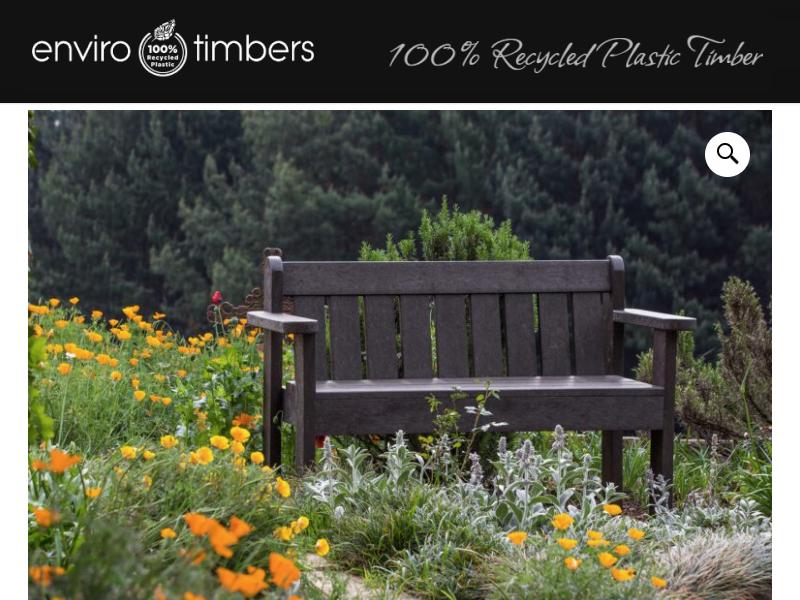
3 years of milk consumption by one family!Plastic resurrected as furniture
Today, on World Soil Day, we celebrate the fact that healthy, living soil in nature is full of dead things, dung, fungi, gazillions of tiny creatures, bacteria and nutrients – just what plants need to grow, in their great variety, producing biomass, and generating food for everyone. Let us remember that in nature we all eat, poop and die.
This World Soil Day I want to share my experience with recycling human waste. Discarding our precious waste is such a waste! And flush toilets waste precious water. A human composting toilet saves both water and nutrients to fertilize the garden.
I’m not crazy, and I’m not the only one doing this! One can even buy human composting toilets online. But I didn’t want to spend loads of money on fancy equipment or install something I might regret. Instead, I attached an old broken toilet seat to an old plywood plank, and laid it across the bathtub which we never use anymore (because we take short showers to save water), with a bucket underneath, and another bucket with compost.
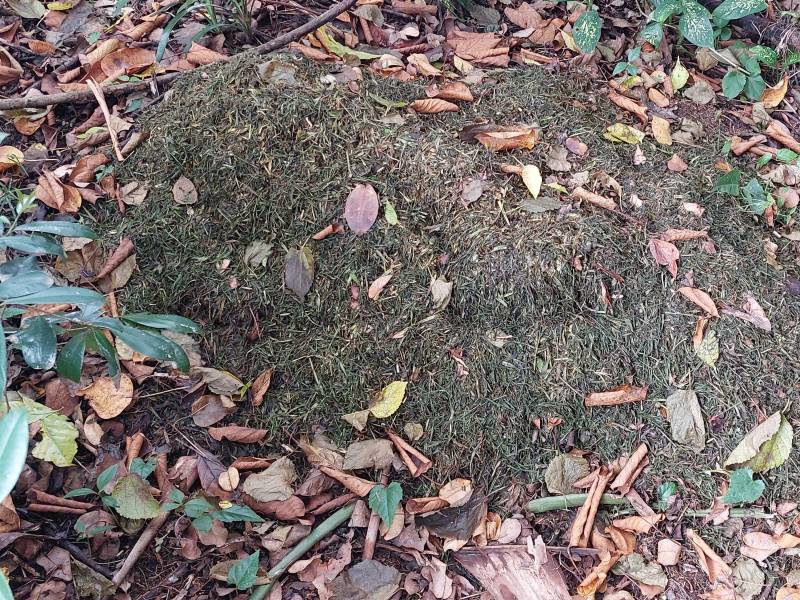
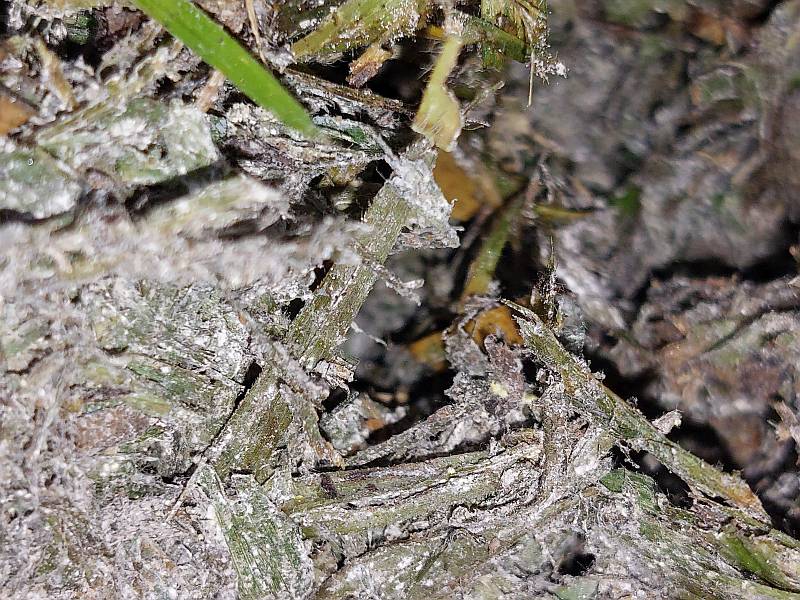
I tried both well-decomposed leaf litter from a compost heap in the garden, and fairly recently cut lawn clippings. (We dump cut grass in a pile under a tree. After 2-3 weeks it turns white, covered in mold.) Both kinds of compost worked fine.
A pile of lawn clippingsInside, fungi start the decompositionWhite fungal growthMy very own human composting toilet system (not copy-righted).
It’s very simple: 1) scatter some compost in the bottom of the toilet bucket, 2) do your business, 3) cover the business with another two handfuls of compost. Ok, and then put a lid on.
Surprisingly, it does not stink. The compost seems to absorb the bad odors. All you smell is the pleasant forest fragrance of the compost itself. It’s best to keep the solids and liquids separate, so don’t pee in the bucket with the solid waste. (Diluted urine can be used separately as fertilizer.)
Anyway, every week or two I emptied the bucket it into a compost box. This didn’t stink either. After several months I kind of lost interest in the experiment, but the pile of sh*t continued to do its job, and a year later I found a load of beautiful ‘brown gold’: high quality fertilizer for my garden.
Brown gold: rich natural fertilizer
To do this permanently, one would have to rotate through two or more separate compost boxes, to give each batch a chance to decompose fully.
What about contamination and disease? Helminth eggs and protozoa cysts die off at a certain rate, depending on various factors such as aeration, temperature, moisture and sun exposure, so the compost becomes safe after a certain time – anything from 6 months to 2 years. The climate, the setting, the material mixed with the waste, all play a role. Digging the compost under the soil instead of sprinkling it on top increases safety. I can’t help thinking my approach of adding ‘living’ compost from the garden would have sped up the natural composting process. For further information, this detailed report is a useful source.
My biggest problem was convincing my family to help collect this ‘brown gold’. They understand in principle why it is a good thing, but I suppose we have all been conditioned to consider our waste disgusting, rather than natural and useful. “Expand your mind, allow yourselves to think new thoughts, try work with me, this is just one more way to live sustainably,” I tried to motivate them. No success (yet). Maybe some day we won’t have a choice.
Seeing how that flooding event here in Durban damaged so much infrastructure, including sewers and water purification plants, and seeing how a year later raw sewage was still flowing in our streams and onto our beaches, made me think how with climate change we can’t take things for granted anymore. Perhaps I’m being over-dramatic, but there may come a time when we will have to manage our own waste, who knows. Best to be prepared. It’s called disaster readiness.
The theme of this year’s World Environment Day is “Only One Earth“. Over the past year the Intergovernmental Panel on Climate Change (IPCC, a United Nations organization) has released three key climate reports, that have one single, resounding message: We are in crisis. Or in the words of the UN Secretary General: this is “Code Red for humanity”.
As one of the IPCC support staff, I have read and re-read several drafts of these reports, as well as the Special Reports released in 2018 and 2019. “Every year matters!” the first one said. But a year ticked by. And another. And another. And another. The crisis is upon us, and still we are dilly dallying, carrying on as before. It scares me how much is known, and how little is being done. It is surreal.
This year Durban got flooded – one of the worst floods on record. But… we mopped up the mess, made (or started to make) repairs, and carried on. Six weeks later it happened again! Disasters like this will keep getting worse and happen more often.
Today, on World Environment Day, EASTER Action would like to thank and congratulate the hundreds of scientists who contributed towards the IPCC reports, who spent so much of their time and energy, often under extremely difficult situations, to bring together, assess and summarize the latest, up-to-date information on climate change, and to map out the options. Thank you, thank you, all you dear people! And well done! Thanks to you we know what to do next.
May the world listen to your warning, and do what needs to be done, to save this one and only earth, our home, and all its children.
We highly recommend these brief 2-3min trailers. They are beautifully made and give a fantastic overview of the current state of climate science.
The latest reports (2021/2022):
The Physical Science Basis
Impacts, Adaptation and Vulnerability
Mitigation of Climate Change
The Special Reports (2018/2019):
Special Report on Global Warming of 1.5°C
Special Report on the Oceans and Cryosphere
Special Report on Land
About the IPCC and the current assessment cycle.
See the IPCC channel for more videos on the various press conferences etc.
The theme for this year’s World Environment Day is: It is the Time for Nature. This coronavirus pandemic is in many ways a result of humanity’s unsustainable relationship with nature. But it is also an opportunity to think carefully about where we are going.
On this day we would have loved to invite folks to a live event at one of our beautiful nature reserves, but here we all are, in lock-down! Instead we decided to release a 40 min video on “how all living things on Earth are connected in the web of life“, by looking more closely at the biggest cog in this complex clockwork: insects.
After a brief introduction on species population trends, biodiversity and biomass, the presentation goes through some of the major roles that insects play in the food web and in nature generally, which then clearly points to what we can do to help and “how we can act for nature“.
We would value your feedback. Please fill in the survey.
So the kids could not only hear amazing stories about them and see them in the book, but also meet them live and study them closely, aided by a digital endoscope which magnified them on a laptop screen.
Children got a magnified view of live insects on a laptop screen, with the aid of a digital endoscope.
I recently visited Incheon where I was struck by the Korean government’s efforts to create a very dense and green city (featured image).
Trees in cities hold great potential for their cooling properties and carbon sequestration, for ground stabilization and water absorption, biodiversity and biophilia, food and fuel, etc. This article on urban tree-planting is part of a collection of opinion pieces on “empowering cities to plan for a positive natural future” recently published The Nature of Cities.
In this article I wrote, Plant indigenous trees! Everywhere, always, more! – Retrospectively, I would like to add “…but without thereby altering existing healthy ecosystems.” Planting trees in existing savanna or wetlands for example, does not benefit nature.
The beautiful Common Striped Hawk moth (Hippotion eson) eats our local arum lily (Zantedeschia aethiopica), but refused a range of common, exotic garden plants of the same family (Araceae – below).
So what?
Well, this was a little experiment in my own garden, that illustrates (1) what fussy eaters plant-eating insects are, (2) why exotic (non-native) garden plants always look so perfect (they don’t get eaten), (3) therefore, why they hardly contribute to the food chain, and (4) why, if you truly love nature, you should plant indigenous plants.
They are irritating. They sting. They eat our vegetables. They make honey. They pollinate flowers.
That was kind of it.
It was such fun telling them about the many crucial roles insects play in nature, how we couldn’t exist without them, and then sending them on an insect treasure hunt outside. There was a map to follow, instructions to read, insects to spot, questions to answer…
Now watch this:
Don’t you love it? The entomologists of tomorrow…
This is the result you get when introducing children to insects.
Today I stand with EO Wilson in heart and spirit, as he and his team celebrate the first ever Half Earth Day, and as they set out to protect and preserve half the earth’s surface to ensure that 85% of species have a chance to survive.
Watch a video at:
To mark the day, I visited a local school primary school and spoke to the Grade 6s about the environment, Half Earth Day and of course… insects!
Why do we need the Half-Earth Project?
Just so we are clear: things are really looking dismal. Extinction rates are 1000 times higher than before we spread across the globe.
Yesterday my mom asked, “Exactly why is that a problem?” (that from a life-long nature lover and bird-watcher!) Answer: because we are part of this vast interconnected web-of-life. If they go, we go. Perhaps not all of us, but too many to contemplate. And being left behind in a world depleted of biodiversity is, quite frankly, unimaginable.
For example, are you aware of how many of our food plants are animal pollinated? Do you like fruit and vegetables? Could you do without your morning coffee? Or chocolate? That was enough to convince my mother. Find out more.
Of course that is only one tiny part of it. The fact is, we do not exist APART FROM other life forms, but we are A PART OF life on earth. Read more:
I had never been terribly interested in fungi, until our recent visit to Ngome forest. One just couldn’t help falling in love with these little-known, little-appreciated ‘completers of the food chain’. Their beauty and variety was shocking.
Not sure why I’m posting fungi on this insect site. To share it, I guess, so someone else can go “WOW!”
Of course there were also plenty of insects . I was particularly intrigued to see a bugweed (Solanum mauritianum) apparently getting eaten by ladybird beetles. These horrible local invasive alien plants are normally in perfect condition, because they are so very unpalatable to our local mini-fauna. (Yes! Some ladybirds are herbivores. They are often furry, like these ones.)
Another very interesting sighting was a dead ant. Huh? Yes, an ant that had clamped its jaws tightly onto a twig and died there. A fungus seemed to be growing out of its head. This is a macabre story: the fungus produces brain chemicals that control the ant’s mind, forcing it to do exactly what this ant had gone and done: wander around like a zombie… clamp down and die… become fungus food (read more here).
I was recently invited to speak at the Hillcrest Conservancy AGM. It was extremely humbling and heart-warming to meet so many dear people (mostly pensioners), who for decades have put their time and effort into preserving parcels of our natural heritage. The current chair, George Victor, for example was instrumental in getting Springside Nature Reserve declared and protected (featured image).
These amazing people regularly go in, remove rubbish, clear out invasive aliens, organize walks and public events. They even run training courses for gardeners. Thank you! I salute you!
Enjoying the beauty of Krantzkloof nature reserve, just 15min drive from our home!
This weekend I participated in the Illovo Wagtail Conservation Festival. A local community concerned for their local environment, are trying to conserve the tiny little bit of it that is left.
Here in Durban we are privileged to live in the middle of one of 34 global biodiversity hotspots: the Maputaland-Pondoland-Albany ecosystem.
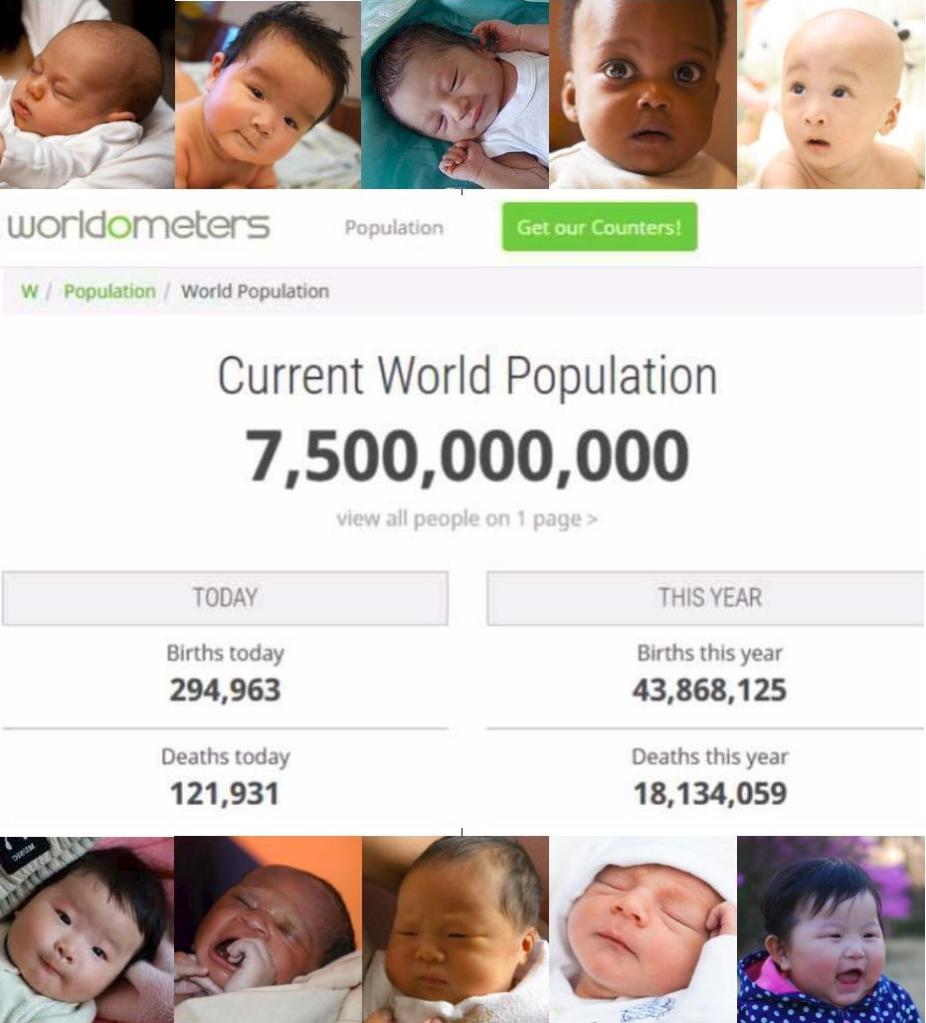
Yesterday, 24 April 18h21 local time, our family watched as the world population clock ticked from 7 499 999 999 to 7 500 000 000. 7.5 billion humans! Each one infinitely precious and worth saving. I know what it feels like to long for a baby agonisingly, to lose one, to give birth to one, to love three.
All these people have to eat and live. Unfortunately we want more than that. …”the lust of the flesh and the lust of the eyes and the boastful pride of life”… (1 John 2:16). What we are doing to earth in our selfish greed is frightening (see WWF and WRI reports).
The problem with us humans is not so much our numbers, but much more so, our gluttony. 2000 years ago people used up very little energy to live: less than 5 Gigajoules per person. 200 years ago we were using around 23, today it’s 75 (V Smil). And that is not just because we live two to three times longer nowadays; our entire life style is simply very expensive to the environment.
Some of us gobble up more than others: 16% of all people – the rich and those living in rich countries – use up 80% of all goods (like meat, cereals, paper, fuel and cars). Sad to say, I’m one of those. Click here to find out how rich you are. Not only that, a lot of food gets wasted: in rich countries like USA and UK around 40%!
Some of us are consuming WAY too much of earth’s limited resources. Even while others are starving. WWF estimates that it would take a year and a half to produce the resources we use up in one year, which means we are literally eating up our own earth. And in our carelessness we are damaging earth so that it can produce less now than it used to.
I love the way the Bible says it:
“Are not two sparrows sold for a penny? Yet not one of them will fall to the ground outside your Father’s care. And even the very hairs of your head are all numbered. So don’t be afraid; you are worth more than many sparrows.” (Matthew 10 v 29-31)
Sparrows – lowly, common birds – not even bird lovers value them very highly. We may undervalue nature, God does not. He cares about every last detail.
He values humans higher, but he does not forget nature. This is the only attitude that will get us to the right answers and solutions, environmentally speaking.
Gave a lecture at Edgewood Campus (UKZN) on 21 April to celebrate Earth Day, which commemorates the birthday of the modern environmental movement 47 years ago. Though some things have improved, we are still losing ground. Since 1970 wild animal populations worldwide have gone down by more than half (WWF). Between 25 and 50% of forests and grasslands have been converted for farming purposes (WRI).
I can’t bear the thought of this lovely indigenous forest in Hogsback, which we visited recently, being threatened. The South African National Biodiversity Institute estimates that a quarter of our indigenous plant species are threatened or in a worrying state, the main threats being habitat destruction or deterioration and invasive aliens. Everywhere we went we saw depressing evidence of this (SANBI Red List stats).
The general attitude towards the environment is still marked by ignorance and apathy. Linked with humanity’s insatiable hunger for money, meat and ‘more-more-more’, nature continues to languish. Quite frankly, I am determined to do whatever I can to change even a few people’s hearts, and show them how they can make a difference in their immediate surroundings.










 EASTERaction