With arbour week coming up, this is the perfect time to share the fourth and final instalment on the temporary insect exhibition, which went up at the Durban Natural Science Museum back during the COVID pandemic.
The message is (spoiler alert): It’s all about plants!
This last article will cover the last major role of insects: being food for others. Then we ask: if insects are so important for the survival of nature as a whole, what do insects need to survive? How important are insects in nature, as a sum total of all the roles they play? And what is our role in all of this?
The focus of this edition of Leopard’s Echo is ‘endangered species’. This is a good opportunity to share the third instalment on the temporary insect exhibition, which went up at the Durban Natural Science Museum back during the COVID pandemic. It was entitled, “Insects: the silent extinction”.
But first, I would like to introduce a group of insects that are particularly endangered in this modern world of industrial scale agriculture, pollution, environmental degradation and climate change: mayflies.
Mayflies
Order Ephemeroptera is an ancient group, the most primitive of flying insects, and one of three primitive orders of insects with aquatic nymphs – the other two being Odonata (dragonflies and damselflies), and Plecoptera (stoneflies).
Many organisms manage fine, or better, without eyesight, but nevertheless eyes are extremely useful. Eyes have evolved on at least 40 separate occasions, in different branches of the animal family tree. On one of those occasions, around 500 million years ago, the early insect/crustacean branch gained their eyesight.
Today, please join me on a quick tour of insect eyes. Insects as a group have two types of eyes: simple and compound.
Simple eyes
Simple eyes, or ‘ocelli’, only detect light intensity, they do not form an image. Gradual changes in light helps insects tell the time – both hours and seasons. Springtails (close insect relatives) have up to six ocelli, but in modern insects, ocelli are usually found in triplets – unless of course they are absent.
This flower mantis (see further below for a picture of the whole animal), has in the middle of its forehead three small, glassy ocelli.
Those bulging fisheye lenses must be exceptionally sensitive. One simple eye (seemingly with a faint pink filter) points forward, two simple eyes (with yellow filter) point left and right. One can only guess what sort of visual cues this flower mantis is recording as it picks the perfect perch. It also has two large, grey-green compound eyes.
In the last article I started presenting the contents of a temporary exhibition that sadly fell victim to the pandemic. We covered the first four roles of insects in nature: pollination, seed dispersal, recycling and improving soil quality. In this article we continue the series, and look at roles 5: pest control, 6: weed control, and another role ‘X’ that goes beyond the content of exhibition – population control.
Role 5. Pest control – insects eat each other
What is a pest? A pest is something that directly harms our crops or livestock, or even us, something that is so numerous that we notice it and that does measurable damage. A lonesome caterpillar in the garden is not a pest.
Many insects that could become pests, never do, because enough of them get killed by their natural enemies. Natural enemies of insects include birds, lizards and other animals, but the most important natural enemies of potential pest insects are other insects. About a quarter of insect species eat other insects, thus keeping them in control.
Predators, such as the praying mantis, ladybird and assassin bug (header), catch their prey, then eat it up whole or suck it dry, depending on their mouth parts.
Back in 2018 and 2019 Andrew Carter of the Durban Natural Science Museum and I put together a temporary exhibition on the roles of insects in nature. In January 2020 Andrew was still putting on the finishing touches when Covid-19 struck. Sadly, visits to the museum stopped or came at a slow trickle.
I would hereby like to present the contents of the exhibition to the readers of Leopard’s Echo, per chance to reach a new audience. The information came largely from the book What Insect Are You? and from educational events offered under its banner. Those who know me may have seen me talk about this topic at local conservation events.
The exhibition also featured specimens that came from the museums’ wonderful insect collection, see the first picture in this article (and it so happens that one of the entomologists who reviewed the book What Insect are You? was the curator of this collection at that time, Kirstin Williams.)
The exhibition was called: Insects: the silent extinction. Do we know what we are losing?
Insects are disappearing at alarming rates. But is this a problem? You probably already know the answer. Insects are not just pests – they also play important roles in nature. Sure, most people can think of a few good uses for insects (they pollinate flowers, they make honey), but for many people that is where the good opinion ends.
Having just returned from an international trip, exhausted from sitting around on aeroplanes and airports for many hours, I couldn’t help marvelling again how small creatures like godwits fly for 11 days non-stop on their own wings. Insects, which are even smaller, are capable of similar feats.
Following a previous article on insect migrations, here we look at some of the fascinating ways in which insects get around, and special adaptations that help them get there.
So let’s go!
Walk before you run
Let’s start at the beginning: Ants, Beetles, Cockroaches, all these and more have six standard-issue walking legs. Even for creatures this small, walking can be pretty efficient, make no mistake. Ants just walk and walk and keep on walking, and don’t they just end up everywhere? By way of pheromone trail markers they find their way home, but now I’m wondering: how many end up getting lost anyway? I couldn’t immediately find an answer to this question on the Internet.
Oh when ants… go marching by… A highway of African army ants spotted in Tanzania.These little chaps – toktokkie beetles – arrived on foot at a karoo picnic site, within minutes. How they found my apple core so quickly, they alone know.Walk weevil walk!
For me personally, the diversity of insects is a wonderful expression of the creativity of the Creator: the vast and seemingly unnecessary variety, the sheer ingenuity, the visual beauty that has no discernible purpose or evolutionary advantage. ‘It must have’ some would say. Maybe.
I appreciate the evolutionary process, but don’t think everything can be so easily labelled as ‘blind, random chance’ and ‘survival of the fittest’ or even ‘runaway selection’. It is much easier to believe that a divine artist had a lot of fun.
Either way, there is something divine about insects.
Dung divine
The scarab was the symbol of Khepri, the ancient Egyptian god of rebirth and the rising sun. Like the beetle rolls a ball of dung, from which a new beetle will hatch in time, Khepri was thought to roll the sun across the sky, where it hatched anew every morning.
The copper dung beetle belongs to the genus Kheper after the god. This male has collected a ball of faeces. The female will lay an egg inside, then the ball gets buried: baby food for the grub.The hieroglyph symbol of the scarab appears in King Tutankhamun’s forename: Nebkheperure. Inset: a scarab ring from his treasure.
There is definitely something divine about insects, both in their benefits, and their deadly powers.
Insects migrate. In a GRAND way. Forget the migration of the wildebeest across the Serengeti. The painted lady butterfly, found all over the world, migrates from as far North as the arctic circle to the tropics and back – a 14 000 round trip. Individuals fly several thousand kilometres! Dragonflies migrate between India and Africa, flying several kilometres up in the air, over open ocean. How is this even possible? The mind boggles.
In my opinion humans always underestimate insects. Because they are small we don’t take them seriously, we don’t appreciate them, we don’t give them the respect they deserve. Even when we are finally made aware of some amazing feat, we are still missing something even more amazing.
The vagrant emperor dragonfly, also featured in the header, is a known migrant. It is a spectacular animal, one of the largest dragonflies that exists. It occurs in Durban – this individual strayed into our house.
The painted lady butterfly completes its migration over the course of a few generations. The offspring can’t learn the route from their parents. So how do they know to stop flying South, but turn around and head back North? This is a mystery worth solving!
The rains have finally come in Durban, good and proper. Just what nature has been waiting for. So much is happening now out there in the bush. Everything is coming to life, babies are being born, food is being gathered, the next generation is being raised. This will continue and increase throughout summer. It’s a wonderful time to look out for insects.
Flowers on legs
These past few weeks the neighbourhood watch has been atwitter with reports of eyed-flower mantids in their final stages of development, all spiny pinks, greens, whites and purples. Finally, with flair, they make their entry into adult society with a splendid attire of post-modern fashion.
Here is a younger mantis, from back in June, immaculately camouflaged. The butterfly didn’t stand a chance.And this is a young adult, on the way to the prom.
Or ‘The poor woman’s guide to higher magnification’
One day I saw this crab spider on a flower. Then I saw my grandfather’s old magnifying glass lying there, looking at me. “Hmm… I wonder…”
I got my camera, held the magnifying glass in front of the lens and took a picture. The one you see above. Thus began my love for macro photography.
Around that time I also got serious about my insect book. But living on one salary, with three kids, this stay-at-home mom could not afford to invest in expensive camera equipment. So I had to make do with my standard 18-55mm kit lens and… several hacks.
To ensure the magnifying glass sat dead straight over the lens, I mounted it in a Marmite lid (with the centre cut out). Usually I simply held it by hand, like so. When I needed my left hand for something else, I attached it to the kit lens with a wide elastic band. The auto-focus works just fine through this extra monocle.
Many photos in the book were taken with my ‘Marmite lid lens’, like this one. This cost me much good-natured teasing at my local camera club.
At some point I ‘upgraded’ my equipment. An old Canon tele-lens, which I had bought secondhand in Singapore ten years before, had turned irreparably moldy. I took it apart brutally, extracted the thick double-lens from its belly, and washed off the offending fungus. This felt more legitimate: at least I was now using bits of photographic equipment!
Eventually I found (for ZAR100 at an SPCA shop!) a working Canon 100mm macro lens. I felt very grown-up now, like a serious photographer… but was it worth the expense? Judge for yourselves.
The equipment: (left) magnifying glass set in Marmite lid; (middle) the innards of a Canon tele-zoom lens; (right) a Canon 100mm macro lens.
The results… can you tell which ‘lens’ took which photo? (And no, they are not in the same order.) Well, can you?
The exciting thing was, now I could get even higher magnification by holding one ‘hand-held’ lens in front of the macro lens – or even both together!
Caterpillar eggs taken (a) with the 100mm macro lens only, (b) plus the ‘canon innards’, (c) plus the ‘Marmite lid lens’ on top of that!
I also tried the reverse lens method, another cheap route to macro photography. You can buy a reversing ring, but there are DIY websites that show you how to hack one. I happened to have a spare lens foot (from the butchered tele-lens) and I had an old screw-on UV filter. Epoxy them together, and there you have it.
Now the kit lens can be mounted onto the camera backward, giving it extreme magnifying powers, but also extremely low depth of field. It kind of works, but you can see that even these thrips nymphs below – minute as they are – are only partially in focus.
Thrips are tiny insects that suck plant juice. These are thrip babies! They leave behind black spots (their excreta seen here as brown droplets) and they cause a ‘silvering’ on leaves, where the waxy cuticle has separated from the green epidermis. They can also spread plant diseases.
Insect macro photography (especially of active creatures in shady locations) usually requires a flash. The on-board flash usually works fine. But sometimes, when you get really close to the subject, the rim of the lens gets in the way and casts a shadow. An external flash however overshoots the subject, since you cannot point it down.
Solution: a DIY reflector. Take external flash and find a box-like object that fits snugly over it (I cut up a kids’ juice bottle). Cut a slot into the box at an angle and a hole for the light to shine through, then slide a pocket mirror into the slot and secure it somehow (I used cable ties).
The mirror reflects the beam of light down onto the subject which can be extremely close to the lens.
When shooting insects in nature, one faces a number of challenges. One challenge is the eternal trade-off between motion, light and depth of field. Another challenge is focusing on a small moving target.
When the camera is very close to the subject, as in macro photography, the depth of field can shrink to a mm or less, and it becomes difficult to get the whole insect, or even part of the insect, in focus. Here are several solutions:
1: Set the F-stop as high as possible: nothing less than 11, better nearer 20, ideally more – depending on other factors, like the size of the insects and available light.
2. To get more of the insect in focus, align it side-on.
3. Line up all the important bits so they are the same distance from the lens, and allow ‘extraneous’ bits get out of focus.
In this (braconid?) wasp the feelers, eyes and sting are all essential features. Lined up exactly at 90 degrees to the lens, they all end up in focus. The feet are less important.
4. Stacking: take two (or more) photos of the insect in the same position, but focus at different levels, then copy the sharp bits from one photo to the other. This usually only works when the insects is sitting still.
1+2=3
A form of ‘stacking’ can even be done on two completely different images:
The firefly’s face was pretty in (1), but its bum was better in (2). So I copied and pasted the rotated light organ from (2) onto the behind of (1). Cheating? Yeah. I guess so. A little.
Motion
Macro photography magnifies movements: whether it is the insect that moves, or a breeze blowing the leaf it is sitting on, or your hand that shakes because you are squatting in an awkward position…
1. Speed: turn up the speed, ideally to over twice the focal length of your lens (i.e. a 100mm macro needs at least 1/200th of a second, ideally more).
This photo, taken with a 100mm lens, at 1/200s, shows different levels of movement: the flower is stationary, the beetle wiggling slightly, the butterfly in full motion.
2. Fridge: some people like to refrigerate insects to slow them down temporarily. I don’t find this method very useful. One, where are you going to find a fridge when you are out in the bush? Two, how long do you leave it in for? Three, they end up in unnatural, dead-looking postures. Four, they warm up real fast, so by the time you have ‘arranged’ their limbs to look more ‘natural’, they are waking up. Having said that, I have used this method successfully on one or two occasions.
By the time I had taken this beetle from the fridge in the kitchen out into the garden and arranged him comfortably on a leaf in the sun, I had a few seconds left before it woke up and scuttled away.
3. It is more useful to trap the insect under a glass, on a suitable substrate, and then simply watch and wait. They do eventually get tired from all the rushing about. In the meantime, get your camera ready and focused. When the insect stops to catch its breath, carefully remove the glass and shoot. When they start running, simply put the glass back. Repeat, until you get the perfect shot…
This busy mutillid wasp – a wingless female – was running errands. Under a glass she eventually paused – just long enough for a photo or three.
4. Hyper-active insects can sometimes be subdued with a bribe: place a drop of sugar water on the substrate (in this case I had chosen a smooth stone) and move the jar over the drop. Wait for the insect to start drinking, then carefully remove the jar and take your shot.
Is it wrong to shoot wildlife at a watering hole?? An energetic mutillid wasp – this one a winged male – did not stop buzzing around until I gave him a drink .
5. To shoot insects on flowers or leaves, when there is a breeze, operate the camera with one hand and hold the flower with the other. Just don’t jerk the flower in an unnatural, non-breezy way that will startle the insect.
Light
Bright sunlight is nice, if you can get it. Here are three different amazing flower chafers. Yes, it is spring time!
High speed and high F-stop settings reduce the amount of light available, resulting in an underexposed photo in all but the brightest sunlight. What to do?
1. Increase the ISO setting. At super-high ISO the picture ends up grainy, but often photo clarity is still totally acceptable at ISO 2000 or even higher. Play around with your camera so you know what results to expect.
2. Insects often have shiny exoskeletons which reflect the sunlight unpleasantly, hiding interesting patterns and colours. In such cases muted sunlight or light shade works better, if you can arrange it.
When bright sunlight doesn’t work.
3. In the absence of sunlight, the obvious – and often the only – solution is using a flash. However, the flash comes with its own set of problems (more about this in the next installment).
Problem situation: a busy, dark, shiny, metallic beetle on a darkly overcast day. The flash fails completely. The dark integument absorbs most of the light, except for a few brilliant reflections, and masks the beautiful metallic sheen. But without flash, automatic settings (in this case 1/125s, F6.3, 400 ISO) simply don’t work: the colours are fine, but depth of field and motion is hopeless.The next time went better: 1/160s, F10, 1250 ISO.
Combining these in the field
I usually start by taking a ‘recording’ photo’ (“I saw this insect”) using a flash with the following settings: F22, 1/200s, 200 ISO (on my 100mm macro lens). Easy numbers to remember.
Then, if there is enough light, I set ISO to auto, and take some more photos at F11+, 1/200s (or more if there is a breeze) – assuming the insect is still there of course.
If light conditions are such that the ISO goes above 6000, I set the camera to manual: 1/200s, f-stop 11 (or 8 in an absolute emergency), ISO as high as possible without ruining the photo due to graininess. If the photo ends up vastly under-exposed, this can often be fixed in an imaging software.
An extreme case of bad photo conditions: overcast day, deep shade in the undergrowth, strong wind, busy beetle. I maxed out the ISO (6400), upped the speed to 1/400s, set the f-stop to 10, and then processed the grainy and under-exposed photo. Result: not perfect, but usable.
Focus
I use the auto focus only on large insects that are sitting still. For instance when shooting basking butterflies with a tele lens.
The rest of the time I ‘lock and rock‘ in manual focus. Meaning I focus approximately, then fine-focus by moving the camera back and forth ever so slightly, closer and nearer to the insect. (I don’t try move my entire head with the camera. Such movements are too clumsy. I keep my body still and move the camera closer and nearer to the eye.)
If the insect is perching on a branch or flower, I may operate the camera with one hand, and fine-focus by moving the perch with the other.
It is terribly easy to jerk out of focus just as you ‘pull the trigger’. The trick is to keep one’s body dead-still, by sitting or kneeling good and proper, not squatting precariously, by leaning on elbows or against something, by leaning the camera against a solid object, or using a spare hand, wrist or knee as a temporary tripod.
Globally, biodiversity teeters on the brink of the next great extinction since the demise of the dinosaurs, only this time human activity, not meteorites, are the cause.
As the world strives for sustainable development and tackles critical environmental challenges, a deeper understanding and love of nature is essential. Educating children for the present and the immediate future is key to achieving global sustainability.
2020Vision is an education initiative that wants to give young people ‘glasses’ of passion and knowledge. Humanity must learn to coexist in harmony with nature. The world needs passionate young people who can see clearly, who understand the workings of nature and global environmental challenges, who know what can and must be done about it and who are motivated to act for the environment, both now and in their future careers.
This innovative school curriculum enrichment programme supports biology, life sciences and environmental education. The programme will include:
Teaching resource kit, containing per school:
20 copies of What Insect are You?
A teachers’ guide with
10 stand-alone topical lessons, designed to supplement the South African life sciences curriculum (grades 4 to 12) but suitable for extra-curricular enrichment even for non-science learners of any age;
Instructions for simple, fun practicals involving live insects;
Classroom activities to stimulate discussion;
10 audio-visual episodes;
Additional relevant articles, audio-visuals and Internet links;
Teacher training workshops targeting 20 schools at a time;
Outdoor educational event for 4 children and 1 teacher per school.
2020Vision is unique in its focus on insects. Insects are the dominant life form on earth (at current reckoning), are indispensable in nature, live everywhere, are small enough to handle yet large enough to observe, and are popular with children. Insects are perfect for learning about nature and the environment.
The resource materials, particularly the book and videos, are designed to arouse heart-felt interest, ignite passion and promote a joy in learning, playfully but convincingly covering important biological, ecological and environmental topics. The insect-centered topics surprise and delight children as young as 6, university students, adults and pensioners.
6-min demo video
The first four units are ready for launching, as soon as funding is available.
Yesterday I was thrilled to discover that the condition I have happily suffered from for most of my life has a name: it’s called ‘Biophilia’.
Fun and joyAwe and wonder
The word was first used by the social psychologist Erich Fromm to describe a healthy ‘life-loving’ attitude. But in his 1984 book Biophilia, Harvard University entomologist Edward O. Wilson published his hypothesis that humans are innately attracted to other species and inclined to love nature. Here is a fascinating interview with Wilson.
Most children have a bug period, and I never grew out of mine. — Edward O. Wilson, Naturalist
I also firmly believe that children do have this innate love, and that ‘biophilia’ can be aroused easily in those who do not have it yet, simply by introducing them to little creatures. With every educational event this belief gets confirmed.
When people love, they become invested. When their heart is invested, they want to protect and nurture. It is the heart that motivates us to pro-environmental action.
Not fear. Not necessarily zealous environmentalism, nor dispassionate facts. But faith that something can be done, hope that we will succeed, and most of all … biophilia: the love for all living things.
And now these three remain: faith, hope, and love; but the greatest of these is love. — 1 Corinthians 13:13
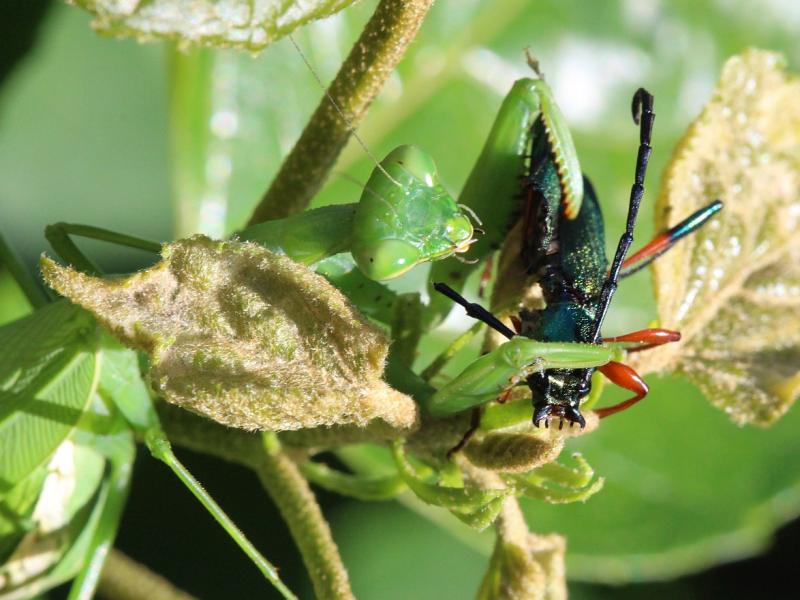
This photo illustrates a camouflaged mantis, purposefully hiding under a leaf, in the act of eating a beautiful longhorn beetle whole. It is hard not to anthropomorphize. That pitiful beetle does look like it’s crying out in terror and pain, while the mantis appears totally unconcerned: “I’m eating. Come back later.”
After sharing on this topic at Hillcrest Camera Club in June, I thought it might be nice to publish something here – in a few installments. It’s a big topic. I’ll start with what I would call ‘philosophy’, then follow it up with technical considerations and general tips and tricks.
Arguably the most important consideration in any form of photography is the content. If the photo ‘tells a story’, all other photographic ‘laws’ and ‘guidelines’ may be relaxed. In extreme cases a photo may even break the number one cardinal rule – “subject must be in focus” – (many would disagree, and I admit I’m a bit squeamish about this one). As long as it is worth looking at. And that happens when the photo has something worthwhile to say.
In insect photography, I would say ‘telling a story’ means showing exactly what insect look like (detail/structure), where and how they live (context) and the amazing things they do (action). If the photo can replace or illustrate a paragraph of words, it tells a story.
If an insect has unique mouth parts, or specially adapted abdominal gadgets, that have a special purpose, then a photo showing these clearly, tells a story. If the insect does something special, then a photo showing it, tells a story. If they live in a particular place, or survive in a particular way, then … you get the idea. For me insect photography is about illustrating the fascinating things I have discovered about insects.
Not all my photos (by far!) manage to tell a story. Many are just ‘records’ of insects I saw. ‘Story photos’ can take time, planning, fore-thought, and of course luck. ‘Recording photos’ can become ‘story photos’ if you know what an insect’s distinguishing characteristics are, where they are supposed to live, what they supposed to be doing, and making sure you capture these in the photo.
The cover photo on my book is a good example of good context, action, even better interaction between species, details of anatomy, even drama:
An assassin bug (a predator) devouring a honey bee, which has come to feed on the flower (location location location!). The ant is an aggressive opportunist. The sucking mouth parts of the bug and the biting mandibles of the ant (bared aggressively) are clearly visible. The bug, an ambush hunter, and the dead bee, are in perfect frozen focus, while the busy ant (an active hunter that also snacks on nectar) is slightly motion-blurred.
Action: a mud dauber wasp is bringing a blob of fresh mud in its mouth. The progress of the construction can be seen in the growth rings on the mud vessel, the last addition still shiny and wet. Something like this cannot be planned. This wasp happened to choose a spot of wall just above a sideboard in our dining room, where I was able to set up my camera while the wasp was away. Normally they build their nests high up under the ceiling. Construction took about three hours. On the one hand I could have missed the whole thing easily. On the other I couldn’t have stood on the top rung of a ladder for that long. I was just lucky. See full blog on this event.
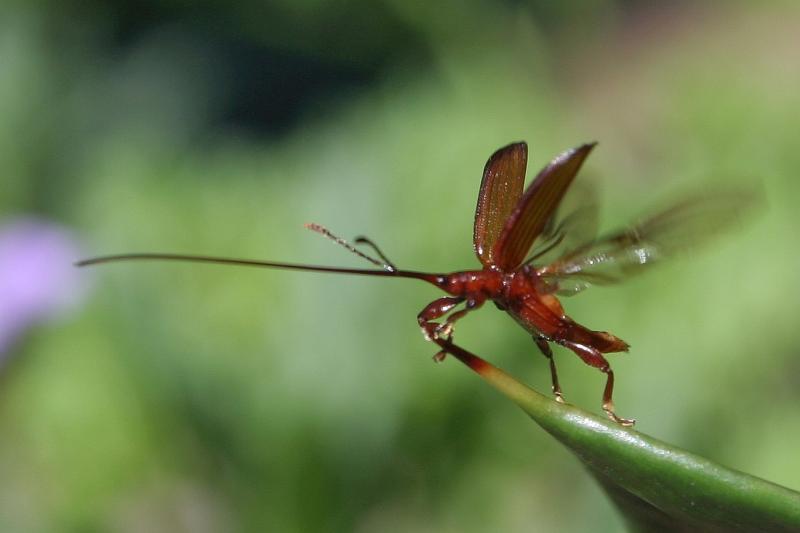
A hosenose cycad weevil, vibrating visibly with the beating of the wings (action), is launching off the tip of a cycad leaf (correct context).
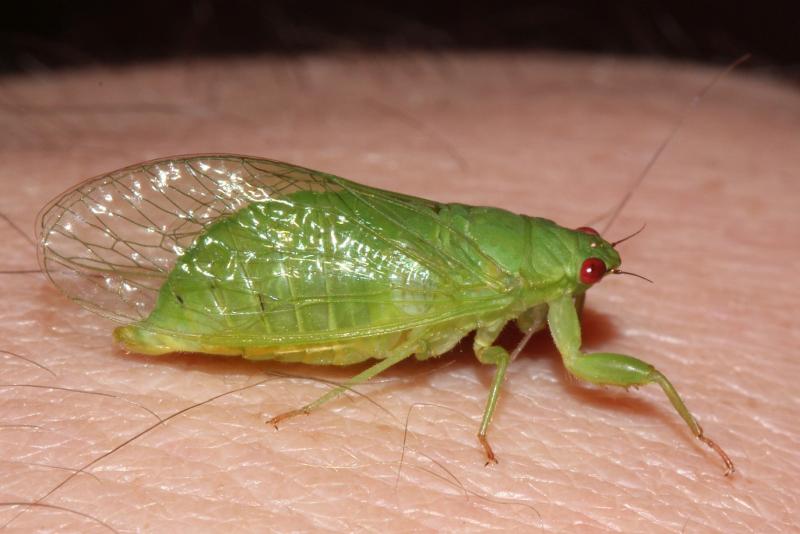
Incorrect context: a plant-sucking ‘green-wing’ cicada on human skin.
Correct context: a dung beetle in dung (as opposed to anywhere else).
Context: bad (on tiles) – better (on a leaf) – best (on the pealing bark of a tree), which illustrates what those strange brown-and-green markings on this moth’s wings are there for: camouflage.
Sometimes it is necessary to do a proper ‘studio session’ with an insect. Some actions or contexts are not possible to capture in the natural (if you are not a BBC photographer with fantastic equipment, working on some documentary). These sessions, like all studio work, are carefully planned, set up and take a while.
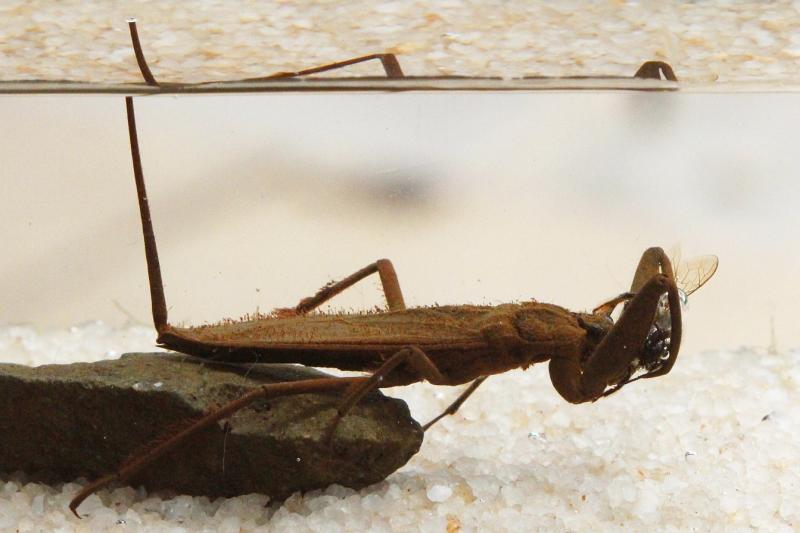
Studio session 1: I needed a nice photo of a caterpillar spinning a cocoon. I had to catch one, feed it until it was ready to pupate, transfer it to a glass jar, then take many photos until I got one that showed the whole thing nicely, without the light reflecting in the glass.Studio session 2: to get this photo of a water scorpion I set up a tank with white gravel and a stone, and clean water to just the right depth. I moved it around a bit until I got the perfect muted daylight conditions I was looking for, and set up the camera. Then I had to catch a bee, move the bug into the correct position, introduce the (live) bee and wait for the bug to pounce. Notice that the refraction on the water surface allowed me to capture not only the underwater bug, but also the tip of its snorkel sucking in air, and showing how it breathes.Studio session 3: Ground hoppers have the crazy habit of diving into water to escape danger. They swim with powerful kicks and hold onto submerged vegetation until the coast is clear. This I wanted to show in a photo. I set up a tank with some water weeds, went into the garden, caught a ground hopper (which are quite common), and threw it in. I took many shots – from above, from below, in sun, in shade, trying to show exactly where it is and what it’s doing. The final (perfect) shot is actually an overlay of two photos: the submerged bits were in perfect focus in one photo, the bits sticking out above the water in the other.
This weekend I participated in the Illovo Wagtail Conservation Festival. A local community concerned for their local environment, are trying to conserve the tiny little bit of it that is left.
Here in Durban we are privileged to live in the middle of one of 34 global biodiversity hotspots: the Maputaland-Pondoland-Albany ecosystem.










 EASTERaction