Climate change in Africa

This is just a quick post to publish various links to useful resources on climate change in Africa, to make them easy to refer to in upcoming events and activities.

The information is based on the work of the Intergovernmental Panel on Climate Change (IPCC), which is the United Nations organization that assesses and reports on the up-to-date scientific knowledge on climate change. In my post from World Environment Day 2022 you will find links to some really beautiful videos on the 6th global Assessment Reports.

What do the IPCC reports say about Africa?

The IPCC reports are frankly humungous! They are almost impossible to read, even for scientists who work in the field. Each report has a Summary for Policymakers to help governments make informed decisions. But otherwise information remains deeply buried within many thousands of pages, unless someone digs it out, and interprets it into ‘normal’ English. I smile as I write this, and so will anyone who ever read or wrote an IPCC report.

While working for the IPCC, I and my colleagues (Drs Andrew Okem, Nina Hunter, Michelle North under leadership of Prof Debra Roberts) made an effort to distill key messages for Africa, producing two booklets.

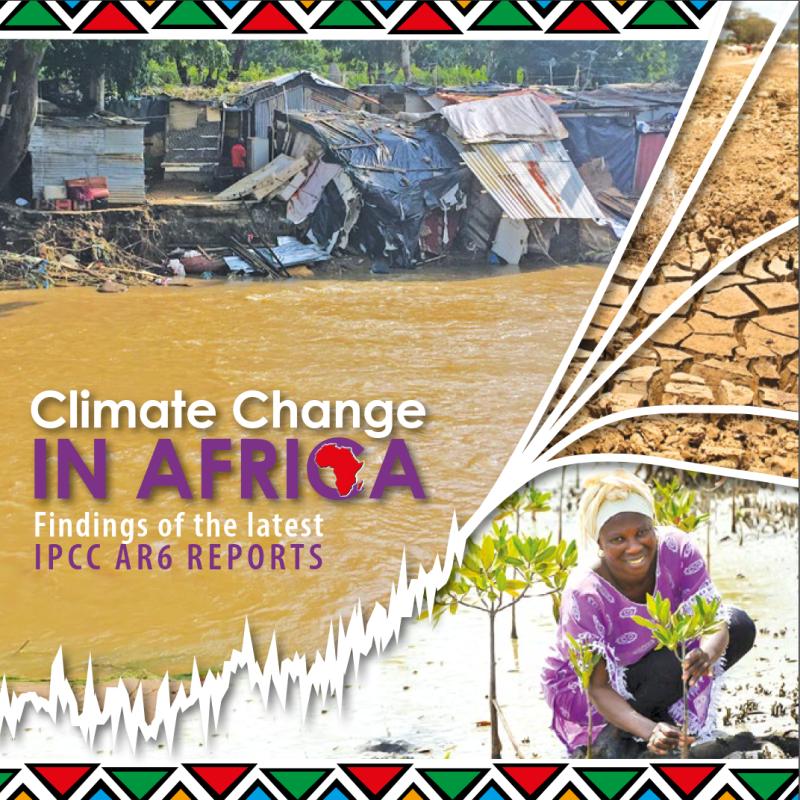
Key messages for Africa in the three Special Reports of the 6th IPCC Assessment Cycle (on 1.5°C Warming; Oceans and Cryosphere; Land)
Key messages for Africa in the Main Assessment Reports of the 6th IPCC Assessment Cycle (from Working Groups I, II and III)

We also produced three short videos on key climate change messages for Africa:

What does science say about climate change in Africa?
Climate change in African cities and settlements
Climate change and Africa’s ecosystems

We then produced a booklet on personal climate mitigation in a local, South African context, along with a checklist. This became the foundation for the edu-action programme I’ve been working on since then, under the umbrella of EASTER Action.

These booklets and videos are products of the Durban Office of the Working Group II Technical Support Unit, and not official products of the IPCC. They are not reviewed or endorsed by the IPCC.

The full IPCC Working Group II Africa chapter is of course a brilliant source of scientific evidence on climate change in Africa. The Figures (39 of them) and the Frequently Asked Questions at the end of the chapter are definitely worth looking at. The IPCC released some official derivative products – extracts from the original reports – including regional fact sheets on Africa, by Working Group I (basic science) and Working Group II (Impacts, Adaptation and Vulnerability).

The Climate and Development Knowledge Network has also published an outstanding series of fact sheets on Africa, plus many other super-useful resources, including a number of interesting videos, see https://cdkn.org/resources.
Climate Action Programme

On Youth Day (24 June 2022) the South African Youth Climate Change Coalition (SAYCCC) ran a workshop in Durban to strategize how to ramp up climate change action and activism, now that Covid-19 restrictions have been relaxed.

It was a timely opportunity for EASTERaction to hand out copies of What I Can Do About Climate Change booklet, and to present our plans for a brand new Action Programme to go with it, which we hope to roll out over the next year.

Participants included representatives from SAYCCC-affiliated climate action groups such as Durban South Peacebuilders, Durban Youth Climate Council, eThekwini municipality, Green Anglicans, Ray Nkonyeni Municipality, uShaka Marine World Education, Vascowiz, and our lovely local beauty pageant, Miss Petite Globe SA, Zoe Nyandeni, who wants to help spread the word on climate change and sustainable living. Go Zoe!!

The booklet was originally written to inform eThekwini municipal councilors about personal climate action. One day before our workshop, the booklet was distributed at a climate induction workshop run by the Environmental Planning and Climate Protection Department.

Thank you SAYCCC for this opportunity and for your enthusiasm! We very much look forward collaborating on ‘the biggest challenge facing humankind ever’.

World Environment Day 2022

The theme of this year’s World Environment Day is “Only One Earth“. Over the past year the Intergovernmental Panel on Climate Change (IPCC, a United Nations organization) has released three key climate reports, that have one single, resounding message: We are in crisis. Or in the words of the UN Secretary General: this is “Code Red for humanity”.

As one of the IPCC support staff, I have read and re-read several drafts of these reports, as well as the Special Reports released in 2018 and 2019. “Every year matters!” the first one said. But a year ticked by. And another. And another. And another. The crisis is upon us, and still we are dilly dallying, carrying on as before. It scares me how much is known, and how little is being done. It is surreal.

This year Durban got flooded – one of the worst floods on record. But… we mopped up the mess, made (or started to make) repairs, and carried on. Six weeks later it happened again! Disasters like this will keep getting worse and happen more often.

Today, on World Environment Day, EASTER Action would like to thank and congratulate the hundreds of scientists who contributed towards the IPCC reports, who spent so much of their time and energy, often under extremely difficult situations, to bring together, assess and summarize the latest, up-to-date information on climate change, and to map out the options. Thank you, thank you, all you dear people! And well done! Thanks to you we know what to do next.

May the world listen to your warning, and do what needs to be done, to save this one and only earth, our home, and all its children.

We highly recommend these brief 2-3min trailers. They are beautifully made and give a fantastic overview of the current state of climate science.

The latest reports (2021/2022):
The Physical Science Basis
Impacts, Adaptation and Vulnerability
Mitigation of Climate Change
The Special Reports (2018/2019):
Special Report on Global Warming of 1.5°C
Special Report on the Oceans and Cryosphere
Special Report on Land
About the IPCC and the current assessment cycle.

See the IPCC channel for more videos on the various press conferences etc.

Also see the channels of other related UN organizations: UNEP, UNFCCC and WMO.

World Environment Day 2020

The theme for this year’s World Environment Day is: It is the Time for Nature. This coronavirus pandemic is in many ways a result of humanity’s unsustainable relationship with nature. But it is also an opportunity to think carefully about where we are going.

On this day we would have loved to invite folks to a live event at one of our beautiful nature reserves, but here we all are, in lock-down! Instead we decided to release a 40 min video on “how all living things on Earth are connected in the web of life“, by looking more closely at the biggest cog in this complex clockwork: insects.

After a brief introduction on species population trends, biodiversity and biomass, the presentation goes through some of the major roles that insects play in the food web and in nature generally, which then clearly points to what we can do to help and “how we can act for nature“.

We would value your feedback. Please fill in the survey.

The insect book is done!

After eight years, big dreams, hundreds of photo moments and many drafts, the book is finally finished and published!!!

book-front

More information on the Book page. 

This book is the product of my various passions: insects, nature, photography, writing, teaching/training and people, especially children (not necessarily in that order).

This book has been a hobby project. I wrote it to bring joy to me and hopefully to others. It has been a labour of love as well as an act of worship. I love everything that ‘lives and moves and has its being’, and I adore the creator of it all. With this book I want to share that passion.

The book saw its first light of day in public when I presented it at our municipal eThekwini Biodiversity Forum. It got a warm reception and the first ten local copies were sold. An endorsement from the Senior Environmental Technician can be found here.

bioforum-talk