Insect photography 3 – Macro experiments

Or ‘The poor woman’s guide to higher magnification’

macro spider.jpg

One day I saw this crab spider on a flower. Then I saw my grandfather’s old magnifying glass lying there, looking at me. “Hmm… I wonder…”

I got my camera, held the magnifying glass in front of the lens and took a picture. The one you see above. Thus began my love for macro photography.

Around that time I also got serious about my insect book. But living on one salary, with three kids, this stay-at-home mom could not afford to invest in expensive camera equipment. So I had to make do with my standard 18-55mm kit lens and… several hacks.

Macro 1b Marmite lid

To ensure the magnifying glass sat dead straight over the lens, I mounted it in a Marmite lid (with the centre cut out). Usually I simply held it by hand, like so. When I needed my left hand for something else, I attached it to the kit lens with a wide elastic band. The auto-focus works just fine through this extra monocle.

macro caterpillar
Many photos in the book were taken with my ‘Marmite lid lens’, like this one. This cost me much good-natured teasing at my local camera club.
Macro 2b Canon innards

At some point I ‘upgraded’ my equipment. An old Canon tele-lens, which I had bought secondhand in Singapore ten years before, had turned irreparably moldy. I took it apart brutally, extracted the thick double-lens from its belly, and washed off the offending fungus. This felt more legitimate: at least I was now using bits of photographic equipment!

Eventually I found (for ZAR100 at an SPCA shop!) a working Canon 100mm macro lens. I felt very grown-up now, like a serious photographer… but was it worth the expense? Judge for yourselves.

macro lenses

The equipment: (left) magnifying glass set in Marmite lid; (middle) the innards of a Canon tele-zoom lens; (right) a Canon 100mm macro lens.

Macro 6a detail
The results… can you tell which ‘lens’ took which photo? (And no, they are not in the same order.) Well, can you?

The exciting thing was, now I could get even higher magnification by holding one ‘hand-held’ lens in front of the macro lens – or even both together!

Macro eggs
Caterpillar eggs taken (a) with the 100mm macro lens only, (b) plus the ‘canon innards’, (c) plus the ‘Marmite lid lens’ on top of that!
macro inverter ring

I also tried the reverse lens method, another cheap route to macro photography. You can buy a reversing ring, but there are DIY websites that show you how to hack one. I happened to have a spare lens foot (from the butchered tele-lens) and I had an old screw-on UV filter. Epoxy them together, and there you have it.

macro reverse lens

Now the kit lens can be mounted onto the camera backward, giving it extreme magnifying powers, but also extremely low depth of field. It kind of works, but you can see that even these thrips nymphs below – minute as they are – are only partially in focus.

Macro thrips
Thrips are tiny insects that suck plant juice. These are thrip babies! They leave behind black spots (their excreta seen here as brown droplets) and they cause a ‘silvering’ on leaves, where the waxy cuticle has separated from the green epidermis. They can also spread plant diseases.

Insect macro photography (especially of active creatures in shady locations) usually requires a flash. The on-board flash usually works fine. But sometimes, when you get really close to the subject, the rim of the lens gets in the way and casts a shadow. An external flash however overshoots the subject, since you cannot point it down.

macro flash

Solution: a DIY reflector. Take external flash and find a box-like object that fits snugly over it (I cut up a kids’ juice bottle). Cut a slot into the box at an angle and a hole for the light to shine through, then slide a pocket mirror into the slot and secure it somehow (I used cable ties).

The mirror reflects the beam of light down onto the subject which can be extremely close to the lens.

macro flash beam

That’s it for today, folks! Happy shooting!
Insect Photography 1 – Story-telling

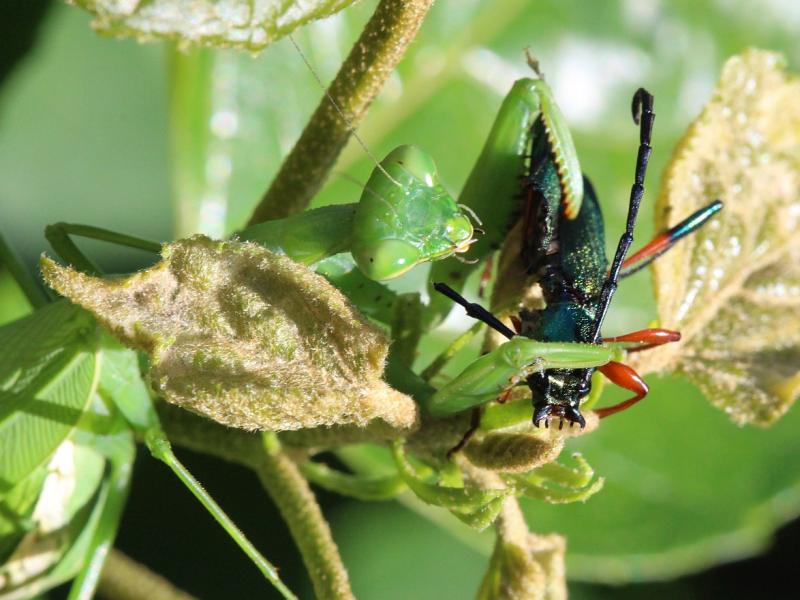
This photo illustrates a camouflaged mantis, purposefully hiding under a leaf, in the act of eating a beautiful longhorn beetle whole. It is hard not to anthropomorphize. That pitiful beetle does look like it’s crying out in terror and pain, while the mantis appears totally unconcerned: “I’m eating. Come back later.”

After sharing on this topic at Hillcrest Camera Club in June, I thought it might be nice to publish something here – in a few installments. It’s a big topic. I’ll start with what I would call ‘philosophy’, then follow it up with technical considerations and general tips and tricks.

Arguably the most important consideration in any form of photography is the content. If the photo ‘tells a story’, all other photographic ‘laws’ and ‘guidelines’ may be relaxed. In extreme cases a photo may even break the number one cardinal rule – “subject must be in focus” – (many would disagree, and I admit I’m a bit squeamish about this one). As long as it is worth looking at. And that happens when the photo has something worthwhile to say.

In insect photography, I would say ‘telling a story’ means showing exactly what insect look like (detail/structure), where and how they live (context) and the amazing things they do (action). If the photo can replace or illustrate a paragraph of words, it tells a story.

If an insect has unique mouth parts, or specially adapted abdominal gadgets, that have a special purpose, then a photo showing these clearly, tells a story. If the insect does something special, then a photo showing it, tells a story. If they live in a particular place, or survive in a particular way, then … you get the idea. For me insect photography is about illustrating the fascinating things I have discovered about insects.

Not all my photos (by far!) manage to tell a story. Many are just ‘records’ of insects I saw. ‘Story photos’ can take time, planning, fore-thought, and of course luck. ‘Recording photos’ can become ‘story photos’ if you know what an insect’s distinguishing characteristics are, where they are supposed to live, what they supposed to be doing, and making sure you capture these in the photo.

The cover photo on my book is a good example of good context, action, even better interaction between species, details of anatomy, even drama:

An assassin bug (a predator) devouring a honey bee, which has come to feed on the flower (location location location!). The ant is an aggressive opportunist. The sucking mouth parts of the bug and the biting mandibles of the ant (bared aggressively) are clearly visible. The bug, an ambush hunter, and the dead bee, are in perfect frozen focus, while the busy ant (an active hunter that also snacks on nectar) is slightly motion-blurred.

Action: a mud dauber wasp is bringing a blob of fresh mud in its mouth. The progress of the construction can be seen in the growth rings on the mud vessel, the last addition still shiny and wet.  Something like this cannot be planned. This wasp happened to choose a spot of wall just above a sideboard in our dining room, where I was able to set up my camera while the wasp was away. Normally they build their nests high up under the ceiling. Construction took about three hours. On the one hand I could have missed the whole thing easily. On the other I couldn’t have stood on the top rung of a ladder for that long. I was just lucky. See full blog on this event.

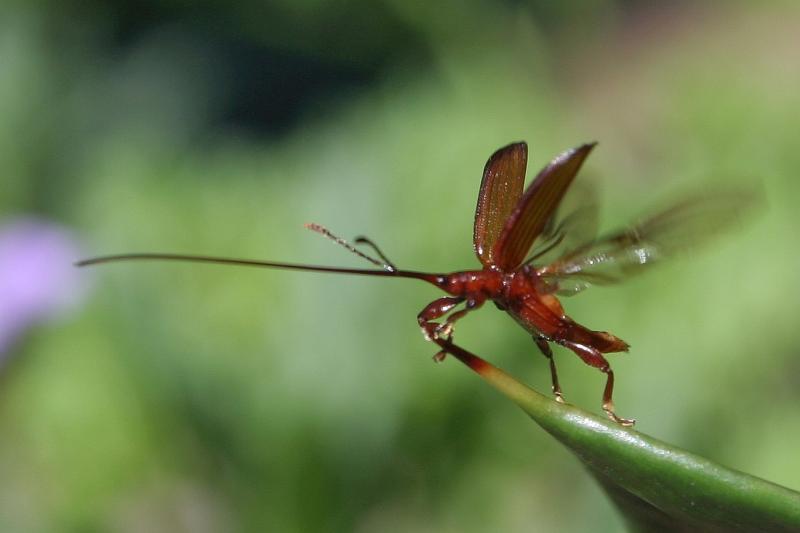
A hosenose cycad weevil, vibrating visibly with the beating of the wings (action), is launching off the tip of a cycad leaf (correct context).
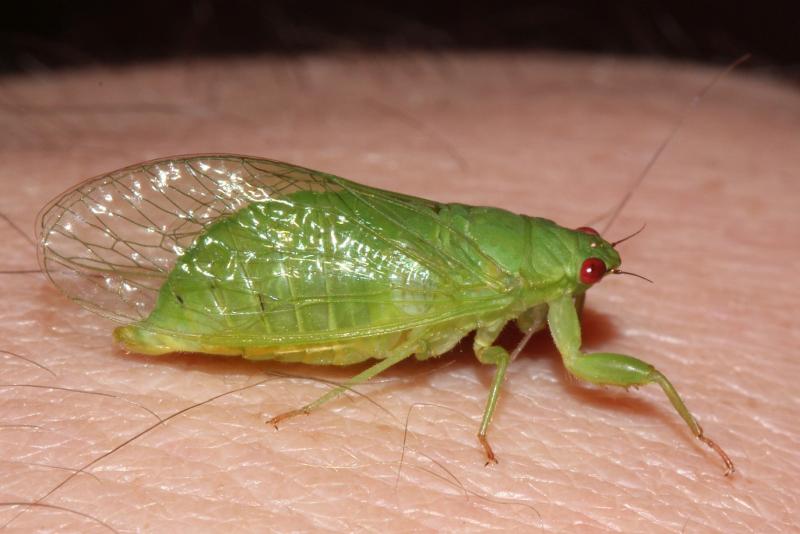
Incorrect context: a plant-sucking ‘green-wing’ cicada on human skin.
Correct context: a dung beetle in dung (as opposed to anywhere else).
Context: bad (on tiles) – better (on a leaf) – best (on the pealing bark of a tree), which illustrates what those strange brown-and-green markings on this moth’s wings are there for: camouflage.

Sometimes it is necessary to do a proper ‘studio session’ with an insect. Some actions or contexts are not possible to capture in the natural (if you are not a BBC photographer with fantastic equipment, working on some documentary). These sessions, like all studio work, are carefully planned, set up and take a while.

Studio session 1: I needed a nice photo of a caterpillar spinning a cocoon. I had to catch one, feed it until it was ready to pupate, transfer it to a glass jar, then take many photos until I got one that showed the whole thing nicely, without the light reflecting in the glass.
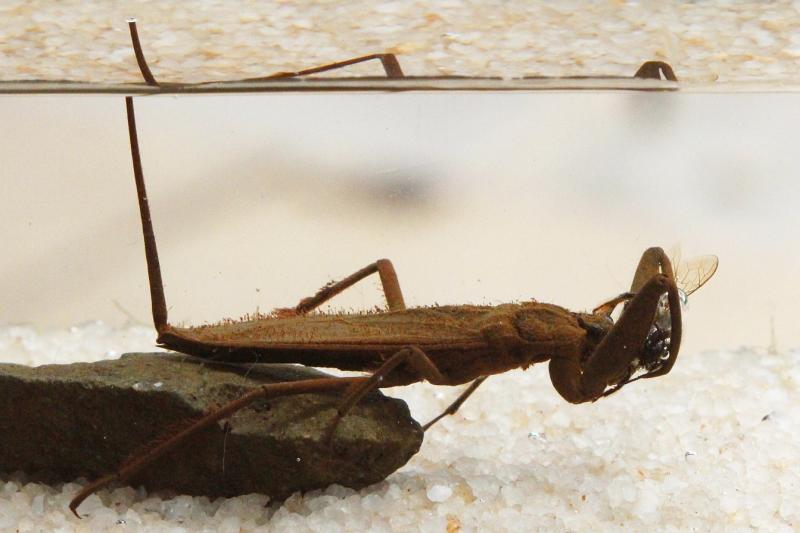
Studio session 2: to get this photo of a water scorpion I set up a tank with white gravel and a stone, and clean water to just the right depth. I moved it around a bit until I got the perfect muted daylight conditions I was looking for, and set up the camera. Then I had to catch a bee, move the bug into the correct position, introduce the (live) bee and wait for the bug to pounce. Notice that the refraction on the water surface allowed me to capture not only the underwater bug, but also the tip of its snorkel sucking in air, and showing how it breathes.
Studio session 3: Ground hoppers have the crazy habit of diving into water to escape danger.  They swim with powerful kicks and hold onto submerged vegetation until the coast is clear. This I wanted to show in a photo. I set up a tank with some water weeds, went into the garden, caught a ground hopper (which are quite common), and threw it in. I took many shots – from above, from below, in sun, in shade, trying to show exactly where it is and what it’s doing. The final (perfect) shot is actually an overlay of two photos: the submerged bits were in perfect focus in one photo, the bits sticking out above the water in the other.