
With this blog I’m happy to share the experience from the first three sessions in a series of climate change workshops with Grade 10 learners, in partnership with Umkhumbane Schools Project in Cato Manor, Durban.

The plan is to work all the way through the What I Can Do About Climate Change edu-action programme, with the same group of learners, firming up the contents, seeing how it is received, and refining the program so it can be implemented by other facilitators in the future, making it more accessible and impactful.
Over three days in March 2025, we completed six units with the same group of students, allowing us to gauge their feedback and see how the material was received. We ran three 2-3 hour sessions over consecutive days, with a mix of short video presentations and interactive, hands-on activities. We covered 6 units, and plan to carry on later in the year.
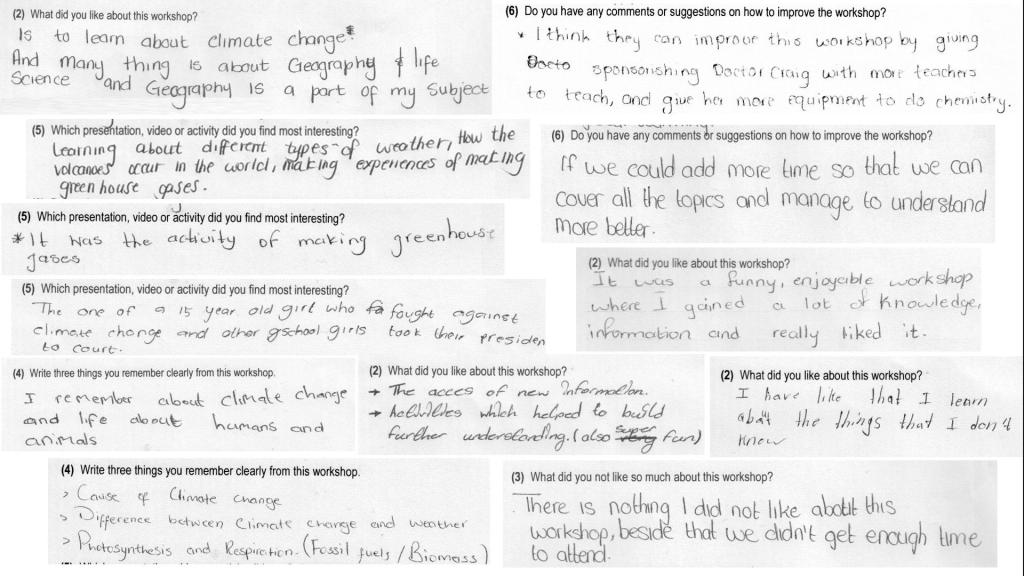
Based on the heart-warming and enthusiastic feedback from the learners, it is clear they found the sessions enjoyable and valuable. As the facilitator, I also had much fun, and learned things that will help me update the activities, and add some more teaching material.
Keep on reading for a more detailed account.
Unit 1 “What on earth is going on?” – about youth activism
The programme kicks off by empowering learners, showing them that before we are individuals, we are citizens of the world. Before even mentioning climate change, this introductory session places the youth at the forefront and shows the role they play in world affairs. It encourages young people to think at the global scale, rather than taking the small-scale view of ‘me, here, now’. Hopefully this arouses an inner sense of importance, relevance, empowerment and capacity.
The interactive video followed by two activities always work well. I have done this many times so there were no surprises. The fun quiz, using Plickers, is always a favourite.
Unit 2 “What is climate change?” – a brief overview
The video gives a very brief overview of climate change. It explains how the world is getting warmer, how this is causing record-breaking global warming and devastating world-wide impacts. Climate change is caused by a sudden recent rise in greenhouse gases to levels which humanity has not seen before. It is a human-made crisis, and it will get a lot worse unless we urgently do something about it.
The activity involves a community survey. The survey is not about gathering information or finding out what people know, its purpose is to give learners a way to ‘interview’ friends or family and so introduce the topic of climate change respectfully and in a neutral and engaging way. At the workshop, learners filled in the survey themselves. They said it was ‘easy’ and were confident and keen to take a second form home.
Two days later, their feedback was very positive. They enjoyed doing it. Some learners had interviewed school mates, or the whole family, or a brother. One learner who had interviewed a cousin at university, felt pleased that she knew more about the subject than the university student.
The feedback they got in turn, was also encouraging: they encountered positive interest rather than any negative responses, and it helped them to talk about the information that they had learned in the workshop.
Unit 3 “Weather or climate?” – the water cycle
The video explains the difference between weather, climate and paleoclimate, and the science of the water cycle. While we couldn’t get the students’ tablets online, we managed to do a live demonstration using Windy.com to show real-time global weather patterns. The learners were fascinated, especially when we located a cyclone over the Indian Ocean.
Unit 4 “Why is the world getting warmer?” – the greenhouse effect
The video starts relatively simple, but then gets increasingly technical. The learners were surprisingly interested in the science. I had planning to stop the video before it got to some really advanced topics (such as the radiation absorption patterns of different atmospheric gases), but they were all keen to carry on.
The learners all take science as a subject, so they had a reference point, and this lesson must have connected with things they already knew, they were just hungry for more! It was delightful seeing in them this appetite for scientific knowledge that also drives me to dig deeper into a topic until I am satisfied and my questions have been answered.
One activity explains global warming in terms of body temperature, to illustrate the importance of one degree of warming. Except for two willing volunteers, most felt too old for the ‘running around’ part, but they were deeply interested in all the information about ambient and body temperature.
It was really sweet: when I gave some learners a lift back to their school at the end of the workshop, they started rehearsing in the car the different temperatures: healthy body temperature, what is a fever, when you should go to hospital, what temperature is deadly. They found it fascinating that feeling hot is not the same as being sick. Well, it IS fascinating, isn’t it?
I had also pointed out how important this knowledge is for when they are adults and have their own children. It had little to do with climate change, but I love bringing real-life knowledge into these lessons, to show how science is not just something you learn at school, but something that is important in life – quite literally!
Unit 5 “Where do greenhouse gases come from?” – the carbon cycle
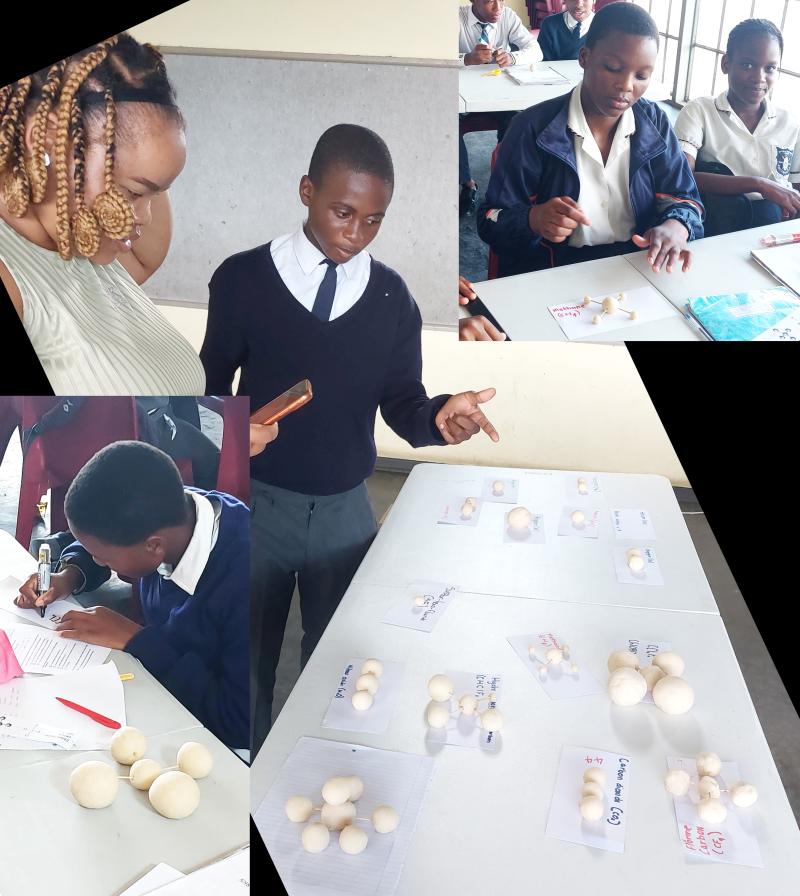
The next video shows how the main three greenhouse gases are deeply connected with life and living things. It turned into an impromptu science lesson, as I realized that some of the information in the video assumed prior knowledge they did not have.
We burned biomass (a dry twig) and watched the wood turn to black coal, we demonstrated how white wax and clear paraffin are indeed carbon-based fuels (by catching soot from the flame on a white saucer), and how burning a candle under a jar does indeed use up the oxygen in the air (the flame dies), producing energy (the flame) and water (steamed-up jar) – we could have tested for CO2.
The biggest thrill was a methane experiment. I had brought a bottle of gas, and showed them pictures of how I had produced this from kitchen waste and pond water. (Ideally they should do the experiment themselves.) We bubbled the gas through soapy water and ignited the foam, creating a little fireball. We all got terribly excited! What a memorable moment!
Unit 6 “Why are greenhouse gases increasing?” – the root causes of climate change
This unit explored the root causes of climate change, specifically fossil fuels. This led to an important side lesson, and I realized we need another video on what fossil fuels are and how they are formed.
The session wrapped up with a highly interactive game, ‘Fossil Fuel Bingo,’ about which everyday fuels are fossil fuels and which are biomass fuels. It was so much fun they asked to play it a second time.
This workshop was a powerful reminder of how eager young people are to learn and get involved. We’re looking forward to continuing our journey with them later this year. Stay tuned for our next workshop as we continue to build a generation of climate-doers.


 EASTERaction